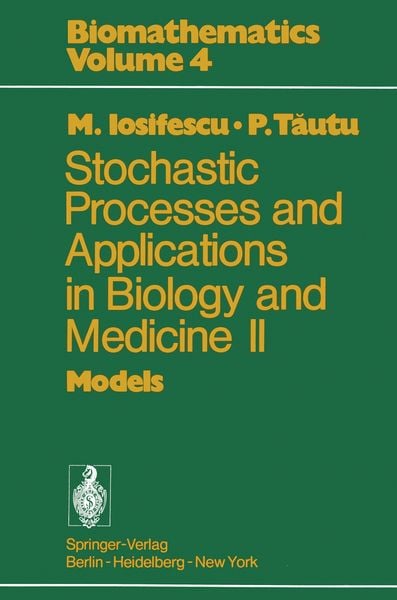
Produktbild: Stochastic processes and applications in biology and medicine II
Band 4

Stochastic processes and applications in biology and medicine II Models

Aus der Reihe Biomathematics

Fr. 72.90

inkl. gesetzl. MwSt., Versandkostenfrei


Beschreibung

Produktdetails

Einband

Taschenbuch

Erscheinungsdatum

15.12.2011

Verlag

Springer Berlin

Seitenzahl

338

Maße (L/B/H)

23.5/15.5/1.9 cm

Gewicht

517 g

Auflage

Softcover reprint of the original 1st ed. 1973

Sprache

Englisch

ISBN

978-3-642-80755-8

Beschreibung

Produktdetails

Einband

Taschenbuch

Erscheinungsdatum

15.12.2011

Verlag

Springer Berlin

Seitenzahl

338

Maße (L/B/H)

23.5/15.5/1.9 cm

Gewicht

517 g

Auflage

Softcover reprint of the original 1st ed. 1973

Sprache

Englisch

ISBN

978-3-642-80755-8

Herstelleradresse

Springer-Verlag KG
Sachsenplatz 4-6
1201 Wien
AT

Email: GPSR Kontakt

Noch keine Bewertungen vorhanden

Verfassen Sie die erste Bewertung zu diesem Artikel

Helfen Sie anderen Kundinnen und Kunden durch Ihre Meinung.

Kundinnen und Kunden meinen

Bewertungen (0)

  • Produktbild: Stochastic processes and applications in biology and medicine II
  • 0. Prolegomenon.- 1. Preliminary considerations.- 1.1. Stochastic and deterministic models in biology.- 1.1.1. Comparisons with deterministic models.- 1.1.2. Equipollent and conjunct models.- 1.2. The structure of biological populations.- 1.2.1. Elements of bio-logic.- 1.2.2. Distinguishability and indistinguishability.- 1.2.3. Equivalence relations and graphs.- 1.2.4. Descendants, generations and families.- 1.2.5. The temporal structure of populations and biological objects.- 1.2.6. Characteristic distributions for some biological populations.- 2. Population growth models.- 2.1. Stochastic population processes.- 2.1.1. Point processes as models of stochastic populations.- 2.1.2. Homogeneous birth-and-death processes.- 2.1.3. A random walk example.- 2.1.4. Birth, death and diffusion processes.- 2.2. Population processes in Euclidean space.- 2.2.1. Homogeneous spatial models.- 2.2.2. Birth, death and migration processes in R2 [and R3.- 2.3. Intrinsic processes.- 2.3.1. Multiple-phase processes.- 2.3.2. The life cycle process.- 2.3.3. The birth, death and marks transmission process.- 2.3.4. Interdependent (self)-replicating process.- 2.3.5. Point mutation processes.- 2.4. Stochastic demographic models.- 2.4.1. The discrete time model.- 2.4.2. A model related to human populations.- 2.4.3. Population growth of the sexes.- 2.4.4. The reproductive process.- 2.5. Other growth models and derived processes.- 2.5.1. The cumulative process.- 2.5.2. The Prendiville (logistic) process.- 2.5.3. Some problems of survival and extinction.- 3. Population dynamics processes.- 3.1. Some multi-dimensional Markov jump processes.- 3.1.1. Consael processes.- 3.1.2. A generalized w-dimensional (n ? 2) linear growth process.- 3.2. Immigration-emigration processes.- 3.2.1. The Kendall process.- 3.2.2. Immigration and emigration processes.- 3.2.3. Intermigration and colonization.- 3.2.4. Taxis and kinesis as dispersion processes.- 3.3. Competition processes.- 3.3.1. Some introductory remarks.- 3.3.2. Stochastic competition processes.- 3.3.3. Quasi-competition processes.- 3.3.4. Population excess and cannibalism.- 3.4. Poikilopoiesis models.- 3.4.1. A stochastic approach to embryogenesis.- 3.4.2. Hematopoiesis models.- 4. Evolutionary processes.- 4.1. Basic problems, models and methods.- 4.1.1. Paradigm for the stochastic evolutionary processes.- 4.1.2. Classical genetic stochastic models.- 4.1.3. Tendency to homozygosity.- 4.1.4. Diffusion approximations.- 4.1.5. Non-Mendelian situations.- 4.1.6. Direct product Galton-Watson chains.- 4.2. Random drift and systematic evolutionary processes.- 4.2.1. Random drift.- 4.2.2. Selection.- 4.2.3. Mutation.- 4.3. Problems of molecular genetics.- 4.3.1. Growing point of donor DNA attachment model.- 4.3.2. An example of a random system with complete connections.- 5. Models in physiology and pathology.- 5.1. Stochastic models in physiology.- 5.1.1. Models of the appearance and the transmission of the neural flux.- 5.1.2. Chemical mediation processes.- 5.1.3. Some problems of stochastic networks.- 5.1.4. A model of muscle contraction.- 5.1.5. Renewal processes in pharmacology.- 5.1.6. Multicompartment systems.- 5.2. Models in pathology.- 5.2.1. The process of infection.- 5.2.2. The clinical process.- 5.2.3. Stochastic models for tumour growth.- 5.2.4. Some stochastic aspects of chemotherapy.- 5.2.5. Competing risks of illness.- 5.2.6. Control of biological processes.- 5.3. Epidemic processes.- 5.3.1. The classical models.- 5.3.2. A general approach to epidemics.- 5.3.3. Epidemic Markov chains.- References.- Notation index.- Author index.