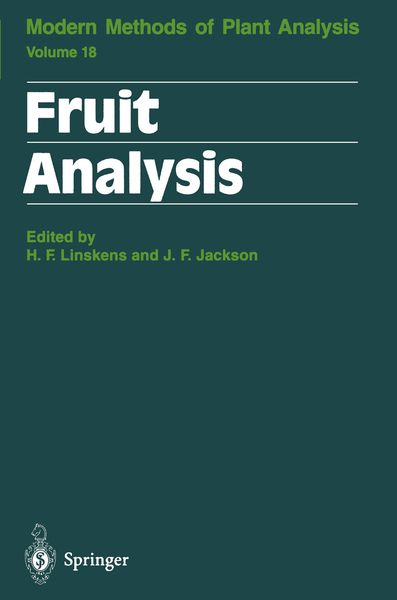
Produktbild: Fruit Analysis
Band 18

Fruit Analysis

Fr. 137.00

inkl. gesetzl. MwSt., Versandkostenfrei


Beschreibung

Produktdetails

Einband

Taschenbuch

Erscheinungsdatum

23.12.2011

Herausgeber

Hans F. Linskens + weitere

Verlag

Springer Berlin

Seitenzahl

160

Maße (L/B/H)

23.5/15.5/1.1 cm

Gewicht

283 g

Auflage

Softcover reprint of the original 1st ed. 1995

Sprache

Englisch

ISBN

978-3-642-79662-3

Beschreibung

Produktdetails

Einband

Taschenbuch

Erscheinungsdatum

23.12.2011

Herausgeber

Verlag

Springer Berlin

Seitenzahl

160

Maße (L/B/H)

23.5/15.5/1.1 cm

Gewicht

283 g

Auflage

Softcover reprint of the original 1st ed. 1995

Sprache

Englisch

ISBN

978-3-642-79662-3

Herstelleradresse

Springer-Verlag KG
Sachsenplatz 4-6
1201 Wien
AT

Email: GPSR Kontakt

Noch keine Bewertungen vorhanden

Verfassen Sie die erste Bewertung zu diesem Artikel

Helfen Sie anderen Kundinnen und Kunden durch Ihre Meinung.

Kundinnen und Kunden meinen

Bewertungen (0)

  • Produktbild: Fruit Analysis
  • Non-Intrusive Fruit and Plant Analysis by Laser Photothermal Measurements of Ethylene Emission.- 1 Introduction.- 2 The Photothermal Deflection Method.- 2.1 The Experimental Setup.- 2.2 Practical Considerations.- 2.3 Local and Fast Ethylene Detection.- 2.3.1 Ethylene Emission Pathways for Intact Cherry Tomatoes.- 2.3.2 Locally Wounded Tomato Tissue.- 3 Photoacoustics Using a CO2 Laser.- 3.1 The Experimental Setup.- 3.2 Practical Considerations.- 3.3 Ethylene Emission Rates for Various Species.- 3.3.1 Local Ethylene Emission by Bell Pepper.- 3.3.2 Periodic Anoxic and Aerobic Conditions for Cherry Tomatoes.- 3.3.3 Germinating Peas Periodically Fumigated with Ozone.- 3.3.4 Rumex palustris Exposed to Flooding Stress.- 4 Photoacoustics Using a CO Laser.- 4.1 The Experimental Setup.- 4.2 Practical Considerations.- 5 Résumé.- References.- Induction of Fruit Aroma and Quality by Post-Harvest Application of Natural Metabolites or Anaerobic Conditions.- 1 Biosynthesis and Degradation of Aroma Volatiles in Fruits During Post-Harvest Life.- 1.1 Ripening and Aroma Production in Fruits.- 1.2 Measurements of Sensory Quality.- 2 Induction of Aroma Volatile Production by Application of Aldehydes, Alcohols and Acids.- 2.1 Application of Acetaldehyde.- 2.2 Biosynthesis of Aroma Volatiles from Various Precursors.- 2.3 Flavour and Taste Enhancement.- 2.4 Effect of Acetaldehyde on Sugar and Acid Content.- 2.5 Volatile Formation in Vitro.- 2.6 Fungicidic Activity of Aldehydes.- 2.7 Disadvantages of Exogenous Application of Metabolites.- 3 Induction of Aroma Volatile Production by Pre-Storage Under Anaerobic Conditions.- 3.1 Application of Anaerobiosis.- 3.2 Induction of Volatile Formation.- 3.3 Removal of Astringency.- 3.4 Changes in Sugar and Acidity.- 3.5 Injury and Off-Flavour Production.- 4 Conclusion.- References.- The Analysis of Flavouring Compounds in Grapes.- 1 Introduction.- 2 Methoxypyrazines.- 2.1 Isolation and Characterization.- 2.2 Quantitative Analysis.- 2.2.1 Principles of Trace Organic Analysis.- 2.2.2 Quantitative Methoxypyrazine Analysis.- 2.3 Methods.- 2.3.1 Methoxypyrazine Standards.- 2.3.2 Instrument Calibration.- 2.3.3 Isolation of Methoxypyrazine Components.- 2.3.4 Determination of Standard Response.- 2.3.5 Mass Spectrometry of Methoxypyrazine Isolates.- 2.4 Sensory Characteristics.- 2.5 Viticultural Influences.- 2.6 Varietal Differences.- 3 Glycosidically Bound Flavour Compounds of Grapes.- 3.1 Isolation of Glycosidic Precursors.- 3.2 Analysis of Intact Glycosides.- 3.2.1 Gas Chromatography.- 3.2.2 High Performance Liquid Chromatography (HPLC) and Other Liquid-Solid Chromatographic Methods.- 3.2.3 Countercurrent Chromatographic Methods.- 3.2.4 Mass Spectrometry.- 3.3 Analysis After Hydrolysis of Glycosides.- 3.3.1 Enzyme Hydrolysis.- 3.3.2 Compositional Analysis of Volatile Aglycones.- 3.3.3 Sensory Analysis of Aglycones.- 3.4 Application of Flavour Precursor and Aglycone Compositional Analysis Data to Grape and Wine Characterization.- 3.5 Effects on Wine Aroma Resulting from Precursor Hydrolysis.- 4 Conclusion.- References.- Analysis of Bitter Principles in Citrus.- 1 Introduction.- 2 Limonoid Bitterness.- 2.1 Limonoid Aglycone Analysis.- 2.1.1 Sample Preparation.- 2.1.2 Thin-Layer Chromatography.- 2.1.3 High-Performance Liquid Chromatography.- 2.1.4 Radioimmunoassay (RIA).- 2.1.5 Enzyme-Linked Immunoassay (EIA).- 2.2 Sources of Limonoid Standards.- 3 Flavonoid Bitterness.- 3.1 Analysis of Flavonoid Bitter Principles.- 3.1.1 Sample Preparation.- 3.1.2 Colorimetric and Spectrophotometric Methods.- 3.1.3 Thin-Layer Chromatography.- 3.1.4 High-Performance Liquid Chromatography.- 3.1.5 Radioimmunoassay (RIA) and Enzyme-Linked Immunoassay (ELISA or EIA).- 3.1.6 Capillary Electrophoresis.- 3.1.7 Gas Chromatography-Mass Spectroscopy.- 3.2 Sources of Flavonoid Standards.- References.- Phenolic Content and l-Phenylalanine Ammonia-Lyase Activity In Peach Fruit.- 1 Introduction.- 2 Phenolic Content and Phenolic Composition of Peach Fruit.- 2.1 Analysis of Phenolic Compounds.- 2.1.1 Total and High-Molecular-Weight Phenolics.- 2.1.2 Condensed Tannins.- 2.1.3 Phenolic Composition.- 2.2 Relationship Between Degree of Astringency Based on Organoleptic Tests and Phenolic Content.- 3 PAL Activity in Peach Fruit.- 3.1 General Phenylpropanoid Metabolism.- 3.2 PAL Extraction and Assay.- 3.2.1 Extraction and Purification.- 3.2.2 Spectrophotometric Assay.- 3.2.3 Radiochemical Assay with [14C] Phenylalanine.- 3.3 Relationships Between Phenolic Content, PAL Activity, and l-Phenylalanine Content.- 4 Factors Affecting Phenolic Content and PAL Activity in Peach Fruit.- 4.1 Inherent Factors.- 4.2 Environmental Factors.- 4.3 Other Factors.- 5 Concluding Remarks.- References.- Astringency in Persimmon.- 1 Introduction.- 2 Persimmon Tannin.- 2.1 Chemical Structure.- 2.2 Differences Among Fruit Types.- 3 Analytical Methods.- 3.1 Tannin Print Method.- 3.2 Folin-Denis Method.- 3.3 Analysis of Total Tannins.- 4 Quantitative Changes in Tannins.- 4.1 Fruit Development.- 4.2 Removal of Astringency.- 5 Notes on Analytical Methods.- References.- Analysis of Fresh and Dried Apricot.- 1 Introduction.- 2 Fresh Apricot Assessment.- 2.1 Determination of Fruit Size.- 2.2 Determination of Fruit Firmness.- 2.2.1 Procedure — Hand-Held Penotrometers.- 2.2.2 Procedure — Instron Universal Testing Instrument.- 2.2.3 Non-Destructive Firmness Test.- 2.3 Determination of Total Soluble Solids (TSS).- 2.3.1 Sample Preparation for Tests.- 2.3.2 Procedure — Hydrometer.- 2.3.3 Procedure — Refractometer.- 2.4 Sugar.- 2.4.1 Determination of Glucose and Fructose.- 2.4.2 Determination of Sucrose by Invertase Hydrolase.- 2.5 Acidity.- 2.5.1 Determination of Total Titratable Acidity.- 2.5.2 pH.- 2.6 Determination of Juice Viscosity.- 2.7 Colour.- 2.7.1 Colour Comparators.- 2.7.2 Light Reflectance Meters.- 2.8 Determination of Pectic Acid.- 2.9 Determination of Starch.- 3 Dried Apricots.- 3.1 Size.- 3.2 Determination of Drying Ratio.- 3.3 Determination of Moisture.- 3.3.1 Vacuum Oven.- 3.3.2 Infra-Red Moisture Meter.- 3.4 Colour.- 3.4.1 Apricot Colour Extraction.- 3.5 Sulphur Dioxide.- 3.5.1 Sulphur Content of Freshly Sulphured Apricots.- 3.5.2 Sulphur Content of Apricots after Drying.- 3.5.3 Modified Monier-William SO2 Method.- 3.6 Storage Life.- References.- Almond Nut Analysis.- 1 Introduction.- 1.1 Determination of Oil Content and Fatty Acid in Almond Kernels.- 1.2 Introduction.- 1.3 Total Oil Determination (Ether Extraction).- 1.3.1 Procedure of Direct Method.- 1.3.2 Procedure of Indirect Method.- 1.4 Determination of Oil Content and Fatty Acid.- 1.4.1 Extraction.- 1.4.2 Gas Chromatography Analysis.- 2 Determination of Total Nitrogen (Crude), Protein, Amino Acid and Free Amino Acid.- 2.1 Determination of Total Nitrogen (Crude) with the Kjeldahl Method.- 2.1.1 Extraction and Analysis.- 2.2 Determination of Protein and Amino Acid.- 2.3 Determination of Free Amino Acid.- 3 Determination of Carbohydrate in Almond Kernels.- 3.1 Ethanol Soluble and Other Non-Structural Carbohydrate in Almond Kernels.- 3.1.1 Extraction.- 3.1.2 Analysis.- 3.2 Determination of Sugars and Sugar-Alcohols in Almond.- 3.2.1 Extraction.- 3.2.2 Gas Chromatography Analysis.- 4 Determination of Gums and Mucilage.- 4.1 Introduction.- 4.1.1 Sample Extraction and Reducing Sugar Analysis.- 4.1.2 Analysis by Gas Chromatography.- 4.1.3 Determination of Uronic Acid Composition.- 5 Pectin Determination.- 5.1 Method.- 6 Determination of Dietary Fibre in Almond.- 6.1 Introduction.- 6.2 Methods for Determination of Dietary Fibre.- 6.3 Neutral and Acid Detergent Fibre, Cellulose and Lignin.- 6.4 Sequential Enzymatic Method for Fibre.- 7 Mineral Elements Measurement in Almond Kernels.- 7.1 Sample Preparation and Analysis.- 8 Determination of Dry Matter and Inorganic Ash.- 8.1 Insoluble and Soluble Ash.- 9 Qualitative and Quantitative Determination of Cyanide in Almond.- 9.1 Qualitative Method.- 9.2 Quantitative Method.- References.- Genetic Characterization of Chestnut.- 1 Introduction.- 2 The Importance of Chestnut Genetic Analysis.- 3 DNA Extraction and Purification.- 3.1 Protein Precipitation.- 3.2 DNA Precipitation.- 3.3 DNA Purification.- 4 DNA Amplification by Polymerase Chain Reaction (PCR).- 5 DNA Separation of the PCR Products by Gel Electrophoresis.- 6 Sample of Chestnut Analysis and Discrimination of Strains.- References.