• Produktbild: PCR: Clinical Diagnostics and Research
  • Produktbild: PCR: Clinical Diagnostics and Research

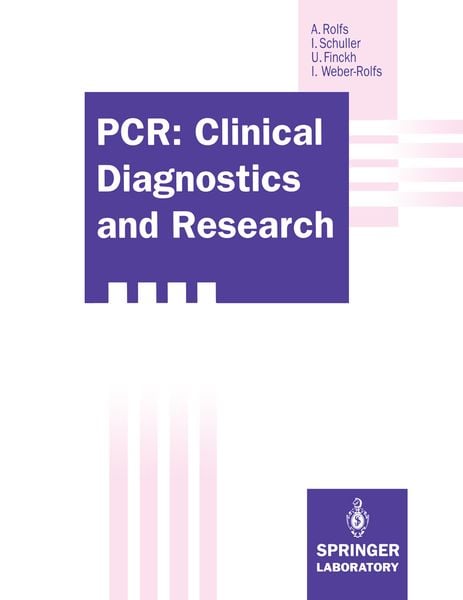
PCR: Clinical Diagnostics and Research

Aus der Reihe Springer Lab Manuals

Fr. 137.00

inkl. gesetzl. MwSt., Versandkostenfrei


Beschreibung

Produktdetails

Einband

Taschenbuch

Erscheinungsdatum

23.12.2011

Abbildungen

XIX, 367 p.

Verlag

Springer Berlin

Seitenzahl

367

Maße (L/B/H)

28/21/2.2 cm

Gewicht

965 g

Auflage

Softcover reprint of the original 1st ed. 1992

Sprache

Englisch

ISBN

978-3-642-77494-2

Beschreibung

Rezension

"an authoratative and comprehensive book on the subject...anyone contemplating introducing the method into a clinical laboratory would find this book invaluable" British Journal of Biomedical Science


"This book will provide valuable information to all those using PCR." - General Pharmacology

Produktdetails

Einband

Taschenbuch

Erscheinungsdatum

23.12.2011

Abbildungen

XIX, 367 p.

Verlag

Springer Berlin

Seitenzahl

367

Maße (L/B/H)

28/21/2.2 cm

Gewicht

965 g

Auflage

Softcover reprint of the original 1st ed. 1992

Sprache

Englisch

ISBN

978-3-642-77494-2

Herstelleradresse

Springer-Verlag KG
Sachsenplatz 4-6
1201 Wien
AT

Email: ProductSafety@springernature.com

Noch keine Bewertungen vorhanden

Verfassen Sie die erste Bewertung zu diesem Artikel

Helfen Sie anderen Kundinnen und Kunden durch Ihre Meinung.

Kundinnen und Kunden meinen

Bewertungen (0)

  • Produktbild: PCR: Clinical Diagnostics and Research
  • Produktbild: PCR: Clinical Diagnostics and Research
  • 1. PCR: principles and reaction components.- 1.1. PCR: A cyclic, exponential, in vitro amplification process.- 1.2. Temperature and time profile of thermal cycling.- 1.3. Taq DNA polymerase and reaction buffer.- 1.4. Deoxynucleotide triphosphates (dNTPs).- 1.5. Primers.- 1.6. Oil overlay and reaction volume.- 1.7. DNA sample.- 1.8. Size and structure of amplification products.- 1.9. PCR set-up strategies.- 2. Optimization strategies.- 2.1. Analytical PCR.- 2.2. Preparative PCR.- 3. General applications of PCR.- 3.1. Asymmetric PCR.- 3.2. Allele-specifîc amplification (ASA).- 3.3. Nested PCR.- 3.4. Multiplex PCR.- 3.5. Differential PCR.- 3.6. Competitive PCR.- 3.7. Amplification of unknown sequences.- 3.8. Application of PCR for genetic examinations, DNA amplification fingerprinting.- 3.9. Amplification with consensus primers.- 3.10. Expression PCR.- 3.11. Detection of infectious agents or rare sequences.- 4. Substances affecting PCR: Inhibition or enhancement.- 4.1. Inhibition introduced by native material.- 4.2. Inhibition introduced by reagents during DNA isolation: Detergents, Proteinase K and Phenol.- 4.3. Additives influencing the efficiency of PCR.- 4.4. Evaluation of the effect of individual additives.- 5. PCR: Contamination and falsely interpreted results.- 5.1. Control experiments.- 5.2. Sources of contaminations.- 5.3. Prevention and elimination of contamination.- 6. Biological material amenable to PCR.- 6.1. Sample preparation and storage.- 7. Isolation of DNA from cells and tissue for PCR.- 7.1. Alkaline lysis.- 7.2. Guanidinium rhodanid method (GuSCN).- 7.3. Proteinase K digestion for the isolation of DNA.- 7.4. Automated DNA extraction.- 8. Isolation of RNA from cells and tissue for PCR.- 8.1. General preparations.- 8.2. Inhibition of endogenous RNases.-8.3. Methods for the isolation of RNA suitable for RT-PCR.- 9. Reverse transcription/PCR (RT-PCR).- 9.1. Setting up an RT-PCR.- 9.2. Selective RT-PCR.- 10. Methods for identification of amplified PCR products.- 10.1. Agarose gel electrophoresis.- 10.2. DNA blot transfer and nonradioactive hybridization /detection.- 10.3. Detection systems of digoxigenin labeled hybrids.- 10.4. Polyacrylamide gel (PAGE) electrophoresis.- 11. Restriction fragment analysis.- 11.1. Restriction endonucleases.- 11.2. Endonuclecase selection.- 11.3. Optimal digestion conditions.- 12. Multiplex PCR.- Method: Detection of three different mycobacterial genom regions in a single PCR tube.- 13. Detection of single base changes using PCR.- 13.1. Allele-specific amplification (ASA, PASA, ASP, ARMS).- 13.2. Allele-specific oligonucleotide hybridisation (ASO).- 13.3. Chemical mismatch cleavage method.- 13.4. Denaturing gradient gel electrophoresis (DGGE).- 13.5. PCR single-strand conformation polymorphism (PCR-SSCP).- 14. Non-radioactive, direct, solid-phase sequencing of genomic DNA obtained from PCR.- 14.1. Generation of single-stranded DNA fragments.- 14.2. Sequencing of biotinylated PCR products.- 15. Application of PCR to analyze unknown sequences.- 15.1. Inverse PCR.- 15.2. Alternative methods to inverse PCR.- 16. Quantification of PCR-products.- 17. Cloning methods using PCR.- Method: Cloning and purification of a partial gag-sequence of HIV-1 using PCR.- 18. Site-directed mutagenesis using the PCR.- 19. In-situ polymerase chain reaction.- 20. Oligonucleotides in the field of PCR.- 20.1. Guidelines for designing PCR primers.- 20.2. Synthesis of primers.- 20.3. Purification of oligonucleotides.- 20.3. Chemical modification of primers.- 21. Review of different heat-stable DNA polymerases.- 21.1.Taq DNA polymerase.- 21.2. Vent polymerase (Thermococcus litoralis).- 21.3. Thermus thermophilus DNA polymerase.- 21.4. Pfu DNA polymerase (Pyrococcus furiosus).- 21.5. Bst polymerase.- 21.6. Fidelity of different heat-stable DNA polymerases.- 22. Physical features of thermocyclers and of their influence on the efficiency of PCR amplification.- 23. Alternative methods to PCR.- 23.1. Ligase chain reaction (LCR).- 23.2. Transcription-based amplification system (TAS).- 23.3. Self-sustained sequence replication (3SR).- 23.4. Q-beta replicase.- Addendum: Methodological examples for the application of the Polymerase chain reaction.- A) Characterization of oncogenes.- B) Detection of infectious agents.- C) Basic methodology and research applications.- Appendix I: Suppliers of specialist items.- Appendix II: List of Contributors.- Appendix III: DNA sequencing chrornato grams.