Gutscheinbedingungen

*Gültig bis 04.08.2026 auf (fast) alles. Ausgeschlossen sind Smartboxen, Zeitschriften, Tickets, Lebensmittel, Gaming-Elektroartikel, Tinte/Toner, Gutscheine, Geschenkkarten, Blumen und Abos | Einlösbar in allen Buchhandlungen von Orell Füssli, Barth Bücher, Buchladen Rapunzel, Papeterie Köhler, Schuler Orell Füssli, Stauffacher und ZAP unter Vorweisung des Gutscheins, auf www.orellfüssli.ch durch Eingabe des Gutscheincodes. Beim Service „eBooks verschenken“ und bei eBook-Käufen via eReader nicht einlösbar | Mindesteinkaufswert: Fr. 30.- | Nicht mit anderen Rabatten kumulierbar.

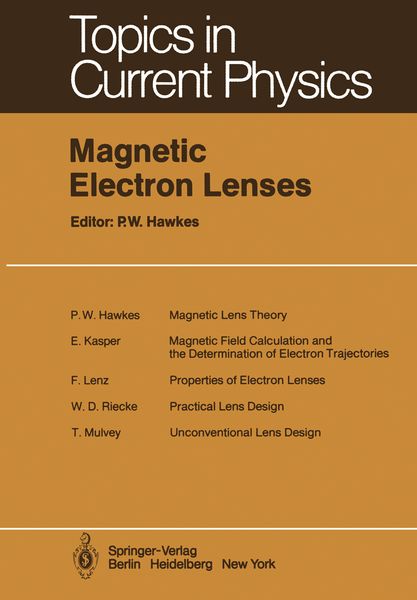
Produktbild: Magnetic Electron Lenses
Band 18

Magnetic Electron Lenses

Fr. 72.90

inkl. gesetzl. MwSt., Versandkostenfrei


Beschreibung

Produktdetails

Einband

Taschenbuch

Erscheinungsdatum

23.12.2011

Herausgeber

P.W. Hawkes

Verlag

Springer Berlin

Seitenzahl

464

Maße (L/B/H)

24.4/17/2.7 cm

Gewicht

828 g

Auflage

Softcover reprint of the original 1st ed. 1982

Sprache

Englisch

ISBN

978-3-642-81518-8

Beschreibung

Produktdetails

Einband

Taschenbuch

Erscheinungsdatum

23.12.2011

Herausgeber

P.W. Hawkes

Verlag

Springer Berlin

Seitenzahl

464

Maße (L/B/H)

24.4/17/2.7 cm

Gewicht

828 g

Auflage

Softcover reprint of the original 1st ed. 1982

Sprache

Englisch

ISBN

978-3-642-81518-8

Herstelleradresse

Springer-Verlag KG
Sachsenplatz 4-6
1201 Wien
AT

Email: GPSR Kontakt

Noch keine Bewertungen vorhanden

Verfassen Sie die erste Bewertung zu diesem Artikel

Helfen Sie anderen Kundinnen und Kunden durch Ihre Meinung.

Kundinnen und Kunden meinen

Bewertungen (0)

  • Produktbild: Magnetic Electron Lenses
  • 1. Magnetic Lens Theory.- 1.1 Derivation of the Equations of Motion of Electrons in Rotationally Symmetric Magnetic Fields.- 1.2 Paraxial Properties.- 1.2.1 General Remarks.- 1.2.2 Real Cardinal Elements.- 1.2.3 Asymptotic Cardinal Elements.- 1.3 Methods of Calculating Aberration Coefficients.- 1.3.1 Characteristic Functions.- 1.3.2 The Trajectory Method.- 1.4 Aberration Coefficients.- 1.4.1 Real (Objective) Aberration Coefficients.- a) Geometrical Aberrations.- b) Chromatic Aberrations.- 1.4.2 Asymptotic (Projector) Aberration Coefficients.- a) Geometrical Aberrations.- b) Chromatic Aberrations.- 1.4.3 Aberration Matrices and the Aberrations of Lens Combinations.- 1.5 Parasitic Aberrations.- References.- 2. Magnetic Field Calculation and the Determination of Electron Trajectories.- 2.1 Basic Concepts.- 2.1.1 General Field Equations.- 2.1.2 Fourier Series Expansions of the Scalar Potential.- 2.1.3 Paraxial Expansions.- 2.1.4 Circular Vector Potentials and Related Fields.- 2.2 Methods of Discretization.- 2.2.1 The Finite-Difference Method.- 2.2.1a The Taylor Series Method.- 2.2.1b The Integral Method.- 2.2.1c Application to a Simple Magnetic Lens.- 2.2.2 Improvement of the Finite-Difference Method.- 2.2.2a Different Mesh Grids.- 2.2.2b Nine-Point Formulae.- 2.2.2c Fields in Regions with Variable Material Coefficients.- 2.2.2d Irregular Mesh Grids.- 2.2.3 The Finite-Element Method.- 2.2.3a Application to Circular Vector Potentials.- 2.2.3b Application to Saturated Magnetic Lenses.- 2.2.3c The Computation of Scalar Potential Fields.- 2.2.3d Comparison of the Finite-Element Method with the Finite-Difference Method.- 2.3 Solution of the Discretized Equations.- 2.3.1 The General Structure of the Discretized Equations.- 2.3.2 The Successive Overrelaxation Method.- 2.3.3 Survey of Other Methods.- 2.4 Differentiation and Interpolation in Mesh Grids.- 2.4.1 The Calculation of the Axial Flux Density.- 2.4.2 Interpolation in Square-Shaped Grids.- 2.5 Analytical Field Calculation.- 2.5.1 Superposition of Aperture Fields.- 2.5.2 Additional Superposition of the Fields of Charged Rings.- 2.5.3 Linear Superposition of Magnetic Ring Fields.- 2.5.4 The Integral Equation Method.- 2.5.4a Solution of Boundary-Value Problems.- 2.5.4b Solution of Problems with Interface Conditions.- 2.5.4c Integral Equations Containing the Magnetization.- 2.6 Field Calculation in Systems Without Rotational Symmetry.- 2.6.1 Lenses with Small Perturbations of the Rotational Symmetry.- 2.6.2 Toroidal Deflection Systems.- 2.6.3 Magnetic Multipole Systems.- 2.7 The Calculation of Electron Trajectories.- 2.7.1 Solution of the Paraxial Ray Equation.- 2.7.1a Initial-Value Problems.- 2.7.1b Boundary-Value Problems.- 2.7.1c Numerical Differentiation.- 2.7.1d Calculation of Aberration Coefficients and Optimization.- 2.7.2 Solution of the Lorentz Equation.- 2.7.2a The Runge-Kutta Method.- 2.7.2b A Predictor-Corrector Method.- 2.8 Concluding Remarks.- References.- 3. Properties of Electron Lenses.- 3.1 Concepts and Definitions.- 3.1.1 Definition of Lenses and Their Properties.- 3.1.2 Saturated and Unsaturated Lenses.- 3.1.3 Lens Strength Parameters.- 3.1.4 Field-Form Factor.- 3.1.5 Scaling of the Field.- 3.1.6 Scaling of Trajectories.- 3.2 Field Distribution in Unsaturated Lenses.- 3.2.1 Symmetrical Lenses.- 3.2.2 Asymmetrical Lenses.- 3.3 Analytical Field Models.- 3.3.1 Glaser’s Bell-Shaped Field.- 3.3.2 Analytical Models for a Symmetrical Lens with S ? D.- 3.3.3 Analytical Models for Symmetrical Lenses with Finite S/D ratios.- 3.3.4 Analytical Models for Asymmetrical Lenses.- 3.3.5 Analytical Solutions of the Paraxial Trajectory Equation.- 3.4 Paraxial Properties.- 3.4.1 Weak Lens Approximation.- 3.4.2 Strong Lens Approximation.- 3.4.3 Focal Length and Focal Position.- 3.4.4 Chromatic Aberration.- 3.4.5 Unified Representations.- 3.5 Third-Order Aberrations.- 3.5.1 Classification of Third-Order Aberrations.- 3.5.2 Unified Representation in the Aperture-Free System.- 3.5.3 Unified Representation of the Asymptotic Aberration Coefficients.- References.- 4. Practical Lens Design.- 4.1 Introduction.- 4.2 General Rules for the Electron Optical Design of the Magnetic Lens.- 4.2.1 Objective Lenses.- 4.2.1a Objective Lens Aberrations, Optimum Apertures.- 4.2.1b Electron Optical Properties Fundamental for Objective Lens Design.- 4.2.1c Optimizing the Objective Lens with Regard to CS and CC.- 4.2.1d Basic Objective Lens Operating Modes.- 4.2.1e The Pin-Hole Objective Lens.- 4.2.2 Projector Lenses.- 4.2.2a Basic Design Considerations for Projector Lenses.- 4.2.2b Optimization of Projector Lenses.- 4.2.2c Practical Realization of a Large Magnification Range for Projector Lenses.- 4.2.3 Condenser Lenses.- 4.3 Design of the Magnetic Circuit.- 4.3.1 Magnetic Design of the Pole-Piece System.- 4.3.1a Calculation of the Magnetic Flux Density Distribution Within the Pole-Piece System.- 4.3.1b Applications and Comparison with Experimental Results.- 4.3.2 The Magnetic Design of the Lens Core.- 4.3.2a Some General Considerations.- 4.3.2b The Hildebrandt-Schiske Procedure for the Calculation of the Magnetic Flux Density in the Lens Core.- 4.3.2c A Perturbation Method for Obtaining the Magnetic Flux Distribution in the Core and Casing of a Magnetic Electron Lens.- 4.3.2d Determination of the Cross-Sectional Area of the Lens Core by Means of the Perturbation Method.- 4.3.3 Magnetic Design of the Lens Casing.- 4.3.4 Comments on Lenses with Highly Saturated Pole-Piece Tips.- 4.4 Other Aspects of Magnetic Lens Design.- 4.4.1 The Lens Coil and Its Cooling System.- 4.4.2 Stigmators.- 4.4.3 Apertures and Their Alignment.- 4.4.4 Special Aspects of Specimen Stages Relevant for the Optical Performance of the Magnetic Lens.- 4.4.5 Mechanical Lens Alignment Devices.- 4.5 Measures for Reducing the Sensitivity of the Magnetic Electron Lens to Environmental Disturbances.- 4.5.1 Design Considerations for Protecting the Lens Against Low Frequency Environmental Vibrations.- 4.5.2 Protective Measures in the Lens Design Against Stray Magnetic Field Disturbances.- 4.6 Permanent Magnet Lenses.- 4.6.1 The General Layout of Electron Optical Lens Systems with Permanent Magnet Lenses.- 4.6.2 Special Design Aspects for Permanent Magnet Lenses.- 4.6.2a Means for Changing the Focal Length of Permanent Magnet Lenses.- 4.6.2b The Permanent Magnet and Its Design.- 4.7 Superconducting Electron Lenses.- 4.7.1 Superconducting Electron Lenses with Ferromagnetic Pole Pieces.- 4.7.2 The Superconducting Shielding Lens.- References.- 5. Unconventional Lens Design.- 5.1 Introduction.- 5.1.1 High Voltage Electron Microscopy.- 5.1.2 Conventional Lenses.- 5.1.3 Electrical Power Requirements.- 5.1.4 Heat Transfer in Lens Windings.- 5.1.5 Tape Windings.- 5.2 Boiling-Water Cooling Systems.- 5.3 Miniature Rotation-Free Magnetic Electron Lenses.- 5.3.1 The Distortion-Free Mode.- 5.4 Iron-Free or Partly Shrouded Magnetic Lenses.- 5.4.1 Conical Lenses.- 5.4.2 Thin Helical (Pancake) Lenses.- 5.4.3 The Ultimate Performance of Pancake Lenses.- 5.4.4 Minimization of Chromatic Aberration.- 5.5 Iron-Shrouded Pancake Lenses.- 5.5.1 The Exponential Field Model.- 5.5.2 The Single Pole-Piece Lens.- 5.5.3 The Magnetized Iron Sphere Model.- 5.5.4 Aberrations of the Uniformly Magnetized Sphere Model.- 5.5.5 The Preferred Form of Single Pole-Piece Lenses.- 5.6 Improved Image Viewing Systems.- 5.7 Correction of Spiral Distortion.- 5.8 Concluding Remarks.- References.- Appendix A Some Earlier Sets of Curves Representing Lens Properties.- Appendix B Bibliography of Publications on Magnetic Electron Lens Properties.