
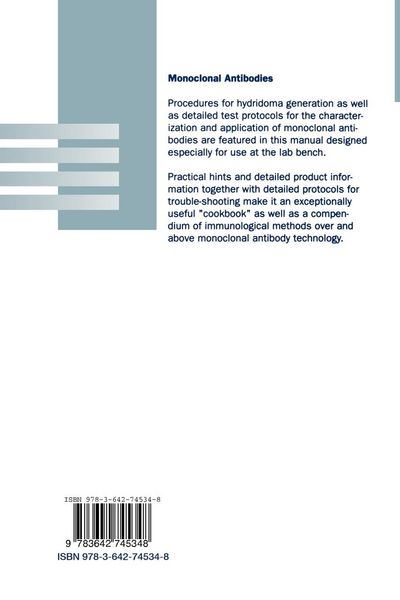
• Produktbild: Monoclonal Antibodies
  • Produktbild: Monoclonal Antibodies

Monoclonal Antibodies

Aus der Reihe Springer Lab Manuals

Fr. 137.00

inkl. gesetzl. MwSt., Versandkostenfrei


Beschreibung

Produktdetails

Einband

Taschenbuch

Erscheinungsdatum

13.12.2011

Illustriert von

R. Gieseler

Herausgeber

Johann H. Peters + weitere

Verlag

Springer Berlin

Seitenzahl

488

Maße (L/B/H)

23.5/15.5/2.8 cm

Gewicht

768 g

Auflage

Softcover reprint of the original 1st ed. 1992

Übersetzt von

P. Debbage

Sprache

Englisch

ISBN

978-3-642-74534-8

Beschreibung

Produktdetails

Einband

Taschenbuch

Erscheinungsdatum

13.12.2011

Illustriert von

R. Gieseler

Herausgeber

Verlag

Springer Berlin

Seitenzahl

488

Maße (L/B/H)

23.5/15.5/2.8 cm

Gewicht

768 g

Auflage

Softcover reprint of the original 1st ed. 1992

Übersetzt von

P. Debbage

Sprache

Englisch

ISBN

978-3-642-74534-8

Herstelleradresse

Springer-Verlag KG
Sachsenplatz 4-6
1201 Wien
AT

Email: GPSR Kontakt

Noch keine Bewertungen vorhanden

Verfassen Sie die erste Bewertung zu diesem Artikel

Helfen Sie anderen Kundinnen und Kunden durch Ihre Meinung.

Kundinnen und Kunden meinen

Bewertungen (0)

  • Produktbild: Monoclonal Antibodies
  • Produktbild: Monoclonal Antibodies
  • 1 Introduction.- 1.1 Principles of Cell Hybridization.- 1.2 Properties and Significance of Monoclonal Antibodies.- 1.3 Use of Monoclonal Antibodies in Human Beings: Quality Control and Legal Aspects.- 2 Preconditions for Hybridoma Technology.- 2.1 Experimental Work with Animals.- 2.1.1 Legal Aspects.- 2.1.2 Animal Maintenance.- 2.2 Equipment of the Cell Culture Laboratory.- 2.3 Equipment for Immunological and Biochemical Work.- 2.4 Organization of the Course of Work (Time Table) and Estimation of Costs.- 3 Immunization.- 3.1 Principles and Strategies for Immunizing Animals.- 3.2 Choice of the Immunogen.- 3.2.1 Native Antigens.- 3.2.2 Modified or Synthetic Antigens.- 3.3 Immunizing the Larger Experimental Animals for Antisera Production.- 3.4 Immunizing Mice.- 3.4.1 The Basics of Immunizing Mice for Hybridoma Production.- 3.4.2 Methods of Immunizing Mice.- 3.5 Influencing the Immune Response.- 3.5.1 Influencing the Immune Response by Use of Selected Mouse Strains.- 3.5.2 Influencing the Immune Response by Use of Adjuvants.- 3.5.3 Influencing the Immune Response by Inducing Tolerance.- 3.5.4 Modifying the Immune Response by Use of Cytostatica.- 3.5.5 Modulating the Immune Response by Masking Especially Immunogenic Epitopes with Antibodies.- 3.5.6 Modifying the Immune Response to Generate Certain Immunoglobulin Subclasses.- 4 Taking Blood and Isolating Cells.- 4.1 Taking Blood from Experimental Animals.- 4.1.1 Taking Blood from Mice.- 4.1.2 Taking Blood from Rats.- 4.1.3 Taking Blood from Rabbits.- 4.1.4 Taking Blood from Sheep and Goats.- 4.2 Isolating Lymphocytes from Spleen and Lymph Nodes.- 4.3 Isolating Human Lymphocytes from Peripheral Blood, Tonsils, or Spleen.- 4.4 Enriching Antigen-Specific Lymphoblasts for Fusion.- 4.5 Isolating Mouse Peritoneal Macrophages for Use as Feeder Cells.- 5 Cell Culture.- 5.1 Requirements for Cell Culture.- 5.1.1 Cleaning, Disinfecting, and Avoiding Toxicity.- 5.1.2 Plastic Ware, Water, Media, Sera, and Additives.- 5.1.3 Culture Conditions.- 5.2 Additives to Media: Growth Factors, Conditioned Media.- 5.3 Cryopreservation of Cells.- 5.3.1 Freeze Storage of Cells Directly After Fusion.- 5.3.2 Freeze Storage of Hybridomas in Cell Culture Plates.- 5.3.3 Storing Lymphocytes in the Cold.- 5.3.4 Keeping Track of Frozen Cells by Use of Computers.- 5.4 Bacterial and Fungal Infections.- 5.5 Limiting an Infection in Multi-Well Plates.- 5.6 Mycoplasmas.- 5.6.1 Mycoplasma Enrichment Cultures in Cell-Free Media.- 5.6.2 Fluorescence Test to Demonstrate Mycoplasma Infections in Cultures of Adherent or Suspended Cells.- 5.6.3 Immunological and Genetical Tests for Mycoplasmas.- 5.6.4 Cleaning Mycoplasma-Infected Cells.- 5.6.4.1 Use of Antibiotics to Eliminate Mycoplasmas.- 5.6.4.2 Clearing Mycoplasmas from Infected Cells by Co-Culture with Macrophages.- 5.7 Cell Viability Testing Using Fluorescent Dyes.- 6 Production of Hybridomas.- 6.1 Basics.- 6.1.1 Properties and Production of Myeloma and Tumor Cell Lines.- 6.1.2 Principles of Selection.- 6.1.3 Survey of Mouse Myelomas.- 6.2 Fusing Cells to Generate Mouse Monoclonal Antibodies.- 6.3 Human Hybridoma Technique.- 6.3.1 Fusion Partner Cell Lines and Methods for Generating Human Monoclonal Antibodies.- 6.3.2 Basics of in Vitro Immunization.- 6.3.3 Preparation of Human B-Lymphocytes for in Vitro Immunization: Principles.- 6.3.4 Preparing the Cells.- 6.3.4.1 Removal of T-Lymphocytes by Panning.- 6.3.4.2 Harvesting Monocytes by Adherence.- 6.3.4.3 Differentiating Out Accessory Cells from Monocytes.- 6.3.4.4 Removal of Lysosome-Rich Cells.- 6.3.5 In Vitro Immunization: Additives.- 6.3.5.1 T-Cell Rosetting and Preparing a Conditioned Medium.- 6.3.6 Procedures for in Vitro Immunization of Human Lymphocytes.- 6.3.7 Fusion of Human Cells.- 6.3.8 Epstein-Barr Virus (EBV) Transformation and EBV Hybridoma Technique.- 6.3.8.1 EBV Transformation.- 6.3.8.2 Heteromyeloma Technique: Fusion of EBV-Transformed B-Lymphocytes with Mouse Myeloma Cells.- 6.3.8.3 Transfecting the Geneticin-Resistance Gene.- 6.3.9 Fusion with Cytoplasts.- 6.3.10 DNA Transformation.- 6.4 Other Fusion Methods.- 6.4.1 Fusion with Viruses.- 6.4.2 Electrofusion.- 6.5 Calculating the Number of Hybridoma Clones To Be Expected.- 6.6 Culture and Enrichment of Hybridomas.- 6.6.1 Growing Hybridomas, Trial Plating.- 6.6.2 Trouble-Shooting During the Generation and Culturing of Hybridomas.- 6.7 Cloning Cells.- 6.7.1 Limiting-Dilution Cloning.- 6.7.2 Cloning Cells with a Cell Sorter.- 6.8 Identifying Human Genomic Material in Mouse-Human Hybridomas.- 6.9 Fine-Tuning Hybridomas.- 6.9.1 Increasing the Proportion of Hybridomas Specific for the Desired Antigen.- 6.9.2 Class-Switch Variants.- 6.9.3 Strategies for Generating Stable Hybridomas Producing Human Monoclonal Antibodies.- 6.9.4 Bispecific, Chimeric, and Recombinant Antibodies.- 6.10 Nomenclature of Monoclonal Antibodies.- 7 Mass Production of Monoclonal Antibodies.- 7.1 Mass Production of Monoclonal Antibodies in Cell Culture or Ascites.- 7.2 Production of Monoclonal Antibodies in Mice.- 7.2.1 Production of Murine Monoclonal Antibodies in the Peritoneal Cavity of the Mouse.- 7.2.2 Production of Human Monoclonal Antibodies in the Peritoneal Cavity of the Mouse.- 7.3 Production of Monoclonal Antibodies in Bioreactors.- 7.4 Serum-Free Cell Culture.- 7.5 Checking the Antibody Properties.- 7.5.1 Protocoling the Production and Quality Control of Monoclonal Antibodies.- 7.5.2 Genome Stability of Mouse Hybridomas.- 8 Purifying Monoclonal Antibodies and Producing Antibody Fragments.- 8.1 Purification of Monoclonal Antibodies: an Overview.- 8.1.1 Ammonium Sulfate Precipitation of Monoclonal Antibodies from Hybridoma Ascites Fluid.- 8.1.2 Protein A/Protein G Column Chromatography.- 8.1.3 Anion Exchange Chromatography for Purification of Monoclonal IgG Antibodies.- 8.2 Producing Immunoreactive Fragments from Mouse Monoclonal Antibodies.- 8.2.1 Preparing Fab Fragments.- 8.2.2 Preparing F(ab)2 Fragments.- 9 Coupling Monoclonal Antibodies.- 9.1 Basic Principles.- 9.2 Conjugation of Enzymes to Monoclonal Antibodies.- 9.2.1 Conjugating Peroxidase.- 9.2.2 Conjugating ss-Galactosidase.- 9.2.3 Conjugating Alkaline Phosphatase.- 9.3 Biotinylating Monoclonal Antibodies.- 9.4 Conjugating Fluorochromes to Monoclonal Antibodies.- 9.4.1 FITC Conjugation.- 9.4.2 Conjugation of Rhodamine, Phycoerythrin, and Cyanine Dyes.- 9.5 Conjugating Monoclonal Antibodies to Solid Phases (Immune Absorption).- 10 Demonstration of Monoclonal Antibodies.- 10.1 How To Find the Correct Monoclonal Antibody.- 10.2 Immunoassays for Soluble Antigens: a Survey.- 10.3 ELISA for Demonstration of Monoclonal Antibodies Against Soluble Antigens.- 10.4 Quantitative Tests to Demonstrate the Synthetic Capacity of Hybridoma Cells.- 10.4.1 Determining Cellular Protein.- 10.4.2 Detection of Mouse and Human IgG: Standard Method.- 10.4.3 Demonstrating Mouse and Human IgG with the Streptavidin-Biotin System.- 10.5 Selection of a Test System for Antibodies Against Cellular Antigens.- 10.5.1 Living and Fixed Cells.- 10.5.2 Nonspecific Binding.- 10.5.3 Choice of the Stain.- 10.5.4 Immunofluorescence.- 10.5.5 Cytochemistry.- 10.5.5.1 Inhibition of Endogenous Alkaline Phosphatase Activity.- 10.5.5.2 Inhibition of Endogenous Peroxidase Activity.- 10.5.6 Labeling with Colloidal Gold.- 10.5.7 Controls.- 10.6 Immunofluorescence Demonstration of Cytoplasmic Ig in Fixed Lymphocytes.- 10.7 Immunofluorescence Demonstration of Membrane Antigens on Living Lymphocytes.- 10.8 Immunocytochemical Staining Techniques.- 10.8.1 Immunocytochemical Demonstration of Antigens in Fixed Cells.- 10.8.2 Indirect Immunoperoxidase Technique.- 10.8.3 Peroxidase-Anti-Peroxidase (PAP) Technique.- 10.8.4 Alkaline Phosphatase-Anti-Alkaline Phosphatase (APAAP) Technique.- 10.8.5 Streptavidin-Biotinylated Peroxidase Complex (Strept-ABC) Technique.- 10.8.6 Double Immunoenzyme Labeling of Tissue Sections and Cytological Preparations.- 10.9 Immunocytochemical Demonstration of Membrane Antigens on Living Cells.- 10.10 ELISA Demonstration of Antigens in Fixed Cells (Cell ELISA).- 10.10.1 Establishing the Cell ELISA.- 10.10.2 Standardizing the Cell ELISA.- 10.11 Local Demonstration of Specific Antibody.- 10.11.1 Elispot (Spot ELISA) for Demonstrating Specific B-Lymphocytes.- 10.11.2 Demonstrating Specific Immunoglobulins in Single Cells with the Repetitive APAAP Technique.- 10.12 Dot Immunobinding Test.- 10.13 Molecular Weight Determination of Membrane Antigens by Means of Chemiluminescence-Autography and Sequential Immunoprecipitation.- 10.14 Depletion of Cells in Suspension by Use of Particle-Bound Antibodies (Magnetic Particles).- 10.15 Typing Class and Subclass (Isotyping) of Mouse Antibodies by Means of ELISA.- 10.16 Analytical HPLC of Monoclonal Antibodies.- 10.17 Analytical SDS Polyacrylamide Gel Electrophoresis (SDS-PAGE).- 10.18 Analytical Isoelectric Focusing of Monoclonal Antibodies.- 10.19 Silver Staining of Polyacrylamide Gels.- 10.20 Protein Blotting, Immunoblotting (“Western Blot”).- 10.21 Epitope Analysis.- 10.21.1 Principles of Epitope Analysis.- 10.21.2 Screening ELISA for Epitope Analysis.- 11 Safety Precautions at Work.- 12 Appendix.- 12.1 Monographs.- 12.2 Reference Works for Obtaining Cells, Reagents, and Laboratory Equipment.- 12.3 Addresses of Firms.