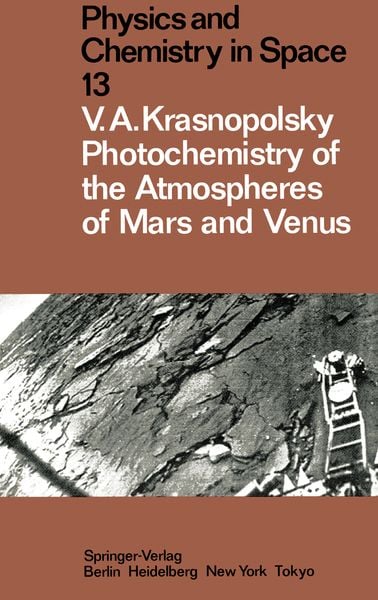
Band 13
Photochemistry of the Atmospheres of Mars and Venus
Aus der Reihe
Physics and Chemistry in Space
-
- Taschenbuch ausgewählt
- eBook
-
Sprache:Englisch
Fr. 137.00
inkl. gesetzl. MwSt.,
Beschreibung
Produktdetails
Einband
Taschenbuch
Erscheinungsdatum
06.12.2011
Herausgeber
U.v. ZahnVerlag
Springer BerlinSeitenzahl
334
Maße (L/B/H)
23.5/15.5/1.9 cm
Gewicht
527 g
Auflage
Softcover reprint of the original 1st ed. 1986
Sprache
Englisch
ISBN
978-3-642-70403-1
Spacecraft study of the Solar system is one of humanity's most outstanding achievements. Thanks to this study, our present knowledge of properties of and conditions on the planets exceeds many-fold that of 20 years ago: planets have been rediscovered. This is especially the case for planetary atmospheres, whose properties were for the most part either not at all or only erroneously known. Much research has been invested in the study of the atmospheres of Mars and Venus, and their chemical composition and photochemistry are basic problems in these studies. In the present publication I have tried to summarize all findings in this field. The English version of the book includes new data in the field from the last 3 years since the book was published in Russian. I wish to thank U. von Zahn, who initiated my talks with Springer-Verlag and acted as technical editor. December 2, 1985 V. A. KRASNOPOLSKY Contents Introduction . . . . . . . . . . . . . . . . . . . . . . . . . . . . . . . . . . . . . . . . . . . . . . . . . . 1 1 Chemical Composition and Structure of the Martian Atmosphere 4 1. 1 Carbon Dioxide and Atmospheric Pressure . . . . . . . . . . . . . . . . . . . 4 1. 2 CO and O Mixing Ratios . . . . . . . . . . . . . . . . . . . . . . . . . . . . . . . . . . 8 2 1. 3 Ozone. . . . . . . . . . . . . . . . . . . . . . . . . . . . . . . . . . . . . . . . . . . . . . . . . . 10 1. 4 Water Vapor . . . . . . . . . . . . . . . . . . . . . . . . . . . . . . . . . . . . . . . . . . . . 18 1. 5 Composition of the Upper Atmosphere as Determined from Airglow Spectroscopy . . . . . . . . . . . . . . . . . . . . . . . . . . . . . . . . . . . . . 23 1. 6 Mass Spectrometric Measurements of the Atmospheric Composition . . . . . . . . . . . . . . . . . . . . . . . . . . . . . . . . . . .. . . . . . . . . 31 1. 7 Ionospheric Composition . . . . . . . . . . . . . . . . . . . . . . . . . . . . . . . . . . 34 1. 8 Temperature Profile of the Lower Atmosphere. . . . . . . . . . . . . . . . 36 1. 9 Temperature of the Upper Atmosphere . . . . . . . . . . . . . . . . . . . . . . 40 1. 10 Eddy Diffusion Coefficient . . . . . . . . . . . . . . . . . . . . . . . . . . . . . . . . 42 2 Photochemistry of the Martian Atmosphere . . . . . . . . . . . . . . . . . .
Noch keine Bewertungen vorhanden
Verfassen Sie die erste Bewertung zu diesem Artikel
Helfen Sie anderen Kundinnen und Kunden durch Ihre Meinung.