• Produktbild: Toxic Organic Chemicals in Porous Media
  • Produktbild: Toxic Organic Chemicals in Porous Media
Band 73

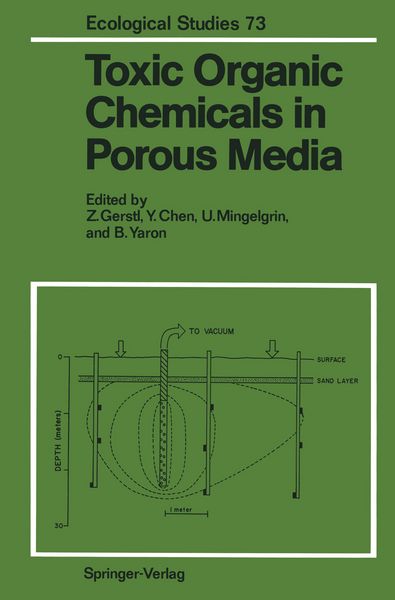
Toxic Organic Chemicals in Porous Media

Aus der Reihe Ecological Studies

Fr. 137.00

inkl. gesetzl. MwSt., Versandkostenfrei


Beschreibung

Produktdetails

Einband

Taschenbuch

Erscheinungsdatum

15.11.2011

Herausgeber

Zev Gerstl + weitere

Verlag

Springer Berlin

Seitenzahl

343

Maße (L/B/H)

23.5/15.5/2 cm

Gewicht

546 g

Auflage

Softcover reprint of the original 1st ed. 1989

Sprache

Englisch

ISBN

978-3-642-74470-9

Beschreibung

Produktdetails

Einband

Taschenbuch

Erscheinungsdatum

15.11.2011

Herausgeber

Verlag

Springer Berlin

Seitenzahl

343

Maße (L/B/H)

23.5/15.5/2 cm

Gewicht

546 g

Auflage

Softcover reprint of the original 1st ed. 1989

Sprache

Englisch

ISBN

978-3-642-74470-9

Herstelleradresse

Springer-Verlag KG
Sachsenplatz 4-6
1201 Wien
AT

Email: GPSR Kontakt

Noch keine Bewertungen vorhanden

Verfassen Sie die erste Bewertung zu diesem Artikel

Helfen Sie anderen Kundinnen und Kunden durch Ihre Meinung.

Kundinnen und Kunden meinen

Bewertungen (0)

  • Produktbild: Toxic Organic Chemicals in Porous Media
  • Produktbild: Toxic Organic Chemicals in Porous Media
  • I: Overview of the Problem.- Introductory Comments.- 1 Dimensions of Ground Water Pollution: A Global Perspective.- 1.1 Water Management Misfortunes.- 1.2 The Emerging Perception of Quality Decline.- 1.3 Man’s Impact on Ground Water ’.- 1.4 A Current Assessment of Ground Water Pollution.- 1.5 Changing Patterns of Waste Disposal.- 1.6 Legislative Controls.- 1.7 The Cleanup.- 1.8 Public Perception.- 1.9 The Professional’s Responsibility to the Public.- 1.10 Reasonable Risk.- 1.11 The Future.- 2 Pollution Hazards from Toxic Organic Chemicals.- 2.1 Introduction.- 2.2 The Facts.- 2.2.1 Pesticides in Groundwater.- 2.2.2 Industrial Chemicals in Groundwater.- 2.2.3 Wastewater.- 2.2.4 Mathematical Modelling of Groundwater Contamination.- 2.3 Conclusions.- 2.4 Recommendations.- References.- II: Physicochemical and Biological Interactions with Porous Media.- Introductory Comments.- 3 Interactions of Toxic Organic Chemicals with Humic Substances.- 3.1 Introduction.- 3.2 Soil and Aquatic Humic Substances.- 3.2.1 Introduction.- 3.2.2 Interactive Properties of Humic Substances.- 3.3 Toxic Organic Chemicals.- 3.3.1 Pesticides.- 3.3.2 Polynuclear Aromatic Hydrocarbons.- 3.3.3 Phthalates.- 3.4 Evidence of Interactions of TOC with Humic Substances.- 3.4.1 Soil.- 3.4.2 Waters.- 3.4.3 Sediments.- 3.5 Modes of Interaction of Humic Substances with Toxic Organic Pollutants.- 3.5.1 Adsorption.- 3.5.2 Partitioning.- 3.5.3 Solubilization Effects.- 3.5.4 Hydrolysis Effects.- 3.5.5 Photosensitization.- 3.6 Conclusions and Recommendations.- References.- 4 Surface Interactions of Toxic Organic Chemicals with Minerals.- 4.1 Introduction.- 4.2 Relevant Properties of the Mineral Components of the Solid Phase.- 4.3 Interrelation Between Components of the Solid Phase.- 4.4 The Exchange Complex.- 4.5 Interrelations Between the Phases.- 4.6 Surface Enhanced Transformations.- 4.7 Factors Affecting Surface Interactions.- 4.7.1 Temperature.- 4.7.2 Moisture Content.- 4.7.3 Intrinsic Properties of the Solid Phase.- 4.7.4 The Composition of the Exchange Complex.- 4.7.5 Other Factors.- 4.8 Mechanisms and Kinetic Considerations.- 4.8.1 A Two Phase (Solid-Liquid) System in Which the Adsorption of the Reactant Follows a Linear Adsorption Isotherm.- 4.8.2 A Two Phase (Solid-Liquid) System in Which the Catalytically Active Surface Sites are Saturated with the Reactant.- 4.8.3 A Porous Medium not in Contact with a Free Liquid Phase.- 4.9 A Unified Description of Surface Interactions.- 4.10 Enzymatic Reactions.- 4.11 General Discussion and Conclusions.- References.- 5 Abiotic Transformations of Toxic Organic Chemicals in the Liquid Phase and Sediments.- 5.1 Introduction.- 5.2 Transformations in the Water Column.- 5.3 Transformations in Sediments.- 5.3.1 Hydrolysis.- 5.3.2 Redox Reactions.- 5.4 Transformations in Groundwaters.- 5.4.1 Hydrolysis.- 5.4.2 Redox Reactions.- 5.5 Future Direction.- References.- III: Pesticides in Porous Media.- Introductory Comments.- 6 Predicting the Mobility and Availability of Toxic Organic Chemicals.- 6.1 Introduction.- 6.2 Current Methods for Predicting Adsorption.- 6.3 Molecular Connectivity.- 6.4 MC-SAR Studies.- 6.5 The Need for Future Work.- 6.6 Summary.- References.- 7 Partition and Adsorption on Soil and Mobility of Organic Pollutants and Pesticides.- 7.1 Introduction.- 7.2 Sorption by Soil in Aqueous Systems.- 7.3 Sorption by Soil from Organic Solvents.- 7.4 Sorption by Soil from the Vapor Phase.- 7.5 Influence of Soil Sorption on Pollutant and Pesticide Activity.- References.- 8 Sorption and Transport of Organic Pollutants at Waste Disposal Sites.- 8.1 Introduction.- 8.2 Solubility in Complex Solvents.- 8.2.1 Solubility in Mixed Solvents.- 8.2.2 Solubility in Multi-Phasic Solvents.- 8.3 Sorption from Complex Solvents.- 8.3.1 Sorption from Mixed Solvents.- 8.3.2 Sorption from Biphasic Solvents.- 8.3.3 Sorption from Complex Solvents Containing PMOS and CMOS.- 8.4 Sorption from Aqueous Solutions of Multi-Sorbate Mixtures.- 8.5 Transport in the Presence of Complex Solvents.- 8.5.1 Transport in Mixed Solvents.- 8.5.2 Transport in Biphasic Solvents.- 8.5.3 Transport in Miscible and Immiscible Solvents.- 8.6 Transport of Mixtures of Organic Pollutants.- References.- 9 Accelerated Degradation of Pesticides.- 9.1 Introduction.- 9.2 Accelerated Degradation of Pesticides.- 9.3 Assessment of Accelerated Degradation.- 9.4 Mechanisms of Accelerated Degradation.- 9.5 Persistence of Accelerated Degradation.- 9.6 Cross Accelerated Degradation.- 9.7 Control and Management of Accelerated Degradation.- 9.8 Conclusions and Prospects.- References.- IV: Petroleum Hydrocarbons.- Introductory Comments.- 10 On the Behavior of Petroleum Hydrocarbons in the Unsaturated Zone: Abiotic Aspects.- 10.1 Introduction.- 10.2 Properties of the Interacting Materials.- 10.2.1 Crude Oils and Petroleum Products.- 10.3 Partitioning Between Gaseous, Aqueous, and Solid Phases.- 10.3.1 Migration into the Gaseous Phase.- 10.3.2 Dissolution in the Water Phase.- 10.3.3 Retention by the Solid Phase.- 10.4 Surface Degradation.- 10.5 Multiphase Transport.- 10.6 Conclusions.- References.- 11 Transport of Organic Pollutants in a Multiphase System.- 11.1 Introduction.- 11.2 Classification of LH According to Contamination Criteria.- 11.3 Introduction of the Pollutant into the Subsurface Water.- 11.4 Migration of LHin the Unsaturated Zone.- 11.5 Migration of LH in the Saturated Zone.- 11.6 Modelling Procedures.- 11.6.1 Gross Control Volumes.- 11.6.2 Differential Control Volumes Referring to the Whole Flow Field.- 11.6.3 Differential Control Volumes Referring to Various Parts of the Flow Field.- 11.7 Determination of the Flow Field Characteristics.- 11.8 Practical Aspects.- References.- 12 Biochemical Aspects of Hydrocarbon Biodegradation in Sediments and Soils.- 12.1 Introduction.- 12.2 Biochemical Considerations.- 12.3 Application of Results of Biochemical Considerations.- 12.4 Laboratory Experiments with Fresh Marine Sediment.- 12.5 Laboratory Experiments with a Standardized and Inoculated Sediment Mixture.- 12.6 Anaerobic Degradation.- 12.7 Hydrocarbon Biodegradation in Soils.- 12.8 Conclusions.- References.- V: Restoration of the Unsaturated Zone and Groundwater.- Introductory Comments.- 13 Manipulation of the Vadose Zone to Enhance Toxic Organic Chemical Removal.- 13.1 Introduction.- 13.2 Physical Methods.- 13.2.1 Leaching.- 13.2.2 Enhanced Volatilization.- 13.2.3 Electrokinetics.- 13.3 Chemical Methods.- 13.4 Biological Methods.- 13.4.1 Stimulation of Native Organisms.- 13.4.2 Addition of Altered Organisms.- 13.5 Conclusions and Future Research Needs.- References.- 14 The Relative Importance of pH, Charge, and Water Solubility on the Movement of Organic Solutes in Soils and Ground Water.- 14.1 Introduction.- 14.2 Experimental.- 14.2.1 Overview of the Injection Site.- 14.2.2 Properties of the Ogallala Aquifer near Stanton, Texas.- 14.2.3 Design and Construction of Injection and Observation Wells.- 14.2.4 Experimental Sequence.- 14.2.5 Solute or Tracer Addition and Observation Well Sampling.- 14.2.6 On Site Analyses in the Mobile Laboratory.- 14.2.7 Laboratory Analyses.- 14.3 Hypotheses to be Tested.- 14.4 Results and Discussion.- 14.5 Conclusions.- References.- 15 Photochemical Inactivation of Organic Pollutants from Water.- 15.1 Introduction.- 15.1.1 Dye-Sensitized Photooxidation Reactions.- 15.2 Photochemical Inactivation of Industrial Organic Pollutants.- 15.2.1 Photolysis of Uracil Derivatives.- 15.2.2 Photolysis of s-Triazine Derivatives.- 15.2.3 Photolysis of Anilide Derivatives.- 15.3 Photochemical Inactivation of Biological Pollutants.- 15.3.1 Laboratory Experiments.- 15.3.2 Pilot Plant Experiments.- 15.4 Summary and Conclusions.- References.- 16 Restoration of Aquifers Polluted with Hydrocarbons.- 16.1 Introduction.- 16.2 The Water Works “Durlacher Wald”.- 16.3 Treatment Results.- 16.4 Microbiological Aspects of the Treatment Used.- 16.5 Summary and Conclusions.- References.