• Produktbild: Structural Complexity II
  • Produktbild: Structural Complexity II
Band 22

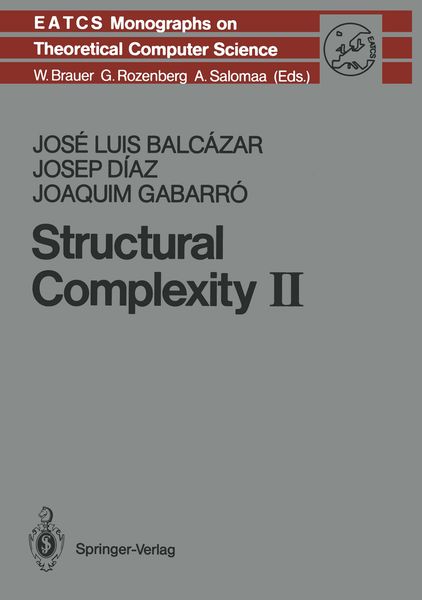
Structural Complexity II

Fr. 149.00

inkl. gesetzl. MwSt., Versandkostenfrei


Beschreibung

Produktdetails

Einband

Taschenbuch

Erscheinungsdatum

13.12.2011

Abbildungen

IX, 283 p.

Verlag

Springer Berlin

Seitenzahl

283

Maße (L/B/H)

24.2/17/1.7 cm

Gewicht

524 g

Auflage

Softcover reprint of the original 1st ed. 1990

Sprache

Englisch

ISBN

978-3-642-75359-6

Beschreibung

Produktdetails

Einband

Taschenbuch

Erscheinungsdatum

13.12.2011

Abbildungen

IX, 283 p.

Verlag

Springer Berlin

Seitenzahl

283

Maße (L/B/H)

24.2/17/1.7 cm

Gewicht

524 g

Auflage

Softcover reprint of the original 1st ed. 1990

Sprache

Englisch

ISBN

978-3-642-75359-6

Herstelleradresse

Springer-Verlag KG
Sachsenplatz 4-6
1201 Wien
AT

Email: ProductSafety@springernature.com

Noch keine Bewertungen vorhanden

Verfassen Sie die erste Bewertung zu diesem Artikel

Helfen Sie anderen Kundinnen und Kunden durch Ihre Meinung.

Kundinnen und Kunden meinen

Bewertungen (0)

  • Produktbild: Structural Complexity II
  • Produktbild: Structural Complexity II
  • 1 Vector Machines.- 1.1 Introduction.- 1.2 Vector Machines: Definition and Basic Properties.- 1.3 Elementary Matrix Algebra on Vector Machines.- 1.4 Relation Between Vector Machines and Turing Machines.- 1.5 Exercises.- 1.6 Bibliographical Remarks.- 2 The Parallel Computation Thesis.- 2.1 Introduction.- 2.2 An Array Machine: the APM.- 2.3 A Multiprocessor Machine: the SIMDAG.- 2.4 A Tree Machine: the k-PRAM.- 2.5 Further Parallel Models.- 2.6 Exercises.- 2.7 Bibliographical Remarks.- 3 Alternation.- 3.1 Introduction.- 3.2 Alternating Turing Machines.- 3.3 Complexity Classes for Alternation.- 3.4 Computation Graphs of a Deterministic Turing Machine.- 3.5 Determinism Versus Nondeterminism for Linear Time.- 3.6 Exercises.- 3.7 Bibliographical Remarks.- 4 Uniform Circuit Complexity.- 4.1 Introduction.- 4.2 Uniform Circuits: Basic Definitions.- 4.3 Relationship with General-Purpose Parallel Computers.- 4.4 Other Uniformity Conditions.- 4.5 Alternating Machines and Uniformity.- 4.6 Robustness of NC and Conclusions.- 4.7 Exercises.- 4.8 Bibliographical Remarks.- 5 Isomorphism and NP-completeness.- 5.1 Introduction.- 5.2 Polynomial Time Isomorphisms.- 5.3 Polynomial Cylinders.- 5.4 Sparse Complete Sets.- 5.5 Exercises.- 5.6 Bibliographical Remarks.- 6 Bi-Immunity and Complexity Cores.- 6.1 Introduction.- 6.2 Bi-Immunity, Complexity Cores, and Splitting.- 6.3 Bi-Immune Sets and Polynomial Time m-Reductions.- 6.4 Complexity Cores and Polynomial Time m-Reductions.- 6.5 Levelability, Proper Cores, and Other Properties.- 6.6 Exercises.- 6.7 Bibliographical Remarks.- 7 Relativization.- 7.1 Introduction.- 7.2 Basic Results.- 7.3 Encoding Sets in NP Relativized.- 7.4 Relativizing Probabilistic Complexity Classes.- 7.5 Isolating the Crucial Parameters.- 7.6 Refining Nondeterminism.- 7.7Strong Separations.- 7.8 Further Results in Relativizations.- 7.9 Exercises.- 7.10 Bibliographical Remarks.- 8 Positive Relativizations.- 8.1 Introduction.- 8.2 A Positive Relativization of the $$P\mathop = \limits^? PSPACE$$ Problem.- 8.3 A Positive Relativization of the $$NP\mathop = \limits^? PSPACE$$ Problem.- 8.4 A Positive Relativization of the $$P\mathop = \limits^? NP$$ Problem.- 8.5 A Relativizing Principle.- 8.6 Exercises.- 8.7 Bibliographical Remarks.- 9 The Low and the High Hierarchies.- 9.1 Introduction.- 9.2 Definitions and Characterizations.- 9.3 Relationship with the Polynomial Time Hierarchy.- 9.4 Some Classes of Low Sets.- 9.5 Oracle-Restricted Positive Relativizations.- 9.6 Lowness Outside NP.- 9.7 Exercises.- 9.8 Bibliographical Remarks.- 10 Resource-Bounded Kolmogorov Complexity.- 10.1 Introduction.- 10.2 Unbounded Kolmogorov Complexity.- 10.3 Resource-Bounded Kolmogorov Complexity.- 10.4 Tally Sets, Printability, and Ranking.- 10.5 Kolmogorov Complexity of Characteristic Functions.- 10.6 Exercises.- 10.7 Bibliographical Remarks.- 11 Probability Classes and Proof-Systems.- 11.1 Introduction.- 11.2 Interactive Proof-Systems: Basic Definitions and Examples.- 11.3 Arthur Against Merlin Games.- 11.4 Probabilistic Complexity Classes and Proof-Systems.- 11.5 Equivalence of AM and IP.- 11.6 Exercises.- 11.7 Bibliographical Remarks.- Appendix: Complementation via Inductive Counting.- 1 Nondeterministic Space is Closed Under Complement.- 2 Bibliographical Remarks.- References.- Author Index.- Symbol Index.