KI-Beratung Beta

Produktbild: Synergetic Economics
Band 53

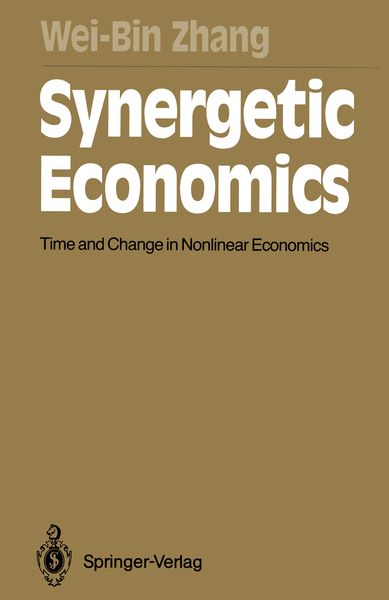
Synergetic Economics Time and Change in Nonlinear Economics

Fr. 72.90

inkl. gesetzl. MwSt., Versandkostenfrei


Beschreibung

Produktdetails

Einband

Taschenbuch

Erscheinungsdatum

15.11.2011

Abbildungen

XV, 246 p.

Verlag

Springer Berlin

Seitenzahl

246

Maße (L/B/H)

24.2/17/1.5 cm

Gewicht

458 g

Auflage

Softcover reprint of the original 1st ed. 1991

Sprache

Englisch

ISBN

978-3-642-75911-6

Beschreibung

Produktdetails

Einband

Taschenbuch

Erscheinungsdatum

15.11.2011

Abbildungen

XV, 246 p.

Verlag

Springer Berlin

Seitenzahl

246

Maße (L/B/H)

24.2/17/1.5 cm

Gewicht

458 g

Auflage

Softcover reprint of the original 1st ed. 1991

Sprache

Englisch

ISBN

978-3-642-75911-6

Herstelleradresse

Springer-Verlag KG
Sachsenplatz 4-6
1201 Wien
AT

Email: ProductSafety@springernature.com

Noch keine Bewertungen vorhanden

Verfassen Sie die erste Bewertung zu diesem Artikel

Helfen Sie anderen Kundinnen und Kunden durch Ihre Meinung.

Kundinnen und Kunden meinen

Bewertungen (0)

  • Produktbild: Synergetic Economics
  • 1. Introduction.- 2. Time and Change in Economics.- 2.1 Economic Evolution — An Introduction.- 2.2 Equilibrium Theories in Economic Analysis.- 2.3 Dynamic Theories in Economics.- 2.4 Samuelson’s Correspondence Principle and Its Limitations.- 2.5 Instabilities in Economic Analysis.- 3. Mathematical Aspects of Dynamic Systems.- 3.1 Dynamics and Equilibrium.- 3.2 Classifications of Two-Dimensional Differential Equations.- 3.3 The Principle of Linearized Stability.- 3.4 Lyapunov’s Direct Method.- 3.5 Structural Stability.- 3.6 Conservative Systems.- 3.7 Bifurcation Theory.- 3.8 Singularity Theory.- 3.9 Catastrophe Theory.- Appendix: Remarks on Bifurcation Theory.- 4. Multiple Equilibria and Structural Changes in Economic Systems.- 4.1 Catastrophe Theory and Comparative Statics Analysis.- 4.2 Modeling Regional Dynamics.- 4.3 Some Examples of Structural Changes.- 4.4 A Bifurcation Analysis for an Economic Growth Model.- 4.5 Singularity Theory in Economic Analysis.- 4.6 Remarks.- 5. Economic Cycles.- 5.1 Theories of Economic Cycles.- 5.2 Some Mathematical Results Related to Limit Cycles.- 5.3 The Simplified Keynesian Business Cycle Model.- 5.4 Non-equilibrium in a Disequilibrium Model.- 5.5 Monetary Cycles in the Generalized Tobin Model.- 5.6 Oscillations in van der Ploeg’s Hybrid Growth Model.- 5.7 Periodic Optimal Employment Policy.- 5.8 Optimal Economic Growth Associated with Endogenous Fluctuations.- 5.9 Remarks on Possible Further Bifurcations from Limit Cycles.- 5.10 Competitive Business Cycles in an Overlapping Generations Economy — A Discrete Model.- 6. Economic Chaos in Deterministic Systems.- 6.1 Chaos in Deterministic Systems.- 6.2 Economic Chaos in a Discrete System.- 6.3 Aperiodic Optimal Economic Growth.- 6.4 Urban Dynamics — The Lorenz System.- 6.5Chaos in an International Economic Model.- 6.6 Chaos and Economic Forecasting.- 6.7 Remarks.- Appendix: Some Criteria for Distinguishing Different Attractors.- 7. Stochastic Processes and Economic Evolution.- 7.1 Random Processes and Economic Evolution.- 7.2 Stochastic Processes — An Introduction.- 7.3 Birth-Death Processes and the Master Equation.- 7.4 A Non-equilibrium Model of the Schumpeter Clock.- 7.5 Effects of Noise on the Nonlinear Stochastic Systems Close to Critical Points.- 7.6 Effects of Random Environment on a Two-Dimensional Deterministic System Near Critical Points.- 7.7 Conclusions.- 8. Urban Pattern Formation Process — Stability, Structural Changes and Chaos.- 8.1 Continuous Spatial Economics and Description of Urban Pattern Formation.- 8.2 The Implications of Structural Stability in the Two-Dimensional Economy.- 83 Economic Cycles in Puu’s Spatial Multiplier-Accelerator Business Model.- 8.4 Spatial Diffusional Effects as a Stabilizer.- 8.5 Separation and Coexistence of Residents.- 8.6 Long-Term Traveling-Wave Urban Pattern.- 8.7 Instabilities and Urban Pattern Formation.- Appendix: Structural Changes in Two Pattern Formation Models.- 9. The Haken Slaving Principle and Time Scale in Economic Analysis.- 9.1 The Haken Slaving Principle.- 9.2 The Center Manifold Theorem.- 9.3 Singular Perturbations.- 9.4 Fast Variable Versus Slow Variable in Economic Analysis.- 9.5 The Time Scale in Economic Analysis.- 9.6 Another Problem — Understanding a Dynamic Man.- Appendix: The Slaving Principle for Stochastic Differential Equations.- 10. Implications of Synergetic Economics.- 10.1 Synergetic Economics and Its Relations to Synergetics.- 10.2 Relations to Traditional Dynamic Economics.- 10.3 Competitive and Planned Economies and Synergetic Economics.- 10.4Implications for Developed and Developing Economies.- 10.5 Chance and Necessity in Economic Life.- 10.6 Policy Decision in a Chaotic World.- 10.7 Relations Between Microeconomics and Macroeconomics.- 11. Conclusions and Prospects for Further Research.- References.