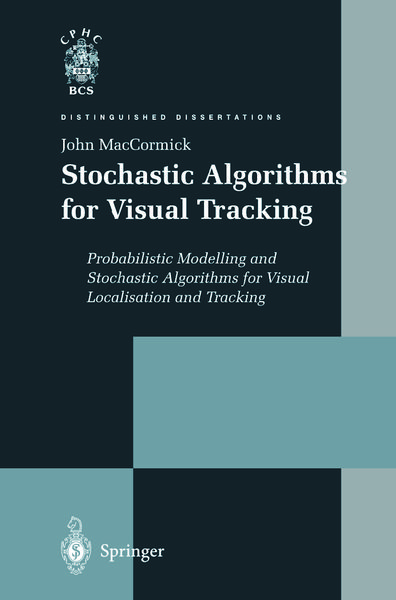
Stochastic Algorithms for Visual Tracking Probabilistic Modelling and Stochastic Algorithms for Visual Localisation and Tracking
Aus der Reihe
Distinguished Dissertations
-
- Englisch ausgewählt
Fr. 138.00
inkl. gesetzl. MwSt.,
Beschreibung
Produktdetails
Einband
Taschenbuch
Erscheinungsdatum
16.09.2011
Abbildungen
IX, 174 p.
Verlag
Springer LondonSeitenzahl
174
Maße (L/B/H)
23.5/15.5/1.1 cm
Gewicht
295 g
Auflage
Softcover reprint of the original 1st edition 2002
Sprache
Englisch
ISBN
978-1-4471-1176-4
A central problem in computer vision is to track objects as they move and deform in a video sequence. Stochastic algorithms -- in particular, particle filters and the Condensation algorithm -- have dramatically enhanced the state of the art for such visual tracking problems in recent years. This book presents a unified framework for visual tracking using particle filters, including the new technique of partitioned sampling which can alleviate the "curse of dimensionality" suffered by standard particle filters. The book also introduces the notion of contour likelihood: a collection of models for assessing object shape, colour and motion, which are derived from the statistical properties of image features. Because of their statistical nature, contour likelihoods are ideal for use in stochastic algorithms. A unifying theme of the book is the use of statistics and probability, which enable the final output of the algorithms presented to be interpreted as the computer's "belief" about the state of the world. The book will be of use and interest to students, researchers and practitioners in computer vision, and assumes only an elementary knowledge of probability theory.
Noch keine Bewertungen vorhanden
Verfassen Sie die erste Bewertung zu diesem Artikel
Helfen Sie anderen Kundinnen und Kunden durch Ihre Meinung.