• Produktbild: Optimization—Theory and Applications
  • Produktbild: Optimization—Theory and Applications
Band 17

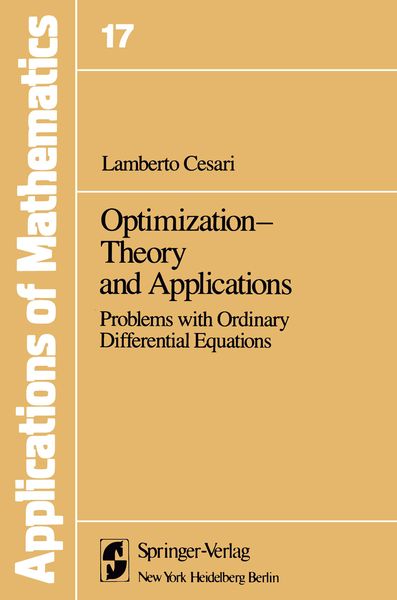
Optimization—Theory and Applications Problems with Ordinary Differential Equations

Fr. 171.00

inkl. gesetzl. MwSt., Versandkostenfrei


Beschreibung

Produktdetails

Einband

Taschenbuch

Erscheinungsdatum

24.10.2011

Verlag

Springer Us

Seitenzahl

542

Maße (L/B/H)

23.5/15.5/3 cm

Gewicht

838 g

Auflage

Softcover reprint of the original 1st ed. 1983

Sprache

Englisch

ISBN

978-1-4613-8167-9

Beschreibung

Produktdetails

Einband

Taschenbuch

Erscheinungsdatum

24.10.2011

Verlag

Springer Us

Seitenzahl

542

Maße (L/B/H)

23.5/15.5/3 cm

Gewicht

838 g

Auflage

Softcover reprint of the original 1st ed. 1983

Sprache

Englisch

ISBN

978-1-4613-8167-9

Herstelleradresse

Springer-Verlag KG
Sachsenplatz 4-6
1201 Wien
AT

Email: GPSR Kontakt

Noch keine Bewertungen vorhanden

Verfassen Sie die erste Bewertung zu diesem Artikel

Helfen Sie anderen Kundinnen und Kunden durch Ihre Meinung.

Kundinnen und Kunden meinen

Bewertungen (0)

  • Produktbild: Optimization—Theory and Applications
  • Produktbild: Optimization—Theory and Applications
  • 1 Problems of Optimization—A General View.- 1.1 Classical Lagrange Problems of the Calculus of Variations.- 1.2 Classical Lagrange Problems with Constraints on the Derivatives.- 1.3 Classical Bolza Problems of the Calculus of Variations.- 1.4 Classical Problems Depending on Derivatives of Higher Order.- 1.5 Examples of Classical Problems of the Calculus of Variations.- 1.6 Remarks.- 1.7 The Mayer Problems of Optimal Control.- 1.8 Lagrange and Bolza Problems of Optimal Control.- 1.9 Theoretical Equivalence of Mayer, Lagrange, and Bolza Problems of Optimal Control. Problems of the Calculus of Variations as Problems of Optimal Control.- 1.10 Examples of Problems of Optimal Control.- 1.11 Exercises.- 1.12 The Mayer Problems in Terms of Orientor Fields.- 1.13 The Lagrange Problems of Control as Problems of the Calculus of Variations with Constraints on the Derivatives.- 1.14 Generalized Solutions.- Bibliographical Notes.- 2 The Classical Problems of the Calculus of Variations: Necessary Conditions and Sufficient Conditions; Convexity and Lower Semicontinuity.- 2.1 Minima and Maxima for Lagrange Problems of the Calculus of Variations.- 2.2 Statement of Necessary Conditions.- 2.3 Necessary Conditions in Terms of Gateau Derivatives.- 2.4 Proofs of the Necessary Conditions and of Their Invariant Character.- 2.5 Jacobi’s Necessary Condition.- 2.6 Smoothness Properties of Optimal Solutions.- 2.7 Proof of the Euler and DuBois-Reymond Conditions in the Unbounded Case.- 2.8 Proof of the Transversality Relations.- 2.9 The String Property and a Form of Jacobi’s Necessary Condition.- 2.10 An Elementary Proof of Weierstrass’s Necessary Condition.- 2.11 Classical Fields and Weierstrass’s Sufficient Conditions.- 2.12 More Sufficient Conditions.- 2.13 Value Function and Further Sufficient Conditions.- 2.14 Uniform Convergence and Other Modes of Convergence.- 2.15 Semicontinuity of Functionals.- 2.16 Remarks on Convex Sets and Convex Real Valued Functions.- 2.17 A Lemma Concerning Convex Integrands.- 2.18 Convexity and Lower Semicontinuity: A Necessary and Sufficient Condition.- 2.19 Convexity as a Necessary Condition for Lower Semicontinuity.- 2.20 Statement of an Existence Theorem for Lagrange Problems of the Calculus of Variations.- Bibliographical Notes.- 3 Examples and Exercises on Classical Problems.- 3.1 An Introductory Example.- 3.2 Geodesics.- 3.3 Exercises.- 3.4 Fermat’s Principle.- 3.5 The Ramsay Model of Economic Growth.- 3.6 Two Isoperimetric Problems.- 3.7 More Examples of Classical Problems.- 3.8 Miscellaneous Exercises.- 3.9 The Integral I = ?(x?2 ? x2)dt.- 3.10 The Integral I = ?xx?2dt.- 3.11 The Integral I = ?x?2(1 + x?)2dt.- 3.12 Brachistochrone, or Path of Quickest Descent.- 3.13 Surface of Revolution of Minimum Area.- 3.14 The Principles of Mechanics.- Bibliographical Notes.- 4 Statement of the Necessary Condition for Mayer Problems of Optimal Control.- 4.1 Some General Assumptions.- 4.2 The Necessary Condition for Mayer Problems of Optimal Control.- 4.3 Statement of an Existence Theorem for Mayer’s Problems of Optimal Control.- 4.4 Examples of Transversality Relations for Mayer Problems.- 4.5 The Value Function.- 4.6 Sufficient Conditions.- 4.7 Appendix: Derivation of Some of the Classical Necessary Conditions of Section 2.1 from the Necessary Condition for Mayer Problems of Optimal Control.- 4.8 Appendix: Derivation of the Classical Necessary Condition for Isoperimetric Problems from the Necessary Condition for Mayer Problems of Optimal Control.- 4.9 Appendix: Derivation of the Classical Necessary Condition for Lagrange Problems of the Calculus of Variations with Differential Equations as Constraints.- Bibliographical Notes.- 5 Lagrange and Bolza Problems of Optimal Control and Other Problems.- 5.1 The Necessary Condition for Bolza and Lagrange Problems of Optimal Control.- 5.2 Derivation of Properties (P1?)—(P4?) from (P1)—(P4).- 5.3 Examples of Applications of the Necessary Conditions for Lagrange Problems of Optimal Control.- 5.4 The Value Function.- 5.5 Sufficient Conditions for the Bolza Problem.- Bibliographical Notes.- 6 Examples and Exercises on Optimal Control.- 6.1 Stabilization of a Material Point Moving on a Straight Line under a Limited External Force.- 6.2 Stabilization of a Material Point under an Elastic Force and a Limited External Force.- 6.3 Minimum Time Stabilization of a Reentry Vehicle.- 6.4 Soft Landing on the Moon.- 6.5 Three More Problems on the Stabilization of a Point Moving on a Straight Line.- 6.6 Exercises.- 6.7 Optimal Economic Growth.- 6.8 Two More Classical Problems.- 6.9 The Navigation Problem.- Bibliographical Notes.- 7 Proofs of the Necessary Condition for Control Problems and Related Topics.- 7.1 Description of the Problem of Optimization.- 7.2 Sketch of the Proofs.- 7.3 The First Proof.- 7.4 Second Proof of the Necessary Condition.- 7.5 Proof of Boltyanskii’s Statements (4.6.iv-v).- Bibliographical Notes.- 8 The Implicit Function Theorem and the Elementary Closure Theorem.- 8.1 Remarks on Semicontinuous Functionals.- 8.2 The Implicit Function Theorem.- 8.3 Selection Theorems.- 8.4 Convexity, Carathéodory’s Theorem, Extreme Points.- 8.5 Upper Semicontinuity Properties of Set Valued Functions.- 8.6 The Elementary Closure Theorem.- 8.7 Some Fatou-Like Lemmas.- 8.8 Lower Closure Theorems with Respect to Uniform Convergence.- Bibliographical Notes.- 9 Existence Theorems: The Bounded, or Elementary, Case.- 9.1 Ascoli’s Theorem.- 9.2 Filippov’s Existence Theorem for Mayer Problems of Optimal Control.- 9.3 Filippov’s Existence Theorem for Lagrange and Bolza Problems of Optimal Control.- 9.4 Elimination of the Hypothesis that A Is Compact in Filippov’s Theorem for Mayer Problems.- 9.5 Elimination of the Hypothesis that A Is Compact in Filippov’s Theorem for Lagrange and Bolza Problems.- 9.6 Examples.- Bibliographical Notes.- 10 Closure and Lower Closure Theorems under Weak Convergence.- 10.1 The Banach-Saks-Mazur Theorem.- 10.2 Absolute Integrability and Related Concepts.- 10.3 An Equivalence Theorem.- 10.4 A Few Remarks on Growth Conditions.- 10.5 The Growth Property (?) Implies Property (Q).- 10.6 Closure Theorems for Orientor Fields Based on Weak Convergence.- 10.7 Lower Closure Theorems for Orientor Fields Based on Weak Convergence.- 10.8 Lower Semicontinuity in the Topology of Weak Convergence.- 10.9 Necessary and Sufficient Conditions for Lower Closure.- Bibliographical Notes.- 11 Existence Theorems: Weak Convergence and Growth Conditions.- 11.1 Existence Theorems for Orientor Fields and Extended Problems.- 112 Elimination of the Hypothesis that A Is Bounded in Theorems (11.1. i-iv).- 11.3 Examples.- 11.4 Existence Theorems for Problems of Optimal Control with Unbounded Strategies.- 11.5 Elimination of the Hypothesis that A Is Bounded in Theorems (11.4.i-v).- 11.6 Examples.- 11.7 Counterexamples.- Bibliographical Notes.- 12 Existence Theorems: The Case of an Exceptional Set of No Growth.- 12.1 The Case of No Growth at the Points of a Slender Set. Lower Closure Theorems..- 12.2 Existence Theorems for Extended Free Problems with an Exceptional Slender Set.- 12.3 Existence Theorems for Problems of Optimal Control with an Exceptional Slender Set.- 12.4 Examples.- 12.5 Counterexamples.- Bibliographical Notes.- 13 Existence Theorems: The Use of Lipschitz and Tempered Growth Conditions.- 13.1 An Existence Theorem under Condition (D).- 13.2 Conditions of the F, G, and H Types Each Implying Property (D) and Weak Property (Q).- 13.3 Examples.- Bibliographical Notes.- 14 Existence Theorems: Problems of Slow Growth.- 14.1 Parametric Curves and Integrals.- 14.2 Transformation of Nonparametric into Parametric Integrals.- 14.3 Existence Theorems for (Nonparametric) Problems of Slow Growth.- 14.4 Examples.- Bibliographical Notes.- 15 Existence Theorems: The Use of Mere Pointwise Convergence on the Trajectories.- 15.1 The Helly Theorem.- 15.2 Closure Theorems with Components Converging Only Pointwise.- 15.3 Existence Theorems for Extended Problems Based on Pointwise Convergence.- 15.4 Existence Theorems for Problems of Optimal Control Based on Pointwise Convergence.- 15.5 Exercises.- Bibliographical Notes.- 16 Existence Theorems: Problems with No Convexity Assumptions.- 16.1 Lyapunov Type Theorems.- 16.2 The Neustadt Theorem for Mayer Problems with Bounded Controls.- 16.3 The Bang-Bang Theorem.- 16.4 The Neustadt Theorem for Lagrange and Bolza Problems with Bounded Controls.- 16.5 The Case of Unbounded Controls.- 16.6 Examples for the Unbounded Case.- 16.7 Problems of the Calculus of Variations without Convexity Assumptions.- Bibliographical Notes.- 17 Duality and Upper Semicontinuity of Set Valued Functions.- 17.1 Convex Functions on a Set.- 17.2 The Function T(x; z).- 17.3 Seminormality.- 17.4 Criteria for Property (Q).- 17.5 A Characterization of Property (Q) for the Sets $$\tilde Q$$(t, x) in Terms of Seminormality.- 17.6 Duality and Another Characterization of Property (Q) in Terms of Duality.- 17.7 Characterization of Optimal Solutions in Terms of Duality.- 17.8 Property (Q) as an Extension of Maximal Monotonicity.- Bibliographical Notes.- 18 Approximation of Usual and of Generalized Solutions.- 18.1 The Gronwall Lemma.- 18.2 Approximation of AC Solutions by Means of C1 Solutions.- 18.3 The Brouwer Fixed Point Theorem.- 18.4 Further Results Concerning the Approximation of AC Trajectories by Means of C1 Trajectories.- 18.5 The Infimum for AC Solutions Can Be Lower than the One for C1 Solutions.- 18.6 Approximation of Generalized Solutions by Means of Usual Solutions.- 18.7 The Infimum for Generalized Solutions Can Be Lower than the One for Usual Solutions.- Bibliographical Notes.- Author Index.