Gutscheinbedingungen

*Gültig bis 20.09.2026 auf (fast) alles. Ausgeschlossen sind Smartboxen, Zeitschriften, Tickets, Lebensmittel, Gaming-Elektroartikel, Tinte/Toner, Gutscheine, Geschenkkarten, Blumen und Abos | Einlösbar in allen Buchhandlungen von Orell Füssli, Barth Bücher, Buchladen Rapunzel, Schuler Orell Füssli, Stauffacher und ZAP unter Vorweisung des Gutscheins, auf www.orellfüssli.ch durch Eingabe des Gutscheincodes. Beim Service „eBooks verschenken“ und bei eBook-Käufen via eReader nicht einlösbar | Mindesteinkaufswert: Fr. 100.- | Nicht mit anderen Rabatten kumulierbar.

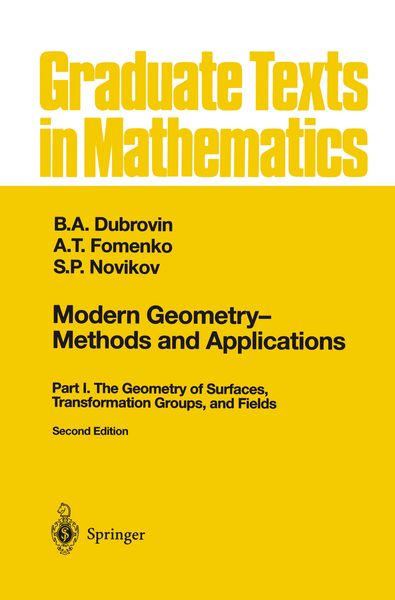
  • Produktbild: Modern Geometry — Methods and Applications
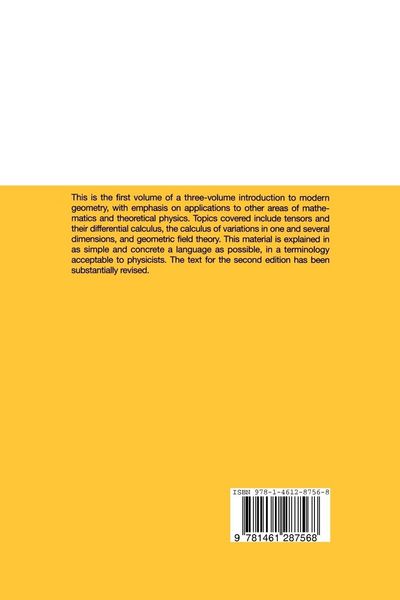
  • Produktbild: Modern Geometry — Methods and Applications
Band 93

Modern Geometry — Methods and Applications Part I: The Geometry of Surfaces, Transformation Groups, and Fields

Fr. 86.90

inkl. gesetzl. MwSt., Versandkostenfrei


Beschreibung

Produktdetails

Einband

Taschenbuch

Erscheinungsdatum

28.10.2011

Abbildungen

XVI, 470 p.

Verlag

Springer Us

Seitenzahl

470

Maße (L/B/H)

23.5/15.5/2.7 cm

Gewicht

739 g

Auflage

2nd ed. 1992

Übersetzt von

R.G. Burns

Sprache

Englisch

ISBN

978-1-4612-8756-8

Beschreibung

Produktdetails

Einband

Taschenbuch

Erscheinungsdatum

28.10.2011

Abbildungen

XVI, 470 p.

Verlag

Springer Us

Seitenzahl

470

Maße (L/B/H)

23.5/15.5/2.7 cm

Gewicht

739 g

Auflage

2nd ed. 1992

Übersetzt von

R.G. Burns

Sprache

Englisch

ISBN

978-1-4612-8756-8

Herstelleradresse

Springer-Verlag KG
Sachsenplatz 4-6
1201 Wien
AT

Email: ProductSafety@springernature.com

Noch keine Bewertungen vorhanden

Verfassen Sie die erste Bewertung zu diesem Artikel

Helfen Sie anderen Kundinnen und Kunden durch Ihre Meinung.

Kundinnen und Kunden meinen

Bewertungen (0)

  • Produktbild: Modern Geometry — Methods and Applications
  • Produktbild: Modern Geometry — Methods and Applications
  • 1 Geometry in Regions of a Space. Basic Concepts.- §1. Co-ordinate systems.- §2. Euclidean space.- §3. Riemannian and pseudo-Riemannian spaces.- §4. The simplest groups of transformations of Euclidean space.- §5. The Serret—Frenet formulae.- §6. Pseudo-Euclidean spaces.- 2 The Theory of Surfaces.- §7. Geometry on a surface in space.- §8. The second fundamental form.- §9. The metric on the sphere.- §10. Space-like surfaces in pseudo-Euclidean space.- §11. The language of complex numbers in geometry.- §12. Analytic functions.- §13. The conformal form of the metric on a surface.- §14. Transformation groups as surfaces in N-dimensional space.- §15. Conformal transformations of Euclidean and pseudo-Euclidean spaces of several dimensions.- 3 Tensors: The Algebraic Theory.- §16. Examples of tensors.- §17. The general definition of a tensor.- §18. Tensors of type (0, k).- §19. Tensors in Riemannian and pseudo-Riemannian spaces.- §20. The crystallographic groups and the finite subgroups of the rotation group of Euclidean 3-space. Examples of invariant tensors.- §21. Rank 2 tensors in pseudo-Euclidean space, and their eigenvalues.- §22. The behaviour of tensors under mappings.- §23. Vector fields.- §24. Lie algebras.- 4 The Differential Calculus of Tensors.- §25. The differential calculus of skew-symmetric tensors.- §26. Skew-symmetric tensors and the theory of integration.- §27. Differential forms on complex spaces.- §28. Covariant differentiation.- §29. Covariant differentiation and the metric.- §30. The curvature tensor.- 5 The Elements of the Calculus of Variations.- §31. One-dimensional variational problems.- §32. Conservation laws.- §33. Hamiltonian formalism.- §34. The geometrical theory of phase space.- §35. Lagrange surfaces.- §36.The second variation for the equation of the geodesics.- 6 The Calculus of Variations in Several Dimensions. Fields and Their Geometric Invariants.- §37. The simplest higher-dimensional variational problems.- §38. Examples of Lagrangians.- §39. The simplest concepts of the general theory of relativity.- §40. The spinor representations of the groups SO(3) and O(3, 1). Dirac’s equation and its properties.- §41. Covariant differentiation of fields with arbitrary symmetry.- §42. Examples of gauge-invariant functionals. Maxwell’s equations and the Yang—Mills equation. Functionals with identically zero variational derivative (characteristic classes).