KI-Beratung Beta

Gutscheinbedingungen

*Gültig bis 08.11.2026 auf (fast) alles. Ausgeschlossen sind tolino shine, Smartboxen, Zeitschriften, Tickets, Lebensmittel, Gaming-Elektroartikel, Tinte/Toner, Gutscheine, Geschenkkarten, Blumen, Dienstleistungen und Abos | Einlösbar in allen Buchhandlungen von Orell Füssli (ausser bei Transa Books), Barth Bücher, Buchladen Rapunzel, Papeterie Köhler, Schuler Orell Füssli, Stauffacher und ZAP unter Vorweisung des Gutscheins, auf orellfüssli.ch durch Eingabe des Gutscheincodes. Beim Service „eBooks verschenken“ und bei eBook-Käufen via eReader nicht einlösbar | Mindesteinkaufswert: Fr. 30.- | Nicht mit anderen Rabatten kumulierbar.

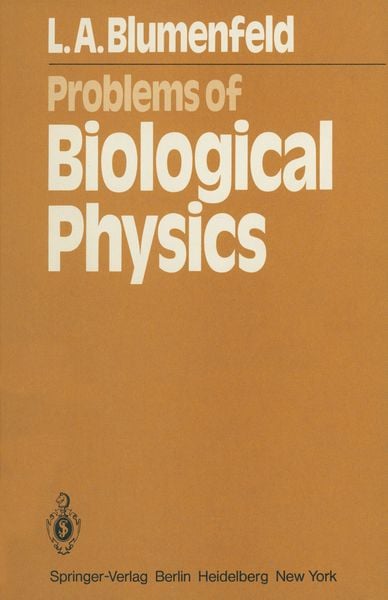
Produktbild: Problems of Biological Physics
Band 7

Problems of Biological Physics

Fr. 72.90

inkl. gesetzl. MwSt., Versandkostenfrei


Beschreibung

Produktdetails

Einband

Taschenbuch

Erscheinungsdatum

16.12.2011

Abbildungen

IX, 224 p.

Herausgeber

Hermann Haken

Verlag

Springer Berlin

Seitenzahl

224

Maße (L/B/H)

24.4/17/1.4 cm

Gewicht

422 g

Auflage

Softcover reprint of the original 1st ed. 1981

Sprache

Englisch

ISBN

978-3-642-67853-0

Herstelleradresse

Springer-Verlag KG
Sachsenplatz 4-6
1201 Wien
AT

Email: ProductSafety@springernature.com

Noch keine Bewertungen vorhanden

Verfassen Sie die erste Bewertung zu diesem Artikel

Helfen Sie anderen Kundinnen und Kunden durch Ihre Meinung.

Kundinnen und Kunden meinen

Bewertungen (0)

  • Produktbild: Problems of Biological Physics
  • 1. Introduction.- 1.1 What is Biophysics?.- 1.2 Cell Components and Their Specific Features.- 1.3 The Aim of the Book.- 2. The Ordering of Biological Structures.- 2.1 Are They so Ordered in Reality?.- 2.2 Entropy and Information.- 2.3 What is the Cost of Biological Ordering?.- 2.4 The Meaning of Biological Ordering.- 2.5 The Necessity of Mechanical Details.- 2.6 The Problems.- 3. Nonequilibrium Thermodynamics and Biological Physics.- 3.1 Open Systems.- 3.2 Phenomenological Relations.- 3.3 Stationary States.- 3.4 Dissipative Structures.- 3.5 Oscillatory Phenomena in Chemistry and Biochemistry.- 3.6 The Problems.- 4. On the Statistical Physics of Biopolymers.- 4.1 Where does Mechanics Begin?.- 4.2 Statistical Physics of a Linear Homopolymer.- 4.3 On the Statistical Nonequilibrium of Biopolymer Structures at Different Levels of Organi zation.- 4.4 On Certain Properties of Biopolymer Structures that Can Be Understood in Terms of Their Statistical-Physical Description.- 5. Conformational and Configurational Changes of Biopolymers.- 5.1 Introductory Remarks.- 5.2 Biopolymer Denaturation.- 5.3 On the Difference Between Activation Energy and Activation Enthalpy.- 5.4 Some Protein Reactions.- 5.5 On the Compensation Effect.- 5.6 On the Validity of the Van’t Hoff and Arrhenius Equations and of the Activated State Theory for Biopolymer Reactions.- 5.7 On Spontaneous Conformational Oscillations of Protein Macromolecules.- 5.8 Conclusions.- 6. The Physics of Enzyme Catalysis.- 6.1 Background.- 6.2 Existing Interpretations of Enzymatic Activity.- 6.3 Conformational Changes as Necessary Steps of Enzymatic Processes.- 6.4 The Effect of Temperature on Enzymes and on the Activation Parameters of Enzyme Reactions.- 6.5 The Physics of Elementary Steps of Enzyme Catalysis [6.69,72,79,80].- 6.6 Dynamic Model for Aspartate-Amino-Transferase.- 6.7 Conclusions.- 7. The Physics of Electron Transfer in Biological Systems.- 7.1 Overview.- 7.2 Free Radicals and Radical Ions in Biochemical Reactions.- 7.3 Electron Transport Chains (ETC) in Mitochondrial and Chloroplast Membranes.- 7.4 Electron Transfer Reactions and Semiconduction in Biological Systems.- 7.5 On the Tunnelling Mechanisms of Electron Transfer Between the ETC Components.- 8. The Physics of Intracellular Energy Transformation and Accumulation.- 8.1 Overview.- 8.2 The ATP Problem.- 8.3 Substrate Phosphorylation.- 8.4 Membrane Phosphorylation: Thermodynamic Aspects.- 8.5 Membrane Phosphorylation: Existing Theories.- 8.6 Some Physical Aspects of Intracellular Energy Transformation as a Relaxation Process.- 9. Conclusion.- References.