
KI-Beratung Beta

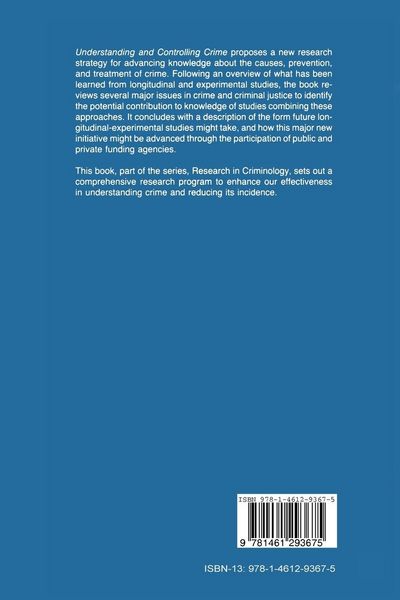
  • Produktbild: Understanding and Controlling Crime
  • Produktbild: Understanding and Controlling Crime

Understanding and Controlling Crime Toward a New Research Strategy

Aus der Reihe Research in Criminology

Fr. 72.90

inkl. gesetzl. MwSt., Versandkostenfrei


Beschreibung

In 1982 the John D. and Catherine T. MacArthur Foundation created a small committee-the Justice Program Study Group (whose membership is listed at the end ofthis preface)-and posed to it what can hardly be regarded as an easy ques tion: "What ideas, what concepts, what basic intellectual frameworks are...

Beschreibung

In 1982 the John D. and Catherine T. MacArthur Foundation created a small committee-the Justice Program Study Group (whose membership is listed at the end ofthis preface)-and posed to it what can hardly be regarded as an easy ques tion: "What ideas, what concepts, what basic intellectual frameworks are lack ing" to understand and to more effectively deal with crime in our society? Those who are acquainted with the work of the members of the Study Group will appreciate how many divergent views were expressed-divergent to the degree that some of us came to the conclusion that we were not a Study Group at all but rather a group being studied, an odd collection of ancient experimental animals serving some dark purpose of the Foundation. Eventually, however, a surprisingly strong concurrence emerged. We found we were impressed by the extent to which in our discussions we placed heavy reliance on the products of two types of research: first, those few longitudinal studies related to juvenile delinquency and crime that had been pursued in this country and, second, a few experimental studies that had sought to measure the consequences of different official interventions in criminal careers. These two research strategies had taught us much about crime and its control. Other strategies-case studies, cross-sectional surveys, participant observations, and similar techniques-had indeed been productive, but it was the longitudinal and experimental designs that firmed up the knowledge that the others helped to discover.

Produktdetails

Einband

Taschenbuch

Erscheinungsdatum

12.10.2011

Abbildungen

211 p.

Verlag Springer Us

Produktdetails

Einband

Taschenbuch

Erscheinungsdatum

12.10.2011

Abbildungen

211 p.

Verlag Springer Us
Seitenzahl

211

Maße (L/B/H)

23.5/15.5/1.3 cm

Gewicht

347 g

Auflage

Softcover reprint of the original 1st ed. 1986

Sprache

Englisch

ISBN

978-1-4612-9367-5

Herstelleradresse

Springer-Verlag GmbH
Tiergartenstr. 17
69121 Heidelberg
DE

Email: ProductSafety@springernature.com

Noch keine Bewertungen vorhanden

Verfassen Sie die erste Bewertung zu diesem Artikel

Helfen Sie anderen Kundinnen und Kunden durch Ihre Meinung.

Kundinnen und Kunden meinen

Bewertungen (0)

  • Produktbild: Understanding and Controlling Crime
  • Produktbild: Understanding and Controlling Crime
  • 1 The Case for a New Crime Research Strategy: An Overview.- 2 What Have We Learned from Major Longitudinal Surveys?.- 3 What Have We Learned from Major Experimental Studies?.- 4 Prevention: Families and Schools.- 5 The Effects of Labeling.- 6 Restructuring the Juvenile Court.- 7 The Effects of Imprisonment.- 8 What Kinds of Longitudinal-Experimental Studies Are Needed?.- References.- Author Index.