Gutscheinbedingungen

*Gültig bis 05.07.2026 auf (fast) alles. Ausgeschlossen sind Smartboxen, Zeitschriften, Tickets, Lebensmittel, Gaming-Elektroartikel, Tinte/Toner, Gutscheine, Geschenkkarten, Blumen und Abos | Einlösbar in allen Buchhandlungen von Orell Füssli, Barth Bücher, Buchladen Rapunzel, Papeterie Köhler, Schuler Orell Füssli, Stauffacher und ZAP unter Vorweisung des Gutscheins, auf www.orellfüssli.ch durch Eingabe des Gutscheincodes. Beim Service „eBooks verschenken“ und bei eBook-Käufen via eReader nicht einlösbar | Mindesteinkaufswert: Fr. 30.- | Nicht mit anderen Rabatten kumulierbar.

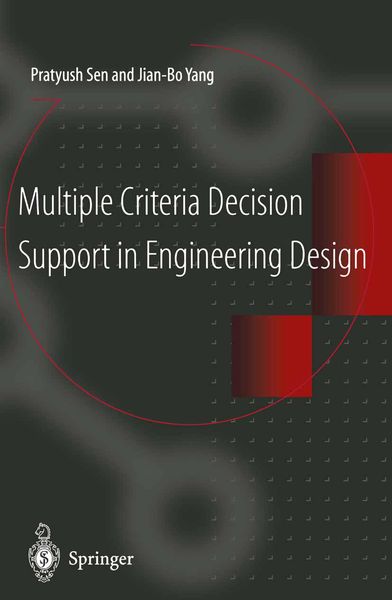
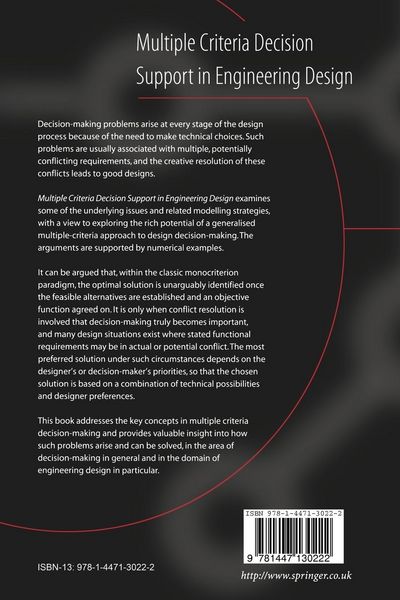
  • Produktbild: Multiple Criteria Decision Support in Engineering Design
  • Produktbild: Multiple Criteria Decision Support in Engineering Design

Multiple Criteria Decision Support in Engineering Design

Fr. 137.00

inkl. gesetzl. MwSt., Versandkostenfrei


Beschreibung

Produktdetails

Einband

Taschenbuch

Erscheinungsdatum

07.12.2011

Verlag

Springer London

Seitenzahl

264

Maße (L/B/H)

23.5/15.5/1.6 cm

Gewicht

450 g

Auflage

Softcover reprint of the original 1st ed. 1998

Sprache

Englisch

ISBN

978-1-4471-3022-2

Beschreibung

Produktdetails

Einband

Taschenbuch

Erscheinungsdatum

07.12.2011

Verlag

Springer London

Seitenzahl

264

Maße (L/B/H)

23.5/15.5/1.6 cm

Gewicht

450 g

Auflage

Softcover reprint of the original 1st ed. 1998

Sprache

Englisch

ISBN

978-1-4471-3022-2

Herstelleradresse

Springer-Verlag KG
Sachsenplatz 4-6
1201 Wien
AT

Email: GPSR Kontakt

Noch keine Bewertungen vorhanden

Verfassen Sie die erste Bewertung zu diesem Artikel

Helfen Sie anderen Kundinnen und Kunden durch Ihre Meinung.

Kundinnen und Kunden meinen

Bewertungen (0)

  • Produktbild: Multiple Criteria Decision Support in Engineering Design
  • Produktbild: Multiple Criteria Decision Support in Engineering Design
  • 1. Introduction.- 1.1 What is Multiple Criteria Decision Making.- 1.2 Relevance of MCDM to Engineering Design.- 1.2.1 The Structure of a Design Problem.- 1.2.2 The Principal Issues in Multiple Criteria Decision Making.- 1.2.3 Issues of Complexity, Subjectivity and Uncertainty.- 1.3 Design Selection vs Design Synthesis.- 1.4 Outline of the Book.- 2. MCDM and The Nature of Decision Making in Design.- 2.1 Introduction.- 2.2 Pareto Optimality: What are the Options?.- 2.3 MCDM Methods and Some Key Terminology.- 2.4 Concluding Comments.- 3. Multiple Attribute Decision Making.- 3.1 Problem Formulations and Method Classification.- 3.1.1 MADM Problems.- 3.1.2 Classification of MADM Methods.- 3.2 Techniques for Weight Assignment.- 3.2.1 Direct Assignment.- 3.2.2 Eigenvector Method.- 3.2.3 Entropy Method.- 3.2.4 Minimal Information Method.- 3.2.4.1 General Pairwise Comparisons and Minimal Information.- 3.2.4.2 Linear Programming Models for Weight Assignment.- 3.2.4.3 An Example.- 3.3 Typical MADM Methods and Applications.- 3.3.1 AHP Method and Application.- 3.3.2 UTA Method and Application.- 3.3.3 TOPSIS Method and Application.- 3.3.4 CODASID Method and Applications.- 3.3.4.1 Information Requirement and Normalization.- 3.3.4.2 New Concordance and Discordance Analyses.- 3.3.4.3 Preference Matrix and CODASID Algorithm.- 3.3.4.4 Applications.- 3.3.5 Comments.- 3.4 A Hierarchical Evaluation Process.- 3.4.1 Design Decision Problems with Subjective Factors.- 3.4.2 A Hierarchical Evaluation Process.- 3.4.3 The Ship Choice Problem.- 3.5 Concluding Comments.- 4. Multiple Objective Decision Making.- 4.1 Multiobjective Optimisation and Method Classification.- 4.1.1 Multiobjective Optimisation and Utility Functions.- 4.1.2 Classification of MODM Methods.- 4.2 Techniques for Single-Objective Optimisation.- 4.2.1 Optimality Conditions.- 4.2.2 Sequential Linear Programming.- 4.2.3 Penalty Methods.- 4.3 Typical MODM Methods.- 4.3.1 Goal Programming.- 4.3.2 Geoffrion’s Method.- 4.3.3 Minimax Method.- 4.3.4 ISTM Method.- 4.3.5 Local Utility Function Method.- 4.4 Multiobjective Ship Design.- 4.4.1 A Nonlinear Preliminary Ship Design Model.- 4.4.2 Generation of Subsets of Efficient Ship Designs.- 4.4.3 Progressive Design.- 4.4.4 Design by Setting Target Values.- 4.4.5 Adaptive and Compromise Design.- 4.5 Concluding Comments.- 5. Multiple Criteria Decision Making and Genetic Algorithms.- 5.1 Introduction.- 5.2 The Mechanics of the Simple Genetic Algorithm.- 5.2.1 Selection, Crossover and Mutation.- 5.2.2 A Bi-Modal Optimisation Problem.- 5.2.3 The Need for a Multiple Criteria Approach.- 5.3 Multiple Criteria Genetic Algorithms.- 5.3.1 Some Comparative Multiple Criteria G A Approaches.- 5.3.2 Common Issues in Multiple Criteria Genetic Algorithms in Engineering Design.- 5.3.3 Crowding and Niching.- 5.3.4 Estimating Niche Sizes.- 5.4 The Multiple Criteria Genetic Algorithm (MCGA): A Summary.- 5.5 A Numerical Example.- 5.6 An MCGA Schedule for a Generalised Job Shop.- 5.6.1 Problem Data.- 5.6.2 String Configuration.- 5.6.3 The Results from MCGA.- 5.7 Concluding Comments.- 6. An Integrated Multiple Criteria Decision Support System.- 6.1 System Structure and Method Selection.- 6.1.1 General Structure of IMC-DSS.- 6.1.2 The Routine Base for MCDM Techniques.- 6.1.3 Rules for Selection of MADM and MODM Methods.- 6.2 Data Base and Model Base.- 6.2.1 Decision Models and File Systems.- 6.2.2 Semi-Automatic Model Generation.- 6.3 A User Interface and Interactive Decision Making.- 6.3.1 Menu-Driven Interfaces.- 6.3.2 A Unified Approach for Generating and Ranking Design.- 6.4 Application of IMC-DSS.- 6.4.1 A Multiattribute Vessel Choice Problem.- 6.4.2 A Multiobjective Semi-Submersible Design Problem.- 6.4.3 Design Using the Unified Approach.- 6.5 Concluding Comments.- 7. Past, Present and the Future.- 7.1 Introduction.- 7.2 Case Studies.- 7.2.1 Designing product development processes to minimize lead times.- 7.2.2 Multicriteria robust optimisation under uncertainty of catamarans from a seakeeping point of view.- 7.3 Concluding Comments.- References.- Topic Index.