• Produktbild: Architecture of Integrated Information Systems
  • Produktbild: Architecture of Integrated Information Systems

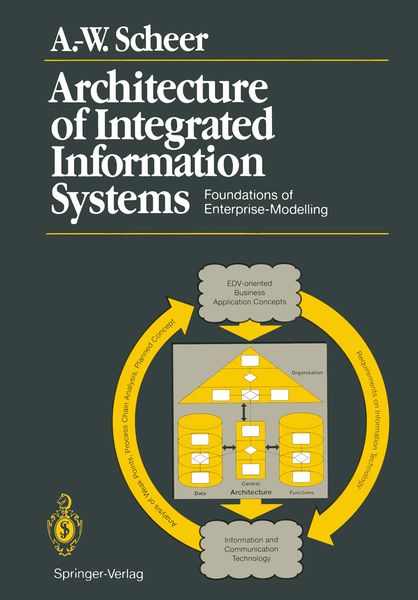
Architecture of Integrated Information Systems Foundations of Enterprise Modelling

Fr. 72.90

inkl. gesetzl. MwSt., Versandkostenfrei


Beschreibung

Produktdetails

Einband

Taschenbuch

Erscheinungsdatum

29.02.2012

Verlag

Springer Berlin

Seitenzahl

219

Maße (L/B/H)

24.4/17/1.4 cm

Gewicht

422 g

Auflage

Softcover reprint of the original 1st ed. 1992

Sprache

Englisch

ISBN

978-3-642-97391-8

Beschreibung

Produktdetails

Einband

Taschenbuch

Erscheinungsdatum

29.02.2012

Verlag

Springer Berlin

Seitenzahl

219

Maße (L/B/H)

24.4/17/1.4 cm

Gewicht

422 g

Auflage

Softcover reprint of the original 1st ed. 1992

Sprache

Englisch

ISBN

978-3-642-97391-8

Herstelleradresse

Springer-Verlag GmbH
Tiergartenstr. 17
69121 Heidelberg
DE

Email: GPSR Kontakt

Kundinnen und Kunden meinen

0 Bewertungen

Informationen zu Bewertungen

Zur Abgabe einer Bewertung ist eine Anmeldung im Konto notwendig. Die Authentizität der Bewertungen wird von uns nicht überprüft. Wir behalten uns vor, Bewertungstexte, die unseren Richtlinien widersprechen, entsprechend zu kürzen oder zu löschen.

Die Bewertungen sind nach Format, Anzahl Sterne und Datum sortiert.

Verfassen Sie die erste Bewertung zu diesem Artikel

Helfen Sie anderen Kund*innen durch Ihre Meinung

Kundinnen und Kunden meinen

0 Bewertungen filtern

  • Produktbild: Architecture of Integrated Information Systems
  • Produktbild: Architecture of Integrated Information Systems
  • A. Conception of the ARIS Architecture for Integrated Information Systems.- A.I The Process Chain Model as Starting Point for Developing the Architecture.- A.II Derivation of the Aris Architecture by Structuring the Process Chain Model.- A.II.1 Concentration on the Transformation of Information.- A.II.2 Creating Views.- A.II.3 Breakdown of the Resource View Using a Phase Model.- A.III Representation of Information Models.- A.IV Comparison of ARIS with other Architectural Concepts.- A.IV.1 IFIP WG 8.1 Architecture.- A.IV.2 CIM-OSA Architecture.- A.IV.3 Further Architectural Approaches in the Literature.- A.IV.4 Architectural Proposals from Computer Suppliers.- A.V Incorporating the Procedural Model for Creating Information Systems.- A.VI Structure of the Remainder of the Book.- A.VI. 1 Organizational Principle.- A.VI.2 Extending the Descriptive Language.- B. Development of the ARIS Information Model (Meta-Information System).- B.I Process Chain Analysis (Recording the Semantic Starting Position).- B.II Modelling the Requirements Definition.- B.II. 1 Requirements Definition of the Function View.- B.II. 1.1 Function Description.- B.II 1.1.1 Function Structure.- B.II. 1.1.2 Operational Sequence.- B.II. 1.1.3 Processing Forms.- B.II. 1.1.4 Decision Models.- B.II. 1.1.5 The Requirements Definition Function Model.- B.II. 1.2 The Procedural Model for Function Modelling (Requirements Definition).- B.II. 1.2.1 Function View of the Procedural Model for Function Modelling.- B.II. 1.2.2 Organization View of the Procedural Model for Function Modelling.- B.II. 1.2.3 Data View of the Procedural Model for Function Modelling.- B.II. 1.2.4 Control View of the Procedural Model for Function Modelling.- B.II.2 Requirements Definition of the Organization View.- B.II.2.1 Organization Description.- B.II.2.1.1 Organizational Structure.- B.II.2.1.2 User Classes.- B.II.2.1.3 The Organization Model.- B.II.2.2 Procedural Model for Organization Modelling.- B.II.2.2.1 Function View.- B.II.2.2.2 Organization View.- B.II.2.2.3 Data View.- B.II.2.2.4 Control View.- B.II.3 Requirements Definition of the Data View.- B.II.3.1 Data Description.- B.II.3.1.1 The Simple ERM.- B.II.3.1.2 The Extended ERM.- B.II.3.2 Procedural Model for Data Modelling.- B.II.3.2.1 Function View.- B.II.3.2.2 Organization View.- B.II.3.2.3 Data View.- B.II.3.2.4 Control View.- B.II.4 Requirements Definition of the Control View.- B.II.4.1 Description of the Control View.- B.II.4.1.1 Linking Functions and Organization.- B.II.4.1.2 Linking Functions and Data.- B.II.4.1.2.1 Event Control.- B.II.4.1.2.2 Data Flow.- B.II.4.1.2.3 Object-Oriented Modelling.- B.II.4.1.3 Linking Organization and Data.- B.II.4.1.4 Linking Functions, Organization and Data.- B.II.4.1.5 The Requirements Definition—Control Model.- B.II.4.2 Procedural Model for the Control Modelling.- B.III Design Specification.- B.III. 1 Design Specification of the Function View.- B.III. 1.1 Module Design.- B.III. 1.2 Mini-Specification.- B.III. 1.3 Output Presentation.- B.III.2 Design Specification of the Organization View.- B.III.2.1 Network Topology.- B.III.2.2 Component Types.- B.III.3 Design Specification of the Data View.- B.III.3.1 Forming Relations.- B.III.3.2 Normalization—Denormalization.- B.III.3.3 Integrity Conditions.- B.III.3.4 Logical Access Paths.- B.III.3.5 Schema for a Database Management System.- B.III.4 Design Specification of the Control View.- B.III.4.1 Linking Module and Organization.- B.III.4.2 Linking Module and Data.- B.III.4.2.1 External Schemata.- B.III.4.2.2 Derivation of Control Structures.- B.III.4.2.3 Database Transactions.- B.III.4.2.4 Trigger Control.- B.III.4.3 Linking Organization and Data.- B.III.4.3.1 Linking User and Data.- B.III.4.3.2 Linking Organizational Units and Data: Distributed Databases.- B.III.4.4 Linking Module, Organization and Data (Distributed Data Processing).- B.IV Design of the Implementation Description.- B.IV.1 Implementation Description of the Function View.- B.IV.2 Implementation Description of the Organization View.- B. IV.3 Implementation Description of the Data View.- B.IV.3.1 Storage.- B.IV.3.2 Storage Assignment.- B.IV.4 Implementation Description of the Control View.- B.V The ARIS Information Model.- References.