• Produktbild: Panic and Phobias
  • Produktbild: Panic and Phobias

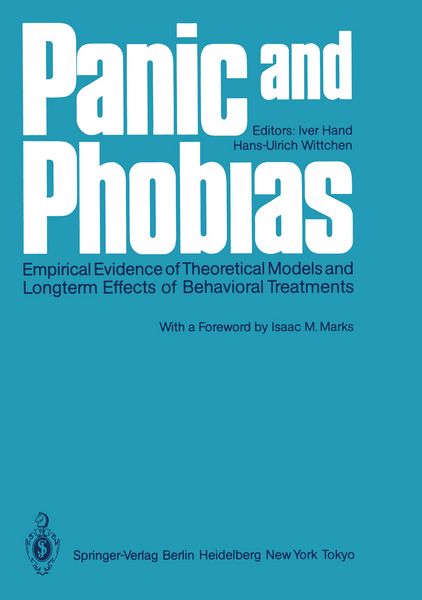
Panic and Phobias Empirical Evidence of Theoretical Models and Longterm Effects of Behavioral Treatments

Fr. 137.00

inkl. gesetzl. MwSt., Versandkostenfrei


Beschreibung

Produktdetails

Einband

Taschenbuch

Erscheinungsdatum

17.11.2011

Herausgeber

Iver Hand + weitere

Verlag

Springer Berlin

Seitenzahl

130

Maße (L/B/H)

24.4/17/0.9 cm

Gewicht

269 g

Auflage

Softcover reprint of the original 1st ed. 1986

Sprache

Englisch

ISBN

978-3-642-71167-1

Beschreibung

Portrait

Prof. Dr. Iver Hand ist ärztlicher Leiter des Arbeitsbereichs Verhaltenstherapie am Universitätsklinikum Eppendorf in Hamburg. Forschungsschwerpunkt: Verhaltenstherapie (Dozent und Supervisor an Ausbildungsinstituten), Angst und Panikstörungen (neurobiologische und physiologische Grundlagen).

Produktdetails

Einband

Taschenbuch

Erscheinungsdatum

17.11.2011

Herausgeber

Verlag

Springer Berlin

Seitenzahl

130

Maße (L/B/H)

24.4/17/0.9 cm

Gewicht

269 g

Auflage

Softcover reprint of the original 1st ed. 1986

Sprache

Englisch

ISBN

978-3-642-71167-1

Herstelleradresse

Springer-Verlag KG
Sachsenplatz 4-6
1201 Wien
AT

Email: GPSR Kontakt

Noch keine Bewertungen vorhanden

Verfassen Sie die erste Bewertung zu diesem Artikel

Helfen Sie anderen Kundinnen und Kunden durch Ihre Meinung.

Kundinnen und Kunden meinen

Bewertungen (0)

  • Produktbild: Panic and Phobias
  • Produktbild: Panic and Phobias
  • 1. Introduction.- I. Diagnostic Reliability and Epidemiology of DSM-III Anxiety Disorders.- 2. Diagnostic Reliability of Anxiety Disorders.- 1. Introduction.- 2. Definition and Classification of Anxiety Disorders.- 3. Aims.- 4. Methods.- 5. Results.- 5.1. Diagnostic Test-Retest Reliability.- 5.2. Test-Retest Reliability of Symptom Questions.- 5.3. Comparison of Two Diagnostic Methods (DSM-III checklist versus CIDI).- 6. Discussion.- 7. References.- 3. Epidemiology of Panic Attacks and Panic Disorders.- 1. Introduction: Contribution of Epidemiological Data to the Classification of Anxiety Disorders.- 2. Aims.- 3. Methods.- 3.1. Description of the Munich Follow-up Study (MFS).- 3.2. Design and Instruments.- 3.3. Data from the NIMH Epidemiological Catchment Area (ECA) Program.- 3.4. Analysis.- 4. Results.- 4.1. Prevalence Rates and Biosocial Characteristics of DSM-III Anxiety Disorders.- 4.2. Frequencies of Symptoms and Syndromes Related to Panic Disorders.- 4.3. Age of Onset of Anxiety Disorders.- 5. Discussion.- 6. References.- II. Theoretical Models and Empirical Evidence.- 4. Panic Attacks: Theoretical Models and Empirical Evidence.- 1. Introduction.- 2. Biological Models of Panic Attacks.- 2.1. Klein’s and Sheehan’s Models.- 2.2. Empirical Evidence.- 2.2.1. Specificity of Drug Treatments.- 2.2.2. Panic Induction.- 2.2.3. Family and Twin Studies.- 2.2.4. Spontaneity of Panic Attacks.- 2.2.5. Separation Anxiety and School Phobia.- 3. Psychophysiological Models of Panic Attacks.- 3.1. Principles of Psychophysiological Models.- 3.2. Empirical Evidence.- 3.2.1. Positive Feedback Loops in Panic.- 3.2.2. Role of Cognitions.- 3.2.3. Role of Hyperventilation.- 3.2.4. Role of Cardiovascular Events.- 3.2.5. Role of Vestibular Dysfunction.- 4. Discussion and Conclusions.- 5. References.- 5. Experimental Panic: Biobehavioral Notes on Empirical Findings.- 1. Introduction.- 2. Phobias.- 2.1 Some Behavioral Models.- 2.2 Biological Aspects of Behavioral Models of Phobias.- 3. Panic.- 3.1 Biological Models.- 3.2 Behavioral Aspects of Pharmacological Panic Models.- 4. Concluding Remarks.- 5. References.- 6. Experimental Induction of Panic Attacks.- 1. Introduction.- 2. Sodium Lactate and Carbon Dioxide as Panic Challenges — Historical Development.- 2.1. Lactate Infusion and Panic Attacks.- 2.2. Carbon Dioxide Inhalation and Panic Attacks.- 3. Results of Panic Induction Studies.- 3.1. Effects of Lactate and CO2.- 3.1.1. Self-Reported Anxiety and Symptoms.- 3.1.2. Physiological Effects.- 3.1.3. Biochemical Effects.- 3.2. Incidence of Lactate and CO2-Induced Panic Attacks.- 3.3. Similarity of Laboratory-Induced and Naturally Occurring Panic.- 4. Panic Induction: Limitations and Open Questions.- 4.1. Methodological Considerations.- 4.2. Sensitivity and Specificity of Panic Challenges.- 4.3. Relevance of Baseline Levels of Anxiety and Arousal.- 5. Two Studies on Panic Induction.- 6. Discussion and Conclusions.- 7. References.- 7. Agoraphobia and the Hyperventilation Syndrome — the Role of Interpretations of Complaints.- 1. Introduction.- 2. Methods.- 3. Results.- 4. Discussion.- 5. References.- 8. Panic Disorder — Overlap with Symptoms of Somatization Disorder.- 1. Introduction.- 2. Methods.- 2.1. Subjects.- 2.2. The Self-Report Inventory for Somatic Symptoms (SISS).- 2.3. Procedure.- 3. Results.- 3.1. Psychometric Properties of the SISS.- 3.2. Differences between Panic and Control Groups.- 3.3. Relationship between Phobic Avoidance and Major Depression.- 3.4. Relationships with Other Measures.- 4. Discussion.- 5. References.- III. Treatments and Longterm Outcome of Phobias with Panic Attacks.- 9. Longterm Efficacy of Exposure in-Vivo for Cardiac Phobia.- 1. Introduction.- 2. Description of our Exposure Therapy Package.- 2.1. Diagnostic Phase.- 2.2. Cognitive Preparation.- 2.3. Intense Exposure in-Vivo.- 2.4. Self-Control.- 3. Goals and Design of our Study.- 4. Methods.- 4.1. Patients and Therapists.- 4.2. Assessment.- 4.2.1. Questionnaire Measures.- 4.2.2. Behavioral Test.- 4.2.3. Other Symptom-Relevant Variables.- 5. Results.- 5.1. Results for the Entire Patient Group.- 5.1.1. Questionnaire Measures.- 5.1.2. Behavioral Test.- 5.1.3. Other Symptom-Relevant Variables.- 5.2. Comparison of Groups A and B.- 6. Discussion.- 7. References.- 10. Cognitive and Physiological Processes in the Maintainance and Treatment of Panic Attacks.- 1. Introduction.- 2. Effectiveness of Treatment Based on the Cognitive Model of Panic.- 3. Interpretation of Treatment Studies.- 4. Effects of Stress and Panic on Respiration in Panic Patients.- 5. Discussion.- 6. Conclusions.- 7. References.- 11. Exposure In-Vivo with Panic Management for Agoraphobia: Treatment Rationale and Longterm Outcome.- 1. Introduction.- 2. Experimental Design.- 2.1. Treatments: Exposure In-Vivo and Panic Management.- 2.2. Patients.- 2.3. Assessments.- 3. Results.- 3.1. Outcome for Total Patient Sample.- 3.1.1. Symptom Scales: Prospective Follow-Up.- 3.1.2. Interview Data: Retrospective Follow-Up.- 3.1.3. Comparison of Outcome with Three Different Modes of Exposure.- 3.2. Outcome of Mild Agoraphobia.- 3.3. Outcome of Severe Agoraphobia.- 3.3.1. Comparison of Outcome with Group Exposure and Home Based Treatment.- 3.3.2. Comparison of Gainers and Losers.- 3.3.3. Level of Multisymptomatic Disturbance and Outcome in Agoraphobia.- 3.3.4. Changes During Follow-Up.- 4. Summary and Discussion.- 5. References.