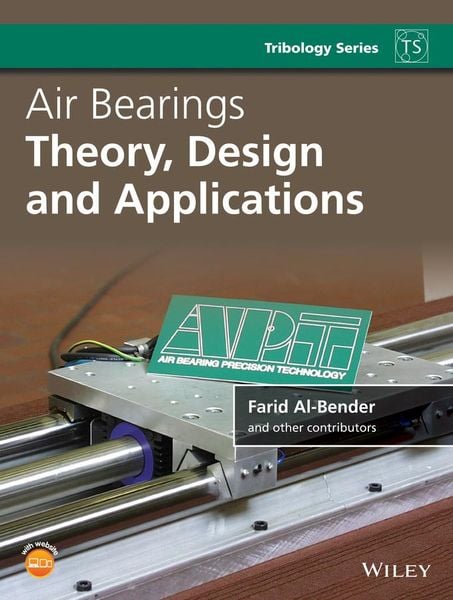

Air Bearings Theory, Design and Applications
Aus der Reihe
Tribology in Practice Series (PEP)
Fr. 179.00
inkl. gesetzl. MwSt.,
Beschreibung
Produktdetails
Einband
Gebundene Ausgabe
Erscheinungsdatum
19.01.2021
Verlag
John Wiley & SonsSeitenzahl
592
Maße (L/B/H)
26/21/4 cm
Gewicht
1635 g
Auflage
1. Auflage
Sprache
Englisch
ISBN
978-1-118-51149-7
Comprehensive treatise on gas bearing theory, design and application
This book treats the fundamental aspects of gas bearings of different configurations (thrust, radial, circular, conical) and operating principles (externally pressurized, self-acting, hybrid, squeeze), guiding the reader throughout the design process from theoretical modelling, design parameters, numerical formulation, through experimental characterisation and practical design and fabrication.
The book devotes a substantial part to the dynamic stability issues (pneumatic hammering, sub-synchronous whirling, active dynamic compensation and control), treating them comprehensively from theoretical and experimental points of view.
Key features:
* Systematic and thorough treatment of the topic.
* Summarizes relevant previous knowledge with extensive references.
* Includes numerical modelling and solutions useful for practical application.
* Thorough treatment of the gas-film dynamics problem including active control.
* Discusses high-speed bearings and applications.
Air Bearings: Theory, Design and Applications is a useful reference for academics, researchers, instructors, and design engineers. The contents will help readers to formulate a gas-bearing problem correctly, set up the basic equations, solve them establishing the static and dynamic characteristics, utilise these to examine the scope of the design space of a given problem, and evaluate practical issues, be they in design, construction or testing.
This book treats the fundamental aspects of gas bearings of different configurations (thrust, radial, circular, conical) and operating principles (externally pressurized, self-acting, hybrid, squeeze), guiding the reader throughout the design process from theoretical modelling, design parameters, numerical formulation, through experimental characterisation and practical design and fabrication.
The book devotes a substantial part to the dynamic stability issues (pneumatic hammering, sub-synchronous whirling, active dynamic compensation and control), treating them comprehensively from theoretical and experimental points of view.
Key features:
* Systematic and thorough treatment of the topic.
* Summarizes relevant previous knowledge with extensive references.
* Includes numerical modelling and solutions useful for practical application.
* Thorough treatment of the gas-film dynamics problem including active control.
* Discusses high-speed bearings and applications.
Air Bearings: Theory, Design and Applications is a useful reference for academics, researchers, instructors, and design engineers. The contents will help readers to formulate a gas-bearing problem correctly, set up the basic equations, solve them establishing the static and dynamic characteristics, utilise these to examine the scope of the design space of a given problem, and evaluate practical issues, be they in design, construction or testing.
Noch keine Bewertungen vorhanden
Verfassen Sie die erste Bewertung zu diesem Artikel
Helfen Sie anderen Kundinnen und Kunden durch Ihre Meinung.