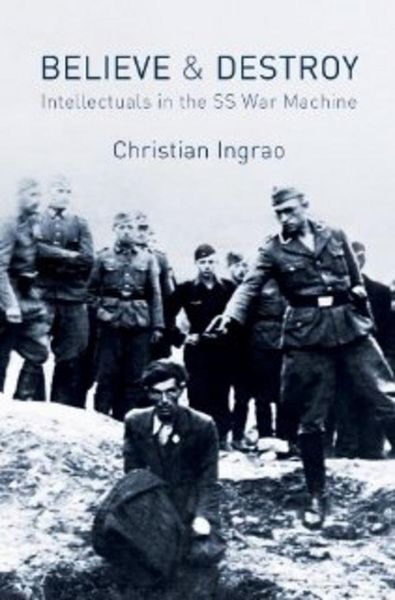
Produktbild: Believe and Destroy

Believe and Destroy Intellectuals in the SS War Machine

Fr. 113.00

inkl. gesetzl. MwSt., Versandkostenfrei


Beschreibung

Produktdetails

Einband

Gebundene Ausgabe

Erscheinungsdatum

01.05.2013

Verlag

John Wiley & Sons Inc

Seitenzahl

432

Maße (L/B/H)

23.6/15.6/4 cm

Gewicht

746 g

Auflage

1. Auflage

Übersetzt von

Andrew Jr Brown

Sprache

Englisch

ISBN

978-0-7456-6026-4

Beschreibung

Rezension

"a thoughtful, well researched, and well written addition to the field of perpetrator studies--a work that illustrates convincingly the role of Germany's "best and brightest" in the prosecution of genocide."
Holocaust and Genocide Studies
"A chilling collective portrait of a generation blinded by the fervor of their ideology and oblivious to the suffering of others."
Wall Street Journal
"Packed with useful information on this important Nazi cadre."
Standpoint
"Presents gripping accounts of particular spectacles of violence and their role in imposing order."
Los Angeles Review of Books
"With this quest for understanding in mind, Ingrao has undertaken what is clearly a mammoth historical task, and ultimately written an astonishingly profound and in-depth book on a subject that ought never be forgotten."
David Marx Book Reviews
"This is an important and original study of ideology and experience rather than yet another catalogue of crime, and it therefore offers a different and powerful explanation for how educated men became perpetrators of mass murder."
Richard Evans, University of Cambridge
"How did highly educated German intellectuals of a certain generation make themselves into believing Nazis, career-minded ideologues, and practitioners of terror? In compelling detail and in a manner consistent with the best accomplishments of recent scholarship, Christian Ingrao guides us astutely and assuredly through this shockingly normalized interior world."
Geoffrey Eley, University of Michigan

Zitat

"A chilling collective portrait of a generation blinded by the fervor of their ideology and oblivious to the suffering of others." Wall Street Journal "Packed with useful information on this important Nazi cadre." Standpoint "This is an important and original study of ideology and experience rather than yet another catalogue of crime, and it therefore offers a different and powerful explanation for how educated men became perpetrators of mass murder." Richard Evans, University of Cambridge "How did highly educated German intellectuals of a certain generation make themselves into believing Nazis, career-minded ideologues, and practitioners of terror? In compelling detail and in a manner consistent with the best accomplishments of recent scholarship, Christian Ingrao guides us astutely and assuredly through this shockingly normalized interior world." Geoffrey Eley, University of Michigan

Produktdetails

Einband

Gebundene Ausgabe

Erscheinungsdatum

01.05.2013

Verlag

John Wiley & Sons Inc

Seitenzahl

432

Maße (L/B/H)

23.6/15.6/4 cm

Gewicht

746 g

Auflage

1. Auflage

Übersetzt von

Andrew Jr Brown

Sprache

Englisch

ISBN

978-0-7456-6026-4

Herstelleradresse

Libri GmbH
Europaallee 1
36244 Bad Hersfeld
DE

Email: GPSR Kontakt

Noch keine Bewertungen vorhanden

Verfassen Sie die erste Bewertung zu diesem Artikel

Helfen Sie anderen Kundinnen und Kunden durch Ihre Meinung.

Kundinnen und Kunden meinen

Bewertungen (0)

Die Leseprobe wird geladen.
  • Produktbild: Believe and Destroy
  • Foreword

    Acknowledgments

    Glossary

    PART ONE: The young men of Germany

    Chapter 1: A 'world of enemies' (I)

    The outbreak of war

    The silence of the Akademiker

    The 'time of troubles': an experience of war?

    Chapter 2: Constructing networks

    Places to study

    Places of association

    Networks of solidarity

    Chapter 3: Activist intellectuals

    The construction of academic knowledge

    Knowledge and activism (1919-1933)

    'Combative science' and SS intellectuals in the Third Reich

    The shadow of the Great War

    PART TWO: Joining the Nazis: a commitment

    Chapter 4: Being a Nazi

    The foundations of the doctrine

    The origins of Nazi fervour: planning a sociobiological

    re-establishment

    The appropriation of a system of beliefs

    Chapter 5: Entering the SD

    Whether to enter the Party or not?

    Towards the SD: Nazi careers

    Recruitment: a social mechanism of enlistenment

    Chapter 6: From struggle to control

    From the 'Security Department of the SS' (SD) to

    the 'Reich Security Main Office' (RSHA)

    A 'world of enemies' (II)

    Control

    PART THREE : Nazism and violence: the culmination 1939-1945

    Chapter 7: Thinking the east, between utopia and anxiety

    The curse of Germanic isolation

    The Nazi project for a sociobiological re-establishment

    Redevelop and settle: forms of Nazi fervour

    Chapter 8: Arguing for war: Nazi rhetoric

    From the reparative war to the 'Great Racial War'

    From the discourse of security to the discourse of genocide

    Expressing violence: defensive rhetorics, utopian rhetorics

    Chapter 9: Violence in action

    The experience of violence

    Demonstrative violence, violence of eradication

    A transgressive violence

    Violence as rite of initiation

    Chapter 10: SS intellectuals confronting defeat

    Defeat rendered unreal

    Finis Germaniae. The return of the old anxiety

    The denouement

    Chapter 11: SS intellectuals on trial

    Strategies of negation

    Strategies of evasion

    Strategies of justification: the Ohlendorf case

    Conclusion: Memory of war, activism and genocide

    Notes

    Sources and bibliography

    A piece of research and its context

    A specific conceptual framework

    List of archival collections consulted

    Printed sources

    Bibliography