KI-Beratung Beta

  • Produktbild: Heterogeneous Networks in LTE-Advanced
  • Produktbild: Heterogeneous Networks in LTE-Advanced

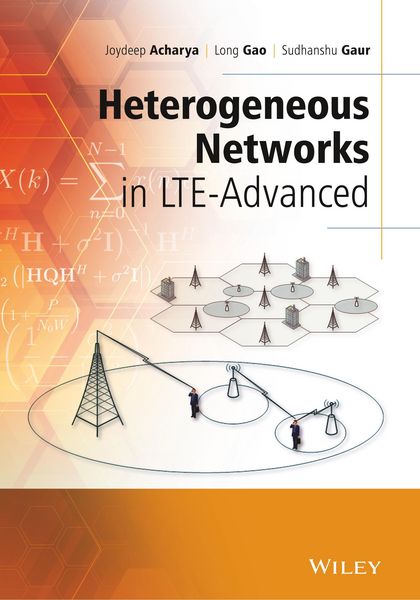
Heterogeneous Networks in LTE-Advanced

Fr. 159.00

inkl. gesetzl. MwSt., Versandkostenfrei


Beschreibung

A comprehensive summary of theoretical and practical developments in LTE Heterogeneous Networks   The last decade has witnessed the proliferation of mobile broadband data and the trend is likely to increase in the coming years. Current cellular networks are ill equipped to deal with this surge in demand....

Beschreibung

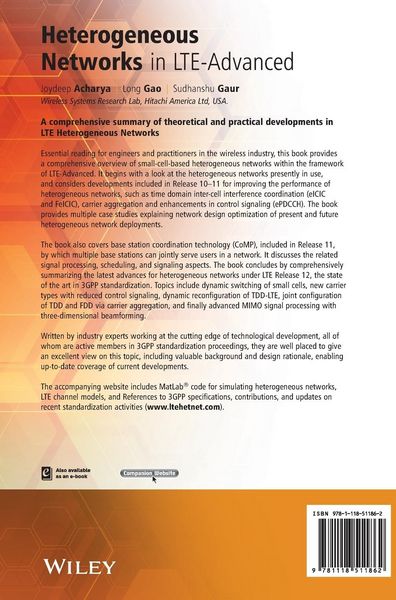
A comprehensive summary of theoretical and practical developments in LTE Heterogeneous Networks
 
The last decade has witnessed the proliferation of mobile broadband data and the trend is likely to increase in the coming years. Current cellular networks are ill equipped to deal with this surge in demand. To satisfy user demand and maximize profits, a new paradigm to operate networks is needed. Heterogeneous networks, that deploy an overlay of small cells with limited coverage and transmit power, over a macro coverage area is the solution by providing capacity and coverage where it is needed.
 
This book presents a comprehensive overview of small cell based heterogeneous networks within the framework of 3GPP LTE-Advanced which is the major enabler of current and future heterogeneous networks. The book first establishes the basics of LTE standards 8 -10. Wherever relevant, the underlying theory of wireless communications is explained and the signaling and protocol aspects of LTE Releases 8-10 are presented. Next the book presents a systematic study of the inter cell interference (eICIC and FeICIC) mechanisms that have been standardized in LTE releases 10 and 11 to mitigate the interference arising in heterogeneous networks. From simple blank subframe design and implementation, the book discusses more advanced transceiver signal processing and carrier aggregation (CA) based mechanisms to improve performance. Besides data, control channel enhancements such as enhanced PDCCH (ePDCCH) are also discussed.
 
Subsequently the book discusses the possibility of base stations being allowed to coordinate to manage interference. This technique, called CoMP, has the potential of vastly improving network performance. However several practical challenges first have to be overcome before this potential can be realized. The book presents the different CoMP categories introduced in LTE release 11, the required signal processing and the changes that were introduced in Release-11 for supporting CoMP. The book then presents the state of the art developments in heterogeneous networks that are currently taking place in 3GPP with the initiation of Release 12. A whole array of new technologies have been introduced such as dynamic switching of small cells, new carrier types with reduced control signaling, dynamic reconfiguration of TDD-LTE, joint configuration of TDD and FDD via carrier aggregation and lastly advanced MIMO signal processing with three dimensional beamforming. All these technologies will work in unison leading to efficient operations of small cells.
 
The authors thus comprehensively summarize the advances in heterogeneous networks over the last couple of years as reflected in various LTE releases and then look ahead at what to expect in the future. Fully illustrated throughout and with an accompanying website including Matlab code for simulating heterogeneous networks, LTE channel models, and References to 3GPP specifications, contributions, and updates on recent standardization activities. The authors, being involved in LTE standardization, are well placed to give an excellent view on this topic, including valuable background and design rationale.
* A comprehensive summary of wireless communications theory and practical developments in LTE heterogeneous networks.
* Authors are experts in this field and are active members in standardization proceedings, enabling up-to-date coverage of current developments
* Multiple case studies explain network design optimization of various heterogeneous network deployments.
* Accompanying website includes Matlab code for simulating heterogeneous networks, LTE channel models, and References to 3GPP specifications, contributions, and updates on recent standardization activities
 
Essential reading for Engineers and practitioners in wireless industry.
Produktdetails

Einband

Gebundene Ausgabe

Erscheinungsdatum

12.05.2014

Verlag John Wiley & Sons Inc
Seitenzahl

296

Produktdetails

Einband

Gebundene Ausgabe

Erscheinungsdatum

12.05.2014

Verlag John Wiley & Sons Inc
Seitenzahl

296

Maße (L/B/H)

25/17.5/2.1 cm

Gewicht

696 g

Auflage

1. Auflage

Sprache

Englisch

ISBN

978-1-118-51186-2

Herstelleradresse

Libri GmbH
Europaallee 1
36244 Bad Hersfeld
DE

Email: gpsr@libri.de

Noch keine Bewertungen vorhanden

Verfassen Sie die erste Bewertung zu diesem Artikel

Helfen Sie anderen Kundinnen und Kunden durch Ihre Meinung.

Kundinnen und Kunden meinen

Bewertungen (0)

Die Leseprobe wird geladen.
  • Produktbild: Heterogeneous Networks in LTE-Advanced
  • Produktbild: Heterogeneous Networks in LTE-Advanced
  • About the Authors xi
     
    Foreword xiii
     
    Preface xv
     
    Acknowledgements xvii
     
    List of Acronyms xix
     
    1 An Introduction to Heterogeneous Networks 1
     
    1.1 Introduction 1
     
    1.2 Heterogeneous Network Deployments 3
     
    1.2.1 Distributed Antenna Systems 3
     
    1.2.2 Public Access Picocells/Metrocells 4
     
    1.2.3 Consumer-Grade Femtocells 4
     
    1.2.4 WiFi Systems 5
     
    1.3 Features of Heterogeneous Networks 5
     
    1.3.1 Association and Load Balancing 5
     
    1.3.2 Interference Management 6
     
    1.3.3 Self-Organizing Networks 6
     
    1.3.4 Mobility Management 7
     
    1.4 Evolution of Cellular Technology and Standards 7
     
    1.4.1 3GPP Standardization Process 9
     
    References 10
     
    Part I OVERVIEW
     
    2 Fundamentals of LTE 15
     
    2.1 Introduction 15
     
    2.2 LTE Core Network 17
     
    2.2.1 Control Plane 18
     
    2.2.2 User Plane 19
     
    2.2.3 Practical Implementations of the Core Network 19
     
    2.3 LTE Radio Access Network 20
     
    2.3.1 Control Plane 20
     
    2.3.2 User Plane 23
     
    2.4 Connectivity Among eNodeBs: The X2 Interface 24
     
    2.4.1 Load- and Interference-Related Information 26
     
    2.4.2 Handover-Related Information 26
     
    2.5 Technologies in LTE 27
     
    2.5.1 Orthogonal Frequency Division Multiplexing 27
     
    2.5.2 Multiple Antenna Communications 36
     
    References 42
     
    3 LTE Signal Structure and Physical Channels 45
     
    3.1 Introduction 45
     
    3.2 LTE Signal Structure 45
     
    3.3 Introduction to LTE Physical Channels and Reference Signals 48
     
    3.4 Resource Block Assignment 51
     
    3.5 Downlink Physical Channels 54
     
    3.5.1 Physical Broadcast Channel (PBCH) 55
     
    3.5.2 Physical Downlink Shared Channel (PDSCH) 57
     
    3.5.3 Physical Multicast Channel (PMCH) 58
     
    3.5.4 Physical Control Format Indicator Channel (PCFICH) 58
     
    3.5.5 Physical Hybrid ARQ Indicator Channel (PHICH) 59
     
    3.5.6 Physical Downlink Control Channel (PDCCH) 60
     
    3.6 Uplink Physical Channels 67
     
    3.6.1 Physical Uplink Shared Channel (PUSCH) 67
     
    3.6.2 Physical Uplink Control Channel (PUCCH) 68
     
    3.6.3 Physical Random Access Channel (PRACH) 70
     
    References 71
     
    4 Physical Layer Signal Processing in LTE 73
     
    4.1 Introduction 73
     
    4.2 Downlink Synchronization Signals 73
     
    4.2.1 Primary Synchronization Signal 74
     
    4.2.2 Secondary Synchronization Signal 76
     
    4.3 Reference Signals 77
     
    4.3.1 Downlink Reference Signals 77
     
    4.3.2 Uplink Reference Signals 84
     
    4.4 Channel Estimation and Feedback 85
     
    4.4.1 Basics of Link Adaptation 85
     
    4.4.2 Feedback for MIMO OFDM Channels 88
     
    4.4.3 New Features in LTE-Advanced 92
     
    4.5 Design Paradigm of LTE Signaling 94
     
    4.6 Scheduling and Resource Allocation 94
     
    4.6.1 Scheduling Algorithms 96
     
    4.6.2 Inter-eNodeB Coordination for Resource Allocation in LTE 98
     
    References 100
     
    Part II INTER-CELL INTERFERENCE COORDINATION
     
    5 Release 10 Enhanced ICIC 103
     
    5.1 Introduction 103
     
    5.2 Typical Deployment Scenarios 103
     
    5.2.1 Macro-Pico Deployment Scenario 104
     
    5.2.2 Macro-Femto Deployment Scenario 107
     
    5.3 Time Domain Techniques 110
     
    5.3.1 Almost Blank Subframe 110
     
    5.3.2 ABS Use Cases 113
     
    5.3.3 UE Measurement and Reporting 116
     
    5.3.4 Backhaul Support 118
     
    5.3.5 Simulation Results 119
     
    5.4 Power Control Techniques 12