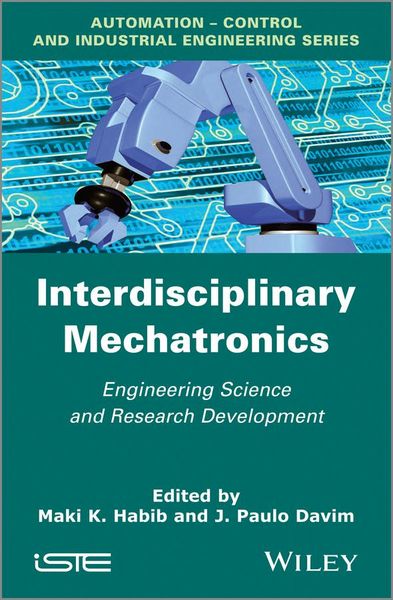
Interdisciplinary Mechatronics Engineering Science and Research Development
Fr. 248.00
inkl. gesetzl. MwSt.,
Beschreibung
Produktdetails
Einband
Gebundene Ausgabe
Erscheinungsdatum
20.05.2013
Herausgeber
M. K. Habib + weitereVerlag
John Wiley & SonsSeitenzahl
624
Maße (L/B/H)
23.4/15.5/3.8 cm
Gewicht
1043 g
Auflage
1. Auflage
Sprache
Englisch
ISBN
978-1-84821-418-7
Mechatronics represents a unifying interdisciplinary and intelligent engineering science paradigm that features an interdisciplinary knowledge area and interactions in terms of the ways of work and thinking, practical experiences, and theoretical knowledge. Mechatronics successfully fuses (but is not limited to) mechanics, electrical, electronics, informatics and intelligent systems, intelligent control systems and advanced modeling, intelligent and autonomous robotic systems, optics, smart materials, actuators and biomedical and biomechanics, energy and sustainable development, systems engineering, artificial intelligence, intelligent computer control, computational intelligence, precision engineering and virtual modeling into a unified framework that enhances the design of products and manufacturing processes. Interdisciplinary Mechatronics concerns mastering a multitude of disciplines, technologies, and their interaction, whereas the science of mechatronics concerns the invention and development of new theories, models, concepts and tools in response to new needs evolving from interacting scientific disciplines. The book includes two sections, the first section includes chapters introducing research advances in mechatronics engineering, and the second section includes chapters that reflects the teaching approaches (theoretical, projects, and laboratories) and curriculum development for under- and postgraduate studies. Mechatronics engineering education focuses on producing engineers who can work in a high-technology environment, emphasize real-world hands-on experience, and engage in challenging problems and complex tasks with initiative, innovation and enthusiasm. Contents: 1. Interdisciplinary Mechatronics Engineering Science and the Evolution of Human Friendly and Adaptive Mechatronics, Maki K. Habib. 2. Micro-Nanomechatronics for Biological Cell Analysis and Assembly, Toshio Fukuda, Masahiro Nakajima, Masaru Takeuchi, Tao Yue and Hirotaka Tajima. 3. Biologically Inspired CPG-Based Locomotion Control System of a Biped Robot Using Nonlinear Oscillators with Phase Resetting, Shinya Aoi. 4. Modeling a Human's Learning Processes toward Continuous Learning Support System, Tomohiro Yamaguchi, Kouki Takemori and Keiki Takadama. 5. PWM Waveform Generation Using Pulse-Type Hardware Neural Networks, Ken Saito, Minami Takato, Yoshifumi Sekine and Fumio Uchikoba. 6. Parallel Wrists: Limb Types, Singularities and New Perspectives, Raffaele Di Gregorio. 7. A Robot-Assisted Rehabilitation System - RehabRoby, Duygun Erol Barkana and Fatih Özkul. 8. MIMO Actuator Force Control of a Parallel Robot for Ankle Rehabilitation, Andrew Mcdaid, Yun Ho Tsoi and Shengquan Xie. 9. Performance Evaluation of a Probe Climber for Maintaining Wire Rope, Akihisa Tabata, Emiko Hara and Yoshio Aoki. 10. Fundamentals on the Use of Shape Memory Alloys in Soft Robotics, Matteo Cianchetti. 11. Tuned Modified Transpose Jacobian Control of Robotic Systems, S. A. A. Moosavian and M. Karimi. 12. Derivative-Free Nonlinear Kalman Filtering for PMSG Sensorless Control, Gerasimos Rigatos, Pierluigi Siano and Nikolaos Zervos. 13. Construction and Control of Parallel Robots, Moharam Habibnejad Korayem, Soleiman Manteghi and Hami Tourajizadeh. 14. A Localization System for Mobile Robot Using Scanning Laser and Ultrasonic Measurement, Kai Liu, Hongbo Li and Zengqi Sun. 15. Building of Open-Structure Wheel-Based Mobile Robotic Platform, Aleksandar Rodic and Ivan Stojkovic. 16. Design and Physical Implementation of Holonomous Mobile Robot-Holbos, Jasmin Velagic, Admir Kaknjo, Faruk Dautovic, Muhidin Hujdur and Nedim Osmic. 17. Advanced Artificial Vision and Mobile Devices for New Applications in Learning, Entertainment and Cultural Heritage Domains, Gian Luca Foresti, Niki Martinel, Christian Micheloni and Marco Vernier. 18. Application of Stereo Vision and ARM Processor for Motion Control, Moharam Habibnejad Korayem, Michal Irani and Saeed Rafee Nekoo. 19. Mechatronics as Science and Engineering - or Both, Balan Pillai and Vesa Salminen. 20. A Mechatronic Platform for Robotic Educational Activities, Ioannis Kostavelis, Evangelos Boukas, Lazaros Nalpantidis and Antonios Gasteratos. 21. The Importance of Practical Activities in the Formation of Mechatronic Engineers, Joao Carlos M. Carvalho and Vera Lúcia D.S. Franco About the Authors Maki K. Habib is Professor of Robotics and Mechatronics in the School of Science and Engineering, at the American University in Cairo, Egypt. He has been regional editor (Africa/Middle East,) for the International Journal of Mechatronics and Manufacturing Systems (IJMMS) since 2010. He is the recipient of academic awards and has published many articles and books. J. Paulo Davim is Aggregate Professor in the Department of Mechanical Engineering at the University of Aveiro, Portugal and is Head of MACTRIB (Machining and Tribology Research Group). His main research interests include manufacturing, materials and mechanical engineering.
Noch keine Bewertungen vorhanden
Verfassen Sie die erste Bewertung zu diesem Artikel
Helfen Sie anderen Kundinnen und Kunden durch Ihre Meinung.