KI-Beratung Beta

Produktbild: Analysis and Synthesis of Fault-Tolerant Control Systems

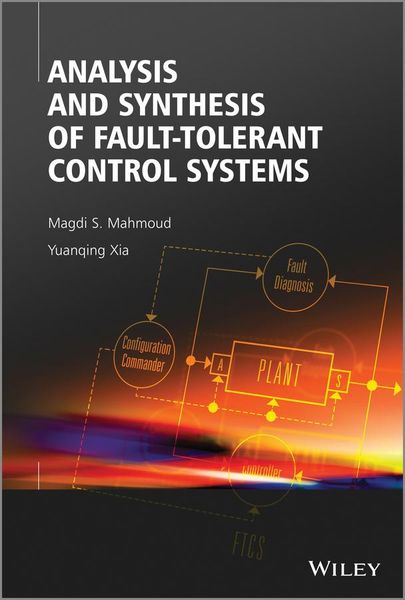
Analysis and Synthesis of Fault-Tolerant Control Systems

Fr. 189.00

inkl. gesetzl. MwSt., Versandkostenfrei


Beschreibung

In recent years, control systems have become more sophisticated in order to meet increased performance and safety requirements for modern technological systems. Engineers are becoming more aware that conventional feedback control design for a complex system may result in unsatisfactory performance, or...

Beschreibung

In recent years, control systems have become more sophisticated in order to meet increased performance and safety requirements for modern technological systems. Engineers are becoming more aware that conventional feedback control design for a complex system may result in unsatisfactory performance, or even instability, in the event of malfunctions in actuators, sensors or other system components. In order to circumvent such weaknesses, new approaches to control system design have emerged which can tolerate component malfunctions while maintaining acceptable stability and performance. These types of control systems are often known as fault-tolerant control systems (FTCS). More precisely, FTCS are control systems which possess the ability to accommodate component failure automatically.
 
Analysis and Synthesis of Fault-Tolerant Control Systems comprehensively covers the analysis and synthesis methods of fault tolerant control systems. It unifies the methods for developing controllers and filters for a wide class of dynamical systems and reports on the recent technical advances in design methodologies. MATLAB(r) is used throughout the book, to demonstrate methods of analysis and design.
 
Key features:
 
* Provides advanced theoretical methods and typical practical applications
* Provides access to a spectrum of control design methods applied to industrial systems
* Includes case studies and illustrative examples
* Contains end-of-chapter problems
 
Analysis and Synthesis of Fault-Tolerant Control Systems is a comprehensive reference for researchers and practitioners working in this area, and is also a valuable source of information for graduates and senior undergraduates in control, mechanical, aerospace, electrical and mechatronics engineering departments.

Produktdetails

Einband

Gebundene Ausgabe

Erscheinungsdatum

14.01.2014

Verlag John Wiley & Sons Inc
Seitenzahl

480

Produktdetails

Einband

Gebundene Ausgabe

Erscheinungsdatum

14.01.2014

Verlag John Wiley & Sons Inc
Seitenzahl

480

Maße (L/B/H)

24.4/16.8/2.8 cm

Gewicht

862 g

Auflage

1. Auflage

Sprache

Englisch

ISBN

978-1-118-54133-3

Herstelleradresse

Libri GmbH
Europaallee 1
36244 Bad Hersfeld
DE

Email: gpsr@libri.de

Noch keine Bewertungen vorhanden

Verfassen Sie die erste Bewertung zu diesem Artikel

Helfen Sie anderen Kundinnen und Kunden durch Ihre Meinung.

Kundinnen und Kunden meinen

Bewertungen (0)

Die Leseprobe wird geladen.
  • Produktbild: Analysis and Synthesis of Fault-Tolerant Control Systems
  • Preface xv
     
    Acknowledgments xvii
     
    1 Introduction 1
     
    1.1 Overview 1
     
    1.2 Basic Concepts of Faults 2
     
    1.3 Classification of Fault Detection Methods 3
     
    1.3.1 Hardware redundancy based fault detection 3
     
    1.3.2 Plausibility test 3
     
    1.3.3 Signal-based fault diagnosis 4
     
    1.3.4 Model-based fault detection 5
     
    1.4 Types of Fault-Tolerant Control System 8
     
    1.5 Objectives and Structure of AFTCS 8
     
    1.6 Classification of Reconfigurable Control Methods 10
     
    1.6.1 Classification based on control algorithms 10
     
    1.6.2 Classification based on field of application 11
     
    1.7 Outline of the Book 11
     
    1.7.1 Methodology 11
     
    1.7.2 Chapter organization 12
     
    1.8 Notes 13
     
    References 13
     
    2 Fault Diagnosis and Detection 17
     
    2.1 Introduction 17
     
    2.2 Related Work 17
     
    2.2.1 Model-based schemes 17
     
    2.2.2 Model-free schemes 18
     
    2.2.3 Probabilistic schemes 19
     
    2.3 Integrated Approach 19
     
    2.3.1 Improved multi-sensor data fusion 19
     
    2.3.2 Unscented transformation 21
     
    2.3.3 Unscented Kalman filter 22
     
    2.3.4 Parameter estimation 23
     
    2.3.5 Multi-sensor integration architectures 24
     
    2.4 Robust Unscented Kalman Filter 26
     
    2.4.1 Introduction 26
     
    2.4.2 Problem formulation 28
     
    2.4.3 Residual generation 29
     
    2.4.4 Residual evaluation 29
     
    2.5 Quadruple Tank System 30
     
    2.5.1 Model of the QTS 31
     
    2.5.2 Fault scenarios in QTS 32
     
    2.5.3 Implementation structure of UKF 33
     
    2.5.4 UKF with centralized multi-sensor data fusion 35
     
    2.5.5 UKF with decentralized multi-sensor data fusion 35
     
    2.5.6 Drift detection 35
     
    2.6 Industrial Utility Boiler 38
     
    2.6.1 Steam flow dynamics 38
     
    2.6.2 Drum pressure dynamics 40
     
    2.6.3 Drum level dynamics 40
     
    2.6.4 Steam temperature 41
     
    2.6.5 Fault model for the utility boiler 42
     
    2.6.6 Fault scenarios in the utility boiler 43
     
    2.6.7 UKF with centralized multi-sensor data fusion 43
     
    2.6.8 UKF with decentralized multi-sensor data fusion 43
     
    2.6.9 Drift detection 45
     
    2.6.10 Remarks 45
     
    2.7 Notes 46
     
    References 46
     
    3 Robust Fault Detection 49
     
    3.1 Distributed Fault Diagnosis 49
     
    3.1.1 Introduction 49
     
    3.1.2 System model 50
     
    3.1.3 Distributed FDI architecture 55
     
    3.1.4 Distributed fault detection method 55
     
    3.1.5 Adaptive thresholds 57
     
    3.1.6 Distributed fault isolation method 62
     
    3.1.7 Adaptive thresholds for DFDI 64
     
    3.1.8 Fault detectability condition 67
     
    3.1.9 Fault isolability analysis 69
     
    3.1.10 Stability and learning capability 71
     
    3.2 Robust Fault Detection Filters 74
     
    3.2.1 Reference model 74
     
    3.2.2 Design of adaptive threshold 76
     
    3.2.3 Iterative update of noise mean and covariance 77
     
    3.2.4 Unscented transformation (UT) 79
     
    3.2.5 Car-like mobile robot application 82
     
    3.3 Simultaneous Fault Detection and Control 90
     
    3.3.1 Introduction 93
     
    3.3.2 System model 93
     
    3.3.3 Problem formulation 95
     
    3.3.4 Simultaneous fault detection and control problem 96
     
    3.3.5 Two-tank system simulation 106
     
    3.4 Data-Driven Fault Detection Design 108
     
    3.4.1 Introduction 109
     
    3.4.2 Problem formulation 111
     
    3.4.3 Selection of weighting matrix 112
     
    3.4.4 Design of FDF for time-