
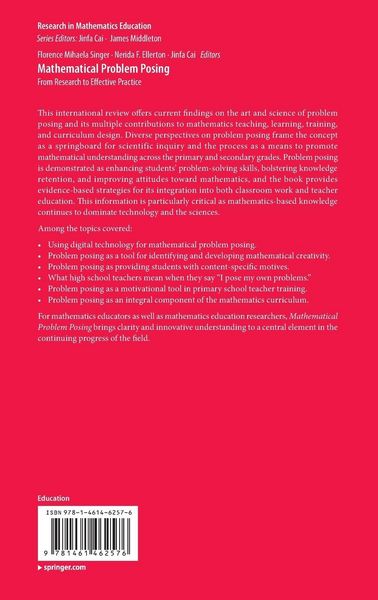
• Produktbild: Mathematical Problem Posing
  • Produktbild: Mathematical Problem Posing

Mathematical Problem Posing From Research to Effective Practice

Fr. 210.00

inkl. gesetzl. MwSt., Versandkostenfrei


Beschreibung

Produktdetails

Einband

Gebundene Ausgabe

Erscheinungsdatum

15.06.2015

Abbildungen

XXXI, 148 illus., 52 illus. in color., schwarz-weiss Illustrationen, farbige Illustrationen

Herausgeber

Florence Mihaela Singer + weitere

Verlag

Springer Us

Seitenzahl

569

Maße (L/B/H)

24.1/16/3.8 cm

Gewicht

1032 g

Auflage

2015

Sprache

Englisch

ISBN

978-1-4614-6257-6

Beschreibung

Rezension

“This edited book of 26 chapters is divided into
four parts: defining the field; mathematical problem posing in the school
curriculum, mathematical problem posing in teacher education, and concluding
remarks. … there are many examples of problem-posing tasks scattered throughout
the book’s many chapters. … the book is for mathematics education graduate
students, but it could also be useful for mathematics teachers at a variety of
levels who could gain ideas and tasks for classroom use.” (Annie Selden, MAA
Reviews, maa.org, January, 2016)

Portrait

Florence Mihaela Singer is a full professor in the Teacher Training Department of the University of Ploiesti, Romania. Her expertise is in curriculum design and development (all grades, all subjects for pre-university education), curriculum administration, teacher training, textbook development (mathematics), Educational management, and international consultancy in education.

Dr. Nerida Ellerton has two doctoral qualifications: one in theoretical and physical chemistry and one in mathematics education. She is an experienced teacher, with a specialist focus on mathematics and has taught at elementary, secondary and college levels. She was Dean of the Faculty of Education at the University of Southern Queensland for four years and is currently a full professor at Illinois State University in the Department of Mathematics.

Dr. Jinfa Cai is an affiliated Full Professor in the School of Education at the University of Delaware. His primary appointment is in the Department of Mathematical Sciences. His research interests include cognitive studies of the teaching and learning of mathematics, mathematical assessment, cross-cultural studies, problem solving and teacher education.

Produktdetails

Einband

Gebundene Ausgabe

Erscheinungsdatum

15.06.2015

Abbildungen

XXXI, 148 illus., 52 illus. in color., schwarz-weiss Illustrationen, farbige Illustrationen

Herausgeber

Verlag

Springer Us

Seitenzahl

569

Maße (L/B/H)

24.1/16/3.8 cm

Gewicht

1032 g

Auflage

2015

Sprache

Englisch

ISBN

978-1-4614-6257-6

Herstelleradresse

Springer-Verlag KG
Sachsenplatz 4-6
1201 Wien
AT

Email: GPSR Kontakt

Noch keine Bewertungen vorhanden

Verfassen Sie die erste Bewertung zu diesem Artikel

Helfen Sie anderen Kundinnen und Kunden durch Ihre Meinung.

Kundinnen und Kunden meinen

Bewertungen (0)

Weitere Artikel finden Sie in

  • Produktbild: Mathematical Problem Posing
  • Produktbild: Mathematical Problem Posing
  • Mathematical Problem Posing Practices and Research: 1970-2010.- Problem Posing From a Modelling Perspective.- Conceptualizing Problem Posing Via Transformation.- Developing a Problem-Posing Pedagogy From the History of Mathematics.- On the Relationship Between Problem Posing, Problem Solving and Creativity.- Is Problem Posing a Tool for Developing Mathematical Creativity?.- Using Digital Technology for Mathematical Problem Posing.- Problem Posing in Mathematics – The Relevance of Philosophy for Children (P4C).- Problem Posing as Lenses for Understanding and Improving Students’ Learning of Mathematics.- Examining Problem Posing in Different Grade Levels: How Students Posed Problems-To-Solve.- Problem Posing by Way of Mediated Activity at Grades Four and five.- Enhancing the Development of Chinese Fifth-Graders’ Problem Posing and Problem Solving Abilities, Beliefs and Attitudes: A Design Experiment.- If You Don't Know Why Do You Ask?.- Problem Posing to Provide Students with Content Related Motives to Proceed.- Providing Elementary Students with Opportunities to Pose problems Through Data Modeling.- Mathematical Problem Posing Activities Using Computers.- An Investigation of High School Students’ Mathematical Problem Posing in the United States and China.- Studying the Evolution of Problem Posing in Relatively Constrained Situations.- Mathematical Problem Posing in Chinese Classrooms.- Problem Posing as a Pedagogical Strategy: A Teacher's Perspective".- Problem Posing as a Motivational Tool in Primary School Teachers Training.- In-Service Mathematics Teachers as Composers of Problems for Their Teaching: A Preliminary Study.- The Poznan Theater Problem: Exploring Problem-Posing and Problem-Solving in the Route to Self-Guided Discovery in Developmental Mathematics Classes.- Problem Posing in a Collegiate Geometry Class.- From Proof to Investigations and Back to Proof in Geometry.- Developing the Problem Posing Abilities of Prospective Elementary and Middle School Teachers.- Conceptualizing Problem Posing Through Teachers’ Thinking in Posing Mathematical Word Problems.- Problem Posing in the Training of Prospective Elementary Teachers: A Review.- Problem Posing as an Integral Component of the Mathematics Curriculum: A Study with Prospective Middle-School Teachers.