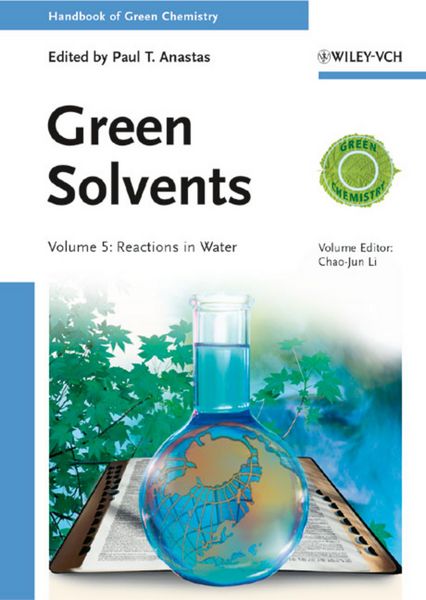
Band 5
Handbook of Green Chemistry - Green Solvents
Aus der Reihe
Handbook of Green Chemistry
-
Sprache:Englisch
-
Auflage:1. Auflage
Fr. 232.00
inkl. gesetzl. MwSt.,
Beschreibung
Produktdetails
Einband
Gebundene Ausgabe
Abbildungen
2 Farbabb.
Herausgeber
Chao-Jun LiVerlag
Wiley-VCHSeitenzahl
427
Maße (L/B/H)
2.7/17/24 cm
Gewicht
962 g
Auflage
1. Auflage
Sprache
Englisch
ISBN
978-3-527-32591-7
There has been dramatic growth in the community of researchers and industrialists working in the area of Green Chemistry. There has been an increasing recognition by a wide-range of scientists and engineers in the chemical enterprise that the framework of Green Chemistry is relevant and enabling to their work. There has been a significant body of work that has accumulated over the past decade that details the breakthroughs, innovation and creativity within Green Chemistry and Engineering.
While there have been edited volumes on Green Chemistry that collect a limited number of papers often on a particular topic area, there is not currently a series that seeks to provide a more comprehensive overview of the current state of the science. The lack of this type of series is a notable niche for which the continually growing Green Chemistry and engineering community would value and welcome.
The Handbook of Green Chemistry comprises of 9 volumes in total, split into 3 subject-specific sets. The three sets are available individually. All 9 volumes are available individually, too.
Set I: Green Catalysis
- Volume 1: Homogeneous Catalysis
- Volume 2: Heterogeneous Catalysis
- Volume 3: Biocatalysis
Set II: Green Solvents
- Volume 4: Supercritical Solvents
- Volume 5: Reactions in Water
- Volume 6: Ionic Liquids
Set III: Green Processes
- Volume 7: Green Synthesis
- Volume 8: Green Nanoscience
- Volume 9: Designing Safer Chemicals
The Handbook of Green Chemistry is also available as Online Edition .
Podcasts
Listen to two podcasts in which Professor Paul Anastas and Journals Editor Paul Trevorrow discuss the origin and expansion of Green Chemistry and give an overview of The Handbook of Green Chemistry .
While there have been edited volumes on Green Chemistry that collect a limited number of papers often on a particular topic area, there is not currently a series that seeks to provide a more comprehensive overview of the current state of the science. The lack of this type of series is a notable niche for which the continually growing Green Chemistry and engineering community would value and welcome.
The Handbook of Green Chemistry comprises of 9 volumes in total, split into 3 subject-specific sets. The three sets are available individually. All 9 volumes are available individually, too.
Set I: Green Catalysis
- Volume 1: Homogeneous Catalysis
- Volume 2: Heterogeneous Catalysis
- Volume 3: Biocatalysis
Set II: Green Solvents
- Volume 4: Supercritical Solvents
- Volume 5: Reactions in Water
- Volume 6: Ionic Liquids
Set III: Green Processes
- Volume 7: Green Synthesis
- Volume 8: Green Nanoscience
- Volume 9: Designing Safer Chemicals
The Handbook of Green Chemistry is also available as Online Edition .
Podcasts
Listen to two podcasts in which Professor Paul Anastas and Journals Editor Paul Trevorrow discuss the origin and expansion of Green Chemistry and give an overview of The Handbook of Green Chemistry .
Noch keine Bewertungen vorhanden
Verfassen Sie die erste Bewertung zu diesem Artikel
Helfen Sie anderen Kundinnen und Kunden durch Ihre Meinung.