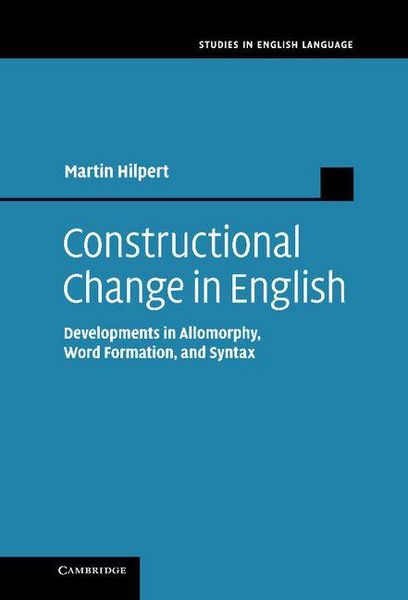
Constructional Change in English Developments in Allomorphy, Word Formation, and Syntax
-
- Hardcover ausgewählt
- Taschenbuch
- eBook
-
Sprache:Englisch
Fr. 172.00
inkl. gesetzl. MwSt.,
Beschreibung
Produktdetails
Einband
Gebundene Ausgabe
Erscheinungsdatum
27.11.2013
Verlag
Cambridge AcademicSeitenzahl
248
Maße (L/B/H)
23.5/15.7/1.8 cm
Gewicht
500 g
Sprache
Englisch
ISBN
978-1-107-01348-3
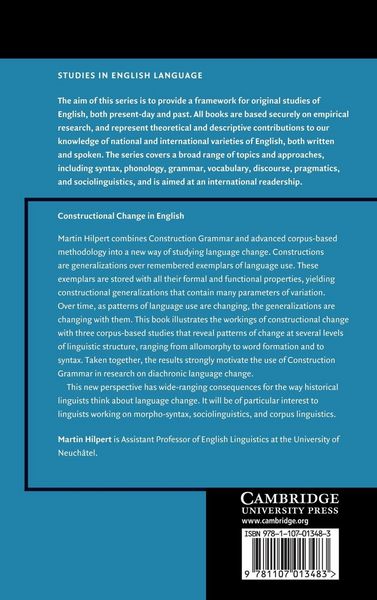
Martin Hilpert combines construction grammar and advanced corpus-based methodology into a new way of studying language change. Constructions are generalizations over remembered exemplars of language use. These exemplars are stored with all their formal and functional properties, yielding constructional generalizations that contain many parameters of variation. Over time, as patterns of language use are changing, the generalizations are changing with them. This book illustrates the workings of constructional change with three corpus-based studies that reveal patterns of change at several levels of linguistic structure, ranging from allomorphy to word formation and to syntax. Taken together, the results strongly motivate the use of construction grammar in research on diachronic language change. This new perspective has wide-ranging consequences for the way historical linguists think about language change. It will be of particular interest to linguists working on morpho-syntax, sociolinguistics and corpus linguistics.
Noch keine Bewertungen vorhanden
Verfassen Sie die erste Bewertung zu diesem Artikel
Helfen Sie anderen Kundinnen und Kunden durch Ihre Meinung.