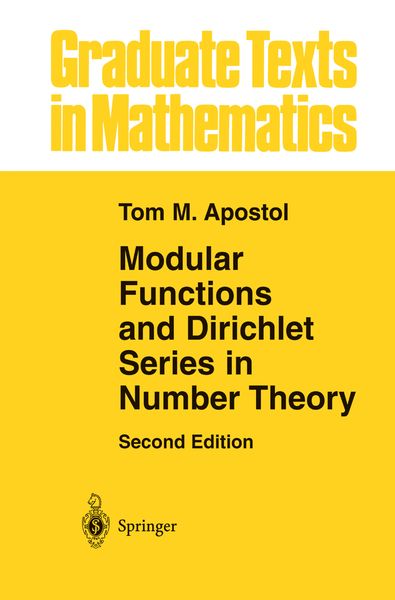

• Produktbild: Modular Functions and Dirichlet Series in Number Theory
  • Produktbild: Modular Functions and Dirichlet Series in Number Theory
Band 41

Modular Functions and Dirichlet Series in Number Theory

Fr. 93.90

inkl. gesetzl. MwSt., Versandkostenfrei


Beschreibung

Produktdetails

Einband

Taschenbuch

Erscheinungsdatum

02.10.2012

Verlag

Springer Us

Seitenzahl

207

Maße (L/B/H)

23.5/15.5/1.3 cm

Gewicht

341 g

Auflage

Second Edition 1990

Sprache

Englisch

ISBN

978-1-4612-6978-6

Beschreibung

Rezension

From the reviews of the second edition:

“Apostol is an excellent writer of mathematics and the topics that are covered in this book are covered thoroughly in a concise, precise manner. … the writing is characterized by its easy, readable, fluid style. Each chapter is complemented with a nice set of exercises.” (Álvaro Lozano-Robledo, The Mathematical Association of America, June, 2011)

Produktdetails

Einband

Taschenbuch

Erscheinungsdatum

02.10.2012

Verlag

Springer Us

Seitenzahl

207

Maße (L/B/H)

23.5/15.5/1.3 cm

Gewicht

341 g

Auflage

Second Edition 1990

Sprache

Englisch

ISBN

978-1-4612-6978-6

Herstelleradresse

Springer-Verlag GmbH
Tiergartenstr. 17
69121 Heidelberg
DE

Email: GPSR Kontakt

Noch keine Bewertungen vorhanden

Verfassen Sie die erste Bewertung zu diesem Artikel

Helfen Sie anderen Kundinnen und Kunden durch Ihre Meinung.

Kundinnen und Kunden meinen

Bewertungen (0)

  • Produktbild: Modular Functions and Dirichlet Series in Number Theory
  • Produktbild: Modular Functions and Dirichlet Series in Number Theory
  • 1 Elliptic functions.- 1.1 Introduction.- 1.2 Doubly periodic functions.- 1.3 Fundamental pairs of periods.- 1.4 Elliptic functions.- 1.5 Construction of elliptic functions.- 1.6 The Weierstrass p function.- 1.7 The Laurent expansion of p near the origin.- 1.8 Differential equation satisfied by p.- 1.9 The Eisenstein series and the invariants g2 and g3.- 1.10 The numbers e1, e2, e3.- 1.11 The discriminant ?.- 1.12 Klein’s modular function J(?).- 1.13 Invariance of J under unimodular transformations.- 1.14 The Fourier expansions of g2(?) and g3(?).- 1.15 The Fourier expansions of ?(?) and J(?).- Exercises for Chapter 1.- 2 The Modular group and modular functions.- 2.1 Möbius transformations.- 2.2 The modular group ?.- 2.3 Fundamental regions.- 2.4 Modular functions.- 2.5 Special values of J.- 2.6 Modular functions as rational functions of J.- 2.7 Mapping properties of J.- 2.8 Application to the inversion problem for Eisenstein series.- 2.9 Application to Picard’s theorem.- Exercises for Chapter 2.- 3 The Dedekind eta function.- 3.1 Introduction.- 3.2 Siegel’s proof of Theorem 3.1.- 3.3 Infinite product representation for ?(?).- 3.4 The general functional equation for ?(?).- 3.5 Iseki’s transformation formula.- 3.6 Deduction of Dedekind’s functional equation from Iseki’s formula.- 3.7 Properties of Dedekind sums.- 3.8 The reciprocity law for Dedekind sums.- 3.9 Congruence properties of Dedekind sums.- 3.10 The Eisenstein series G2(?).- Exercises for Chapter 3.- 4 Congruences for the coefficients of the modular function j.- 4.1 Introduction.- 4.2 The subgroup ?0(q).- 4.3 Fundamental region of ?0(p).- 4.4 Functions automorphic under the subgroup ?0(p).- 4.5 Construction of functions belonging to ?0(p).- 4.6 The behavior of fp under thegenerators of ?.- 4.7 The function ?(?) = ?(q?)/?(?).- 4.8 The univalent function ?(?).- 4.9 Invariance of ?(?) under transformations of ?0(q).- 4.10 The function jp expressed as a polynomial in ?.- Exercises for Chapter 4.- 5 Rademacher’s series for the partition function.- 5.1 Introduction.- 5.2 The plan of the proof.- 5.3 Dedekind’s functional equation expressed in terms of F.- 5.4 Farey fractions.- 5.5 Ford circles.- 5.6 Rademacher’s path of integration.- 5.7 Rademacher’s convergent series for p(n).- Exercises for Chapter 5.- 6 Modular forms with multiplicative coefficients.- 6.1 Introduction.- 6.2 Modular forms of weight k.- 6.3 The weight formula for zeros of an entire modular form.- 6.4 Representation of entire forms in terms of G4 and G6.- 6.5 The linear space Mk and the subspace Mk,0.- 6.6 Classification of entire forms in terms of their zeros.- 6.7 The Hecke operators Tn.- 6.8 Transformations of order n.- 6.9 Behavior of Tnf under the modular group.- 6.10 Multiplicative property of Hecke operators.- 6.11 Eigenfunctions of Hecke operators.- 6.12 Properties of simultaneous eigenforms.- 6.13 Examples of normalized simultaneous eigenforms.- 6.14 Remarks on existence of simultaneous eigenforms in M2k,0.- 6.15 Estimates for the Fourier coefficients of entire forms.- 6.16 Modular forms and Dirichlet series.- Exercises for Chapter 6.- 7 Kronecker’s theorem with applications.- 7.1 Approximating real numbers by rational numbers.- 7.2 Dirichlet’s approximation theorem.- 7.3 Liouville’s approximation theorem.- 7.4 Kronecker’s approximation theorem: the one-dimensional case.- 7.5 Extension of Kronecker’s theorem to simultaneous approximation.- 7.6 Applications to the Riemann zeta function.- 7.7 Applications to periodic functions.- Exercisesfor Chapter 7.- 8 General Dirichlet series and Bohr’s equivalence theorem.- 8.1 Introduction.- 8.2 The half-plane of convergence of general Dirichlet series.- 8.3 Bases for the sequence of exponents of a Dirichlet series.- 8.4 Bohr matrices.- 8.5 The Bohr function associated with a Dirichlet series.- 8.6 The set of values taken by a Dirichlet series f(s) on a line ? = ?0.- 8.7 Equivalence of general Dirichlet series.- 8.8 Equivalence of ordinary Dirichlet series.- 8.9 Equality of the sets Uf(?0) and Ug(?0) for equivalent Dirichlet series.- 8.10 The set of values taken by a Dirichlet series in a neighborhood of the line ? = ?0.- 8.11 Bohr’s equivalence theorem.- 8.12 Proof of Theorem 8.15.- 8.13 Examples of equivalent Dirichlet series. Applications of Bohr’s theorem to L-series.- 8.14 Applications of Bohr’s theorem to the Riemann zeta function.- Exercises for Chapter 8.- Supplement to Chapter 3.- Index of special symbols.- Index 201.