
Design Models for Hierarchical Organizations Computation, Information, and Decentralization
-
- Hardcover
- Taschenbuch ausgewählt
-
Sprache:Englisch
Fr. 191.00
inkl. gesetzl. MwSt.,
Beschreibung
Produktdetails
Einband
Taschenbuch
Erscheinungsdatum
02.10.2012
Abbildungen
XIV, 279 p.
Herausgeber
Richard M. Burton + weitereVerlag
Springer UsSeitenzahl
279
Maße (L/B/H)
23.5/15.5/1.7 cm
Gewicht
452 g
Auflage
Softcover reprint of the original 1st edition 1995
Sprache
Englisch
ISBN
978-1-4613-5964-7
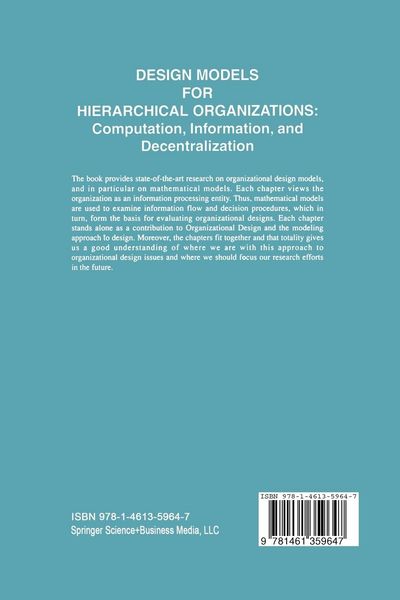
Design Models for Hierarchical Organizations: Computation, Information, and Decentralization provides state-of-the-art research on organizational design models, and in particular on mathematical models. Each chapter views the organization as an information processing entity. Thus, mathematical models are used to examine information flow and decision procedures, which in turn, form the basis for evaluating organization designs. Each chapters stands alone as a contribution to organization design and the modeling approach to design. Moreover, the chapters fit together and that totality gives us a good understanding of where we are with this approach to organizational design issues and where we should focus our research efforts in the future.
Noch keine Bewertungen vorhanden
Verfassen Sie die erste Bewertung zu diesem Artikel
Helfen Sie anderen Kundinnen und Kunden durch Ihre Meinung.