Gutscheinbedingungen

*Gültig bis 20.07.2026 auf alle Bücher. Ausgeschlossen sind Zeitschriften, Prozentbücher und Abos | Einlösbar in allen Buchhandlungen von Orell Füssli, Barth Bücher, Buchladen Rapunzel, Papeterie Köhler, Schuler Orell Füssli, Stauffacher und ZAP unter Vorweisung des Gutscheins, auf www.orellfüssli.ch durch Eingabe des Gutscheincodes. Beim Service „eBooks verschenken“ und bei eBook-Käufen via eReader nicht einlösbar | Mindesteinkaufswert: Fr. 30.- | Nicht mit anderen Rabatten kumulierbar.

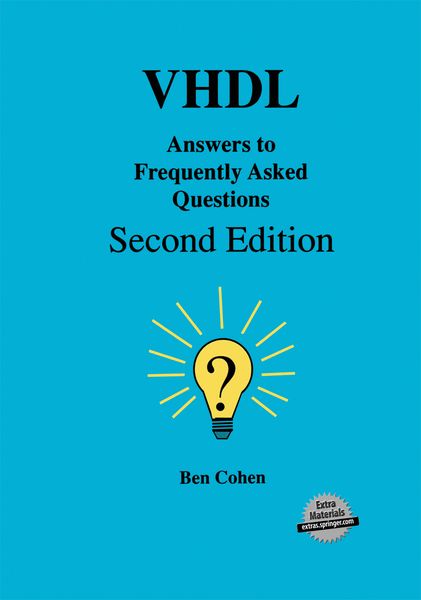
  • Produktbild: VHDL Answers to Frequently Asked Questions
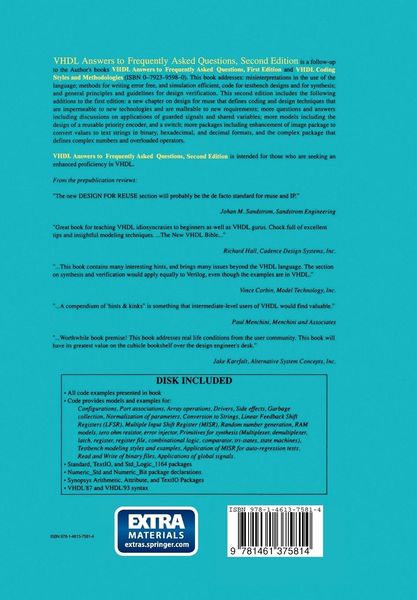
  • Produktbild: VHDL Answers to Frequently Asked Questions

VHDL Answers to Frequently Asked Questions

Fr. 191.00

inkl. gesetzl. MwSt., Versandkostenfrei


Beschreibung

Produktdetails

Einband

Taschenbuch

Erscheinungsdatum

08.10.2012

Verlag

Springer Us

Seitenzahl

384

Maße (L/B/H)

25.4/17.8/2.3 cm

Gewicht

786 g

Auflage

Second Edition 1998

Sprache

Englisch

ISBN

978-1-4613-7581-4

Beschreibung

Produktdetails

Einband

Taschenbuch

Erscheinungsdatum

08.10.2012

Verlag

Springer Us

Seitenzahl

384

Maße (L/B/H)

25.4/17.8/2.3 cm

Gewicht

786 g

Auflage

Second Edition 1998

Sprache

Englisch

ISBN

978-1-4613-7581-4

Herstelleradresse

Springer-Verlag GmbH
Tiergartenstr. 17
69121 Heidelberg
DE

Email: GPSR Kontakt

Noch keine Bewertungen vorhanden

Verfassen Sie die erste Bewertung zu diesem Artikel

Helfen Sie anderen Kundinnen und Kunden durch Ihre Meinung.

Kundinnen und Kunden meinen

Bewertungen (0)

  • Produktbild: VHDL Answers to Frequently Asked Questions
  • Produktbild: VHDL Answers to Frequently Asked Questions
  • 1. Language Elements.- 1.1 Why VHDL for Digital Designs.- 1.2 Salient Points of Concurrent Statements.- 1.3 Guarded Signal Assignments.- 1.4 Signals and Ports.- 1.5 Configurations.- 1.6 Arithmetic Issues and Operators.- 1.7 PACKAGE STD_LOGIC_1164.- 1.8 Range Constraint in Type Definition.- 1.9 Shared Variables.- 2. Arrays.- 2.1 Array Structure Representations.- 2.2 Arrays — Legal Operations.- 2.3 Array Slices and Ranges.- 2.4 Array Initialization.- 2.5 Constant Arrays in Case.- 2.6 Constrained and Unconstrained Arrays.- 2.7 Mapping Arrays of Different Sizes.- 2.8 Unconstrained Aggregate with “Others ”.- 2.9 Illegal Array Types.- 3. Drivers.- 3.1 Multiple Drivers — Case 1.- 3.2 Multiple Drivers — Case 2.- 3.3 Multiple Drivers Error — Case 3.- 3.4 Multiple Drivers Error — Component.- 3.5 Coding Style for Detection of Multiple Drivers.- 4. Subprograms.- 4.1 Side Effects From A Procedure.- 4.2 Garbage Collection of Dynamically Created Objects.- 4.3 Acceptable Types in Parameter Lists for Function Calls.- 4.4 Files Declarations in Procedures.- 4.5 Multiple Accesses of Same File.- 4.6 File Array.- 4.7 Conversion Function From Integer To Time.- 4.8 Normalization In Subprograms.- 5. Packages.- 5.1 Converting Typed Objects To Strings.- 5.2 Printing Objects From Vhdl.- 5.3 Multiple Input Signature Register (Misr).- 5.4 Design of a Linear Feedback Shift Register (Lfsr).- 5.5 Random Number Generation.- 5.6 Deferred Constant in Package Declaration.- 5.7 Complex Numbers and Overloaded Operators.- 5.8 Ieee Standards.- 6. Models.- 6.1 Large Ram Model For Simulation..- 6.2 Zero Ohm Resistor (Wire, Bridge) Model.- 6.3 Error Injector Model.- 6.4 Transfer Gate (Switch).- 7. Synthesis.- 7.1 Supported/Unsupported Constructs for Synthesis.- 7.2 Synthesis Sensitivity Rules.- 7.3Latch/Register/Combinational Logic.- 7.4 Latch Inferrance in Functions.- 7.5 Variable Initialization and Lifetime.- 7.6 Wait Statement.- 7.7 Defining Shift Registers in Synthesis.- 7.8 Register File.- 7.9 Multiplexer Model.- 7.10 Demultiplexer Model.- 7.11 Barrel Shifter.- 7.12 Use of “don’t Care” in Case Statement.- 7.13 Parameterized Priority Encoder.- 7.14 Generating A Synchronous Precharge.- 7.15 Technology and Vhdl Code Design.- 7.16 Synthesizing Tri-States.- 7.17 Subelement Association.- 7.18 Finite State Machine (Fsm).- 7.19 One-Hot Encoding.- 7.20 Instantiating Synopsys® Designware Components.- 7.21 Resource Sharing.- 7.22 Applying Digital Design Experiences.- 7.23 Address Range Identification Via Inferred Comparator.- 7.24 Port Mapping to Ground Or Vcc.- 7.25 Bit Reversal.- 7.26 How to Design a Timer in Vhdl.- 7.27 Specifying a Multiplier.- 7.28 Behavioral Synthesis.- 8. Design Verification and Testbench.- 8.1 Verification Processes.- 8.2 Functional Verification.- 8.3 Regression Tests.- 8.4 Formal Verification.- 8.5 Bus Functional Model (Bfm) Modeling.- 8.6 Application of Misr, Random, Lfsr Packages for Auto-Regression.- 8.7 Strength Stripper.- 9. Potpourri.- 9.1 Methods To Enhance Simulation Speed.- 9.2 Accessing Signals Internal to Components.- 9.3 Transferring a Line Onto a Signal.- 9.4 Type Declaration in Multiple Packages.- 9.5 Internet - Frequently Asked Questions.- 9.6 Vhdl Text Editor?.- 9.7 Vital.- 9.8 Behavioral Modeling.- 9.9 Final Vhdl Exam.- 10. Design for Reuse.- 10.1 Design Processes for Reusability.- 10.2 Parameterized, Reusable and Readable Code.- 10.3 Documentation of Vhdl Designs.- Appendix A: Vhdl’93 and Vhdl’87 Syntax Summary.- Appendix B: Package Standard.- Appendix C: Package Textio.- Appendix D: Package Std_Logic_1164.-Appendix E: Package Std_Logic_Arith.- Appendix F: Vhdl Predefined Attributes.