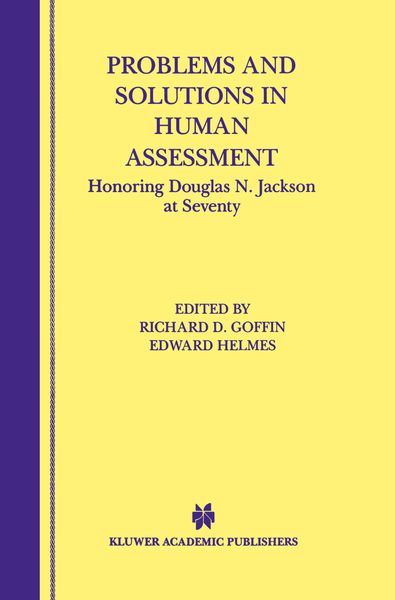
Problems and Solutions in Human Assessment Honoring Douglas N. Jackson at Seventy
-
- Hardcover
- Taschenbuch ausgewählt
- eBook
-
Sprache:Englisch
Fr. 191.00
inkl. gesetzl. MwSt.,
Beschreibung
Produktdetails
Einband
Taschenbuch
Erscheinungsdatum
04.10.2012
Herausgeber
Richard D. Goffin + weitereVerlag
Springer UsSeitenzahl
357
Maße (L/B/H)
23.5/15.5/2.1 cm
Gewicht
587 g
Auflage
Softcover reprint of the original 1st ed. 2000
Sprache
Englisch
ISBN
978-1-4613-6978-3
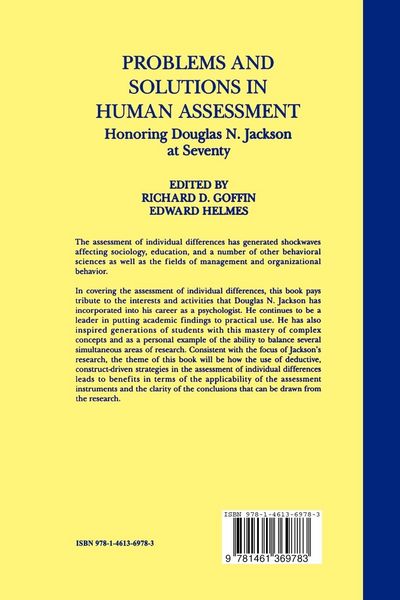
The assessment of individual differences has generated shockwaves affecting sociology, education, and a number of other behavioral sciences as well as the fields of management and organizational behavior.
In covering the assessment of individual differences, this book pays tribute to the interests and activities that Douglas N. Jackson has incorporated into his career as a psychologist. He continues to be a leader in putting academic findings to practical use. He has also inspired generations of students with his mastery of complex concepts and as a personal example of the ability to balance several simultaneous areas of research. Consistent with the focus of Jackson's research, the theme of this book will be how the use of deductive, construct-driven strategies in the assessment of individual differences leads to benefits in terms of the applicability of the assessment instruments and the clarity of the conclusions that can be drawn from the research.
In covering the assessment of individual differences, this book pays tribute to the interests and activities that Douglas N. Jackson has incorporated into his career as a psychologist. He continues to be a leader in putting academic findings to practical use. He has also inspired generations of students with his mastery of complex concepts and as a personal example of the ability to balance several simultaneous areas of research. Consistent with the focus of Jackson's research, the theme of this book will be how the use of deductive, construct-driven strategies in the assessment of individual differences leads to benefits in terms of the applicability of the assessment instruments and the clarity of the conclusions that can be drawn from the research.
Noch keine Bewertungen vorhanden
Verfassen Sie die erste Bewertung zu diesem Artikel
Helfen Sie anderen Kundinnen und Kunden durch Ihre Meinung.