• Produktbild: Gender and Timebound Commandments in Judaism
  • Produktbild: Gender and Timebound Commandments in Judaism

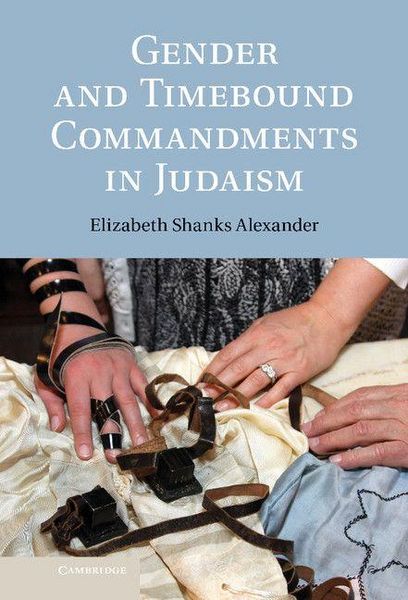
Gender and Timebound Commandments in Judaism

Fr. 153.00

inkl. gesetzl. MwSt., Versandkostenfrei


Beschreibung

Produktdetails

Einband

Gebundene Ausgabe

Erscheinungsdatum

25.03.2014

Verlag

Cambridge University Press

Seitenzahl

300

Maße (L/B/H)

23.5/15.7/2.2 cm

Gewicht

610 g

Sprache

Englisch

ISBN

978-1-107-03556-0

Beschreibung

Zitat

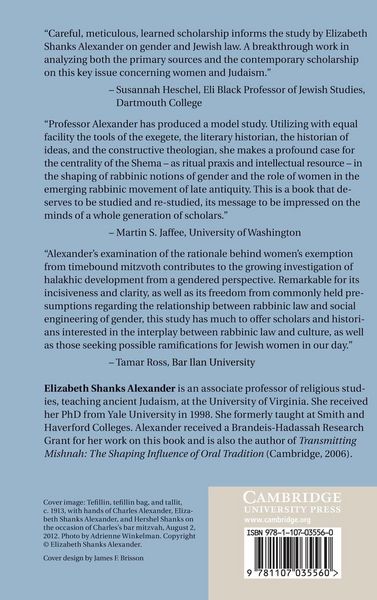
"Careful, meticulous, learned scholarship informs the study by Elizabeth Shanks Alexander on gender and Jewish law. A breakthrough work in analyzing both the primary sources and the contemporary scholarship on this key issue concerning women and Judaism." - Susannah Heschel, Eli Black Professor of Jewish Studies, Dartmouth College "Prof. Alexander has produced a model study. Utilizing with equal facility the tools of the exegete, the literary historian, the historian of ideas, and the constructive theologian, she makes a profound case for the centrality of the Shema - as ritual praxis and intellectual resource - in the shaping of rabbinic notions of gender and the role of women in the emerging rabbinic movement of late antiquity. This is a book that deserves to be studied and re-studied, its message to be impressed on the minds of a whole generation of scholars." - Martin S. Jaffee, University of Washington "Alexander's examination of the rationale behind women's exemption from timebound mitzvoth contributes to the growing investigation of halakhic development from a gendered perspective. Remarkable for its incisiveness and clarity, as well as its freedom from commonly held presumptions regarding the relationship between rabbinic law and social engineering of gender, this study has much to offer scholars and historians interested in the interplay between rabbinic law and culture, as well as those seeking possible ramifications for Jewish women in our day." - Tamar Ross, Bar Ilan University "Slicing through centuries of ideological (ab)use of the rabbinic exemption of women from timebound, positive commandments, Alexander carefully and judiciously enables her readers to see the exemption - for the first time - for what it is and what it is not. Combining philological exactitude with the methods of the broader humanities, she disables traditional religious, academic, and even feminist misunderstandings of the exemption, restores it to its original context, and analyzes it afresh with tools drawn from ritual and gender studies. The pay-off is rich - and utterly surprising." --Christine Hayes, Weis Professor of Religious Studies in Classical Judaica, Yale University

Produktdetails

Einband

Gebundene Ausgabe

Erscheinungsdatum

25.03.2014

Verlag

Cambridge University Press

Seitenzahl

300

Maße (L/B/H)

23.5/15.7/2.2 cm

Gewicht

610 g

Sprache

Englisch

ISBN

978-1-107-03556-0

Kundinnen und Kunden meinen

0 Bewertungen

Informationen zu Bewertungen

Zur Abgabe einer Bewertung ist eine Anmeldung im Konto notwendig. Die Authentizität der Bewertungen wird von uns nicht überprüft. Wir behalten uns vor, Bewertungstexte, die unseren Richtlinien widersprechen, entsprechend zu kürzen oder zu löschen.

Die Bewertungen sind nach Format, Anzahl Sterne und Datum sortiert.

Verfassen Sie die erste Bewertung zu diesem Artikel

Helfen Sie anderen Kund*innen durch Ihre Meinung

Kundinnen und Kunden meinen

0 Bewertungen filtern

Die Leseprobe wird geladen.
  • Produktbild: Gender and Timebound Commandments in Judaism
  • Produktbild: Gender and Timebound Commandments in Judaism
  • Part I. Gender and the Tannaitic Rule: 1. The rule and social reality: conceiving the category, formulating the rule; 2. Between man and woman: lists of male-female difference; Part II. Talmudic Interpretation and the Potential for Gender: 3. How tefillin became a positive commandment not occasioned by time; 4. Shifting orthodoxies; 5. From description to prescription; Part III. Gender in Women's Ritual Exemptions: 6. Women's exemption from Shema and tefillin; 7. Torah study as ritual; 8. The fringes debate: a conclusion of sorts; 9. Epilogue.