• Produktbild: Medieval Philosophy and the Classical Tradition
  • Produktbild: Medieval Philosophy and the Classical Tradition

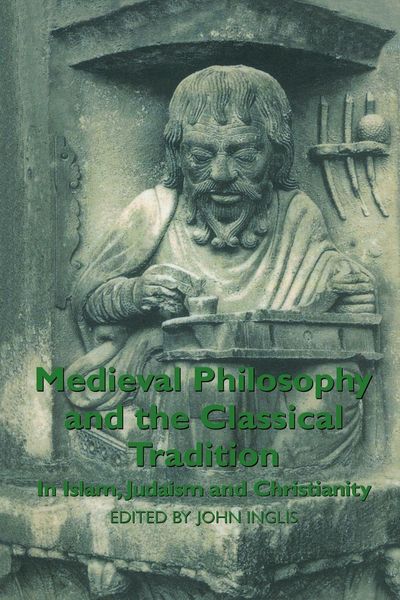
Medieval Philosophy and the Classical Tradition In Islam, Judaism and Christianity

Fr. 94.90

inkl. gesetzl. MwSt., Versandkostenfrei


Beschreibung

Produktdetails

Einband

Taschenbuch

Erscheinungsdatum

25.04.2013

Verlag

Taylor and Francis

Seitenzahl

328

Maße (L/B/H)

23.4/15.6/1.8 cm

Gewicht

610 g

Sprache

Englisch

ISBN

978-0-415-84950-0

Beschreibung

Produktdetails

Einband

Taschenbuch

Erscheinungsdatum

25.04.2013

Verlag

Taylor and Francis

Seitenzahl

328

Maße (L/B/H)

23.4/15.6/1.8 cm

Gewicht

610 g

Sprache

Englisch

ISBN

978-0-415-84950-0

Herstelleradresse

Libri GmbH
Europaallee 1
36244 Bad Hersfeld
DE

Email: gpsr@libri.de

Kundinnen und Kunden meinen

0 Bewertungen

Informationen zu Bewertungen

Zur Abgabe einer Bewertung ist eine Anmeldung im Konto notwendig. Die Authentizität der Bewertungen wird von uns nicht überprüft. Wir behalten uns vor, Bewertungstexte, die unseren Richtlinien widersprechen, entsprechend zu kürzen oder zu löschen.

Die Bewertungen sind nach Format, Anzahl Sterne und Datum sortiert.

Verfassen Sie die erste Bewertung zu diesem Artikel

Helfen Sie anderen Kund*innen durch Ihre Meinung

Kundinnen und Kunden meinen

0 Bewertungen filtern

Die Leseprobe wird geladen.
  • Produktbild: Medieval Philosophy and the Classical Tradition
  • Produktbild: Medieval Philosophy and the Classical Tradition
  • Notes on Contributors Acknowledgements Introduction: Towards a Balanced Historiography of Medieval Philosophy John Inglis Section One: Historical Context 1. Medieval Islamic Philosophy and the Classical Tradition Micheal E. Marmura Section Two: Philosophy 2. A Philosophical Odyssey: Ghazzali's Intentions of the Philosophers Gabriel Said Reynolds 3. The Relationship between Averroes and al-Ghazali: as it presents itself in Averroes' Early Writings, especially in his Commentary on al-Ghazali's al-Mustasfa Frank Griffel 4. Al-Ghazali and Halevi on Philosophy and the Philosophers Barry S. Kogan Section Three: Neoplatonism 5. Projection and Time in Proclus D. Gregory MacIsaac 6. Forms of Knowledge in the Arabic Plotinus Peter Adamson 7. Secundum rei vim vel secundum cognoscentium facultatem : Knower and Known in the Consolation of Philsosophy pf Boethius and the proslogion of Anselm Wayne J. Hankey 8. Proclean 'Remaining' and Avicenna on Existence as Accident: Neoplatonic Methodology and a Defense of 'Pre-Existing' Essences Sarah Pessin 9. Augustine vs Plotinus: The Uniqueness of the Vision at Ostia Thomas Williams Section Four: Creation 10. Infinite Power and Plenitude: Two Traditions on the Necessity of the Eternal Taneli Kukkonen 11. The Challenge to Medieval Christian Philosophy: Relating Creator to Creatures David B. Burrell, C.S.C. Section Five: Virtue 12. Three Kinds of Objectivity Jonathan Jacobs 13. On Defining Maimonides' Aristotelianism Daniel H. Frank 14. Porphyry, Bonaventure and Thomas Aquinas: A Neoplatonic Hierarchy of Virtues and Two Christian Appropriations Joshua P. Hochschild Section Six: The Latin Reception 15. William of Auvergne and the Aristotelians: The Nature of a Servant Michael Miller 16. Is God a 'What'? Avicenna, William of Auvergne, and Aquinas on the Divine Essence John P. Rosheger 17. Maimonides and Roger Bacon: Did Roger Bacon Read Maimonides? Jeremiah Hackett Index