KI-Beratung Beta

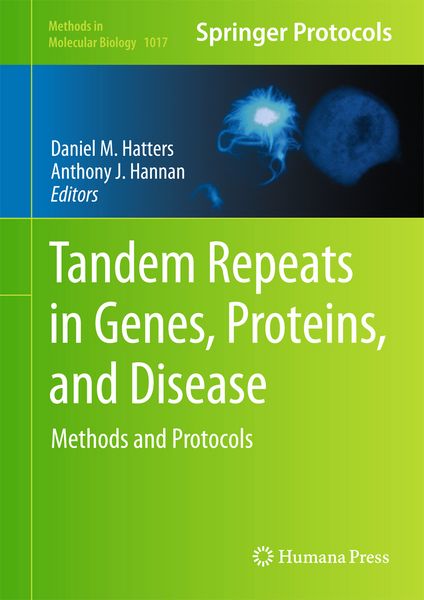
Produktbild: Tandem Repeats in Genes, Proteins, and Disease
Band 1017

Tandem Repeats in Genes, Proteins, and Disease Methods and Protocols

Fr. 137.00

inkl. gesetzl. MwSt., Versandkostenfrei


Beschreibung

The genomes of humans, as well as many other species, are interspersed with hundreds of thousands of tandem repeats of DNA sequences.  Those tandem repeats located as codons within open reading frames encode amino acid runs, such as polyglutamine and polyalanine.  Tandem repeats have not only been implicated...

Beschreibung

The genomes of humans, as well as many other species, are interspersed with hundreds of thousands of tandem repeats of DNA sequences.  Those tandem repeats located as codons within open reading frames encode amino acid runs, such as polyglutamine and polyalanine.  Tandem repeats have not only been implicated in biological evolution, development and function but also in a large collection of human disorders. In
Tandem Repeats in Genes, Proteins, and Disease: Methods and Protocols,
expert researchers in the field detail many methods covering the analysis of tandem repeats in DNA, RNA and protein, in healthy and diseased states.  This will include molecular genetics, molecular biology, biochemistry, proteomics, biophysics, cell biology, and molecular  and cellular approaches to animal models of tandem repeat disorders. Written in the highly successful
Methods in Molecular Biology™
series format, chapters include introductions to their respective topics, lists of the necessary materials and reagents, step-by-step, readily reproducible laboratory protocols, and key tips on troubleshooting and avoiding known pitfalls.


Authoratative and Practical,
Tandem Repeats in Genes, Proteins, and Disease: Methods and Protocols
aids scientists in continuing to study the unique methodological challenges that come from repetitive DNA and poly-amino acid sequences.

Produktdetails

Einband

Gebundene Ausgabe

Erscheinungsdatum

30.05.2013

Abbildungen

XI, 258 p. 55 illus., 23 illus. in color.

Herausgeber Danny M. Hatters + weitere

Produktdetails

Einband

Gebundene Ausgabe

Erscheinungsdatum

30.05.2013

Abbildungen

XI, 258 p. 55 illus., 23 illus. in color.

Herausgeber
Verlag Humana Press
Seitenzahl

258

Maße (L/B/H)

26/18.3/2 cm

Gewicht

650 g

Sprache

Englisch

ISBN

978-1-62703-437-1

Herstelleradresse

Springer-Verlag GmbH
Europaplatz 3
69115 Heidelberg
DE

Email: ProductSafety@springernature.com

Noch keine Bewertungen vorhanden

Verfassen Sie die erste Bewertung zu diesem Artikel

Helfen Sie anderen Kundinnen und Kunden durch Ihre Meinung.

Kundinnen und Kunden meinen

Bewertungen (0)

  • Produktbild: Tandem Repeats in Genes, Proteins, and Disease

  • Longitudinal Imaging and Analysis of Neurons Expressing Polyglutamine-Expanded Proteins.- Atomic Force Microscopy Assays for Evaluating Polyglutamine Aggregation in Solution and on Surfaces.- Morphometric Analysis of Huntington’s Disease Neurodegeneration in
    Drosophila.-
    Size Analysis of Polyglutamine Protein Aggregates using Fluorescence Detection in an Analytical Ultracentrifuge.- A Method for the Incremental Expansion of Polyglutamine Repeats in Recombinant Proteins.- Pulse Shape Analysis (PulSA) to Track Protein Translocalization in Cells by Flow Cytometry: Applications for Polyglutamine Aggregation.- Characterizing Social Behavior in Genetically Targeted Mouse Models of Brain Disorders.- PCR Amplification and Sequence Analysis of GC-rich Sequences:
    Aristaless
    -Related Homeobox Example.- Challenges of “sticky” Co-Immunoprecipitation; Polyalanine Tract Protein-Protein Interactions.- Molecular Pathology of Polyalanine Expansion Disorders-new Perspectives from Mouse Models.- Yeast as a Platform to Explore Polyglutamine Toxicity and Aggregation.- Immunobased Detection Assays to Quantify Distinct Mutant Huntingtin Conformations in Biological Samples.- Modeling and Analysis of Repeat RNA Toxicity in
    Drosophila.-
    Analyzing Modifiers of Protein Aggregation in
    C. elegans
    by Native Agarose Gel Electrophoresis.- Kinetic Analysis of Aggregation Data.- A Bioinformatics Method for Identifying Q/N-rich Prion-like Domains in Proteins.- Detecting Soluble PolyQ Oligomers and Investigating their Impact on Living Cells using Split-GFP.- Cell Biological Approaches To Investigate Polyglutamine-Expanded AR Metabolism.