Band 12
Beschreibung
Produktdetails
Einband
Taschenbuch
Erscheinungsdatum
27.12.2012
Abbildungen
XIV, 225 p.
Verlag
Springer UsSeitenzahl
225
Maße (L/B/H)
22.9/15.2/1.4 cm
Gewicht
354 g
Sprache
Englisch
ISBN
978-1-4684-3314-2
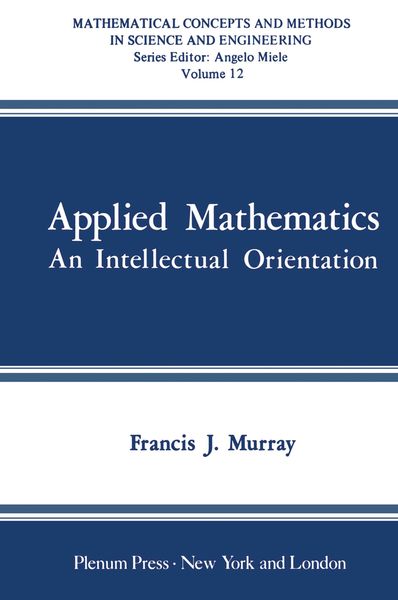
The primary objective of the course presented here is orientation for those interested in applying mathematics, but the course should also be of value or in using math to those interested in mathematical research and teaching ematics in some other professional context. The course should be suitable for college seniors and graduate students, as well as for college juniors who have had mathematics beyond the basic calculus sequence. Maturity is more significant than any formal prerequisite. The presentation involves a number of topics that are significant for applied mathematics but that normally do not appear in the curriculum or are depicted from an entirely different point of view. These topics include engineering simulations, the experience patterns of the exact sciences, the conceptual nature of pure mathematics and its relation to applied mathe matics, the historical development of mathematics, the associated conceptual aspects of the exact sciences, and the metaphysical implications of mathe matical scientific theories. We will associate topics in mathematics with areas of application. This presentation corresponds to a certain logical structure. But there is an enormous wealth of intellectual development available, and this permits considerable flexibility for the instructor in curricula and emphasis. The prime objective is to encourage the student to contact and utilize this rich heritage. Thus, the student's activity is critical, and it is also critical that this activity be precisely formulated and communicated.
Noch keine Bewertungen vorhanden
Verfassen Sie die erste Bewertung zu diesem Artikel
Helfen Sie anderen Kundinnen und Kunden durch Ihre Meinung.