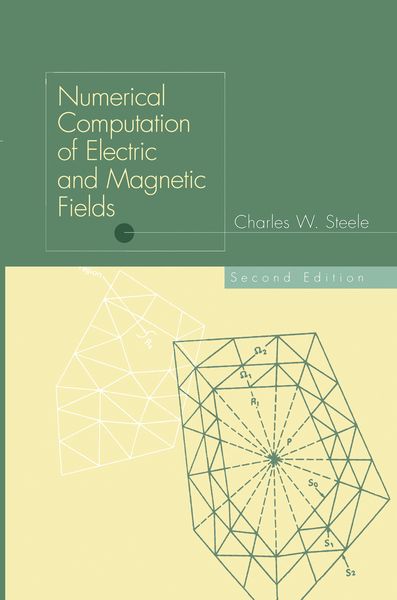

• Produktbild: Numerical Computation of Electric and Magnetic Fields
  • Produktbild: Numerical Computation of Electric and Magnetic Fields

Numerical Computation of Electric and Magnetic Fields

Fr. 218.00

inkl. gesetzl. MwSt., Versandkostenfrei


Beschreibung

Produktdetails

Einband

Taschenbuch

Erscheinungsdatum

24.10.2012

Abbildungen

XV, 260 p.

Verlag

Springer Us

Seitenzahl

260

Maße (L/B/H)

23.5/15.5/1.6 cm

Gewicht

429 g

Auflage

Second Edition 1997

Sprache

Englisch

ISBN

978-1-4613-7766-5

Beschreibung

Produktdetails

Einband

Taschenbuch

Erscheinungsdatum

24.10.2012

Abbildungen

XV, 260 p.

Verlag

Springer Us

Seitenzahl

260

Maße (L/B/H)

23.5/15.5/1.6 cm

Gewicht

429 g

Auflage

Second Edition 1997

Sprache

Englisch

ISBN

978-1-4613-7766-5

Herstelleradresse

Springer-Verlag KG
Sachsenplatz 4-6
1201 Wien
AT

Email: GPSR Kontakt

Noch keine Bewertungen vorhanden

Verfassen Sie die erste Bewertung zu diesem Artikel

Helfen Sie anderen Kundinnen und Kunden durch Ihre Meinung.

Kundinnen und Kunden meinen

Bewertungen (0)

  • Produktbild: Numerical Computation of Electric and Magnetic Fields
  • Produktbild: Numerical Computation of Electric and Magnetic Fields
  • 1. Introduction.- 2. Field Properties.- 2.1 Introduction.- 2.2 Maxwell’s Equations in the Dynamic, Quasi-Static, and Static Cases.- 2.3 Polarization and Magnetization.- 2.4 Laws for Static Fields in Unbounded Regions.- 2.5 Integral Representations for Quasi-Static Fields Using the Helmholtz Theorem.- 2.6 Equivalent Configurations.- 2.7 Steady-State Dynamic Problems and Phasor Field Representations.- 2.8 Continuity Conditions of Fields at a Medium Discontinuity.- References.- 3. Problem Definition.- 3.1 Introduction.- 3.2 Field Problem Domains, Source Problem Domains, Interior Problems, and Exterior Problems.- 3.3 Is the Problem Static, Quasi-Static, or Dynamic?.- 3.4 What Field Is To Be Computed?.- 3.5 Is the Problem Two-Dimensional or Three-Dimensional?.- 3.6 The Medium.- 3.7 Boundary Conditions and Uniqueness of Solutions.- References.- 4. Linear Spaces in Field Computations.- 4.1 Introduction.- 4.2 Basis Functions.- 4.3 Shape Functions.- 4.4 Finite Elements and Shape Functions of Global Coordinates in Two-Dimensional Problem Domains.- 4.5 Isoparametric Shape Functions in Two Dimensions.- 4.6 Finite Elements and Shape Functions of Global Coordinates in Three-Dimensional Problem Domains.- References.- 5. Projection Methods in Field Computations.- 5.1 Introduction.- 5.2 Special Spaces in Field Computations.- 5.3 Operators in Field Calculations.- 5.4 Approaches Used in Obtaining Approximate Solutions to Field Problems.- 5.5 Finite Element Method for Interior Problems.- 5.6 Integral Equation Method.- 5.7 Projection Methods.- 5.8 Orthogonal Projection Methods.- References.- 6. Finite Element Method for Interior Problems.- 6.1 Introduction.- 6.2 Formulation of Finite Element Method for Interior Problems.- 6.3 Computation of Linear System for Finite Element Method.- 6.4Sample Problem.- References.- 7. Finite Element Method for Exterior Problems.- 7.1 Introduction.- 7.2 McDonald-Wexler Algorithm.- 7.3 Silvester et al. Algorithm.- 7.4 Mapping Algorithms.- References.- 8. Automatic and Adaptive Mesh Generation.- 8.1 Introduction.- 8.2 Preliminary Mesh Generation.- 8.3 Delaunay Tesselation.- 8.4 An Algorithm for Local and Global Error Estimation.- 8.5 Mesh Refinement Algorithm.- References.- 9. Integral Equation Method.- 9.1 Introduction.- 9.2 Linear and Uniform Media in Continuity Subdomains.- 9.3 Saturable, Nonlinear, and Nonuniform Media in Continuity Subdomains.- 9.4 Numerical Solution of Integral Equations—General Approach.- 9.5 Finite Elements and Basis Functions Used in the Integral Equation Method.- 9.6 Integral Equation Numerical Solution by the Collocation Method.- 9.7 Integral Equation Numerical Solution by the Galerkin Method.- 9.8 Numerical Integration.- 9.9 Sample Problem.- References.- 10. Static Magnetic Problem.- 10.1 Introduction.- 10.2 Interior Static Field Problems.- 10.3 Exterior Static Problems Approximated by Interior Problems.- 10.4 Exterior Magnetic Field Static Problem.- 10.5 Static Magnetic Field in a Saturable Medium.- References.- 11. Eddy Current Problem.- 11.1 Introduction.- 11.2 Commonly Used Basic Formulations for the Eddy Current Problem.- 11.3 Two-Dimensional Eddy Current Problem.- 11.4 Three-Dimensional Steady-State Eddy Current Problem.- 11.5 Transient Eddy Current Problem.- References.- Appendix A Derivation of the Helmholtz Theorem.- Appendix B Properties of the Magnetic Vector Potential, A.- Appendix C Proof Regarding Split of Quadrangle into Two Triangles.- Appendix D Derivation of Formulations Used in the Cendes-Shenton Adaptive Mesh Algorithm.- Appendix E Integral Expressions for ScalarPotential from Green's Theorem.