KI-Beratung Beta

  • Produktbild: Astronomical Origins of Life
  • Produktbild: Astronomical Origins of Life

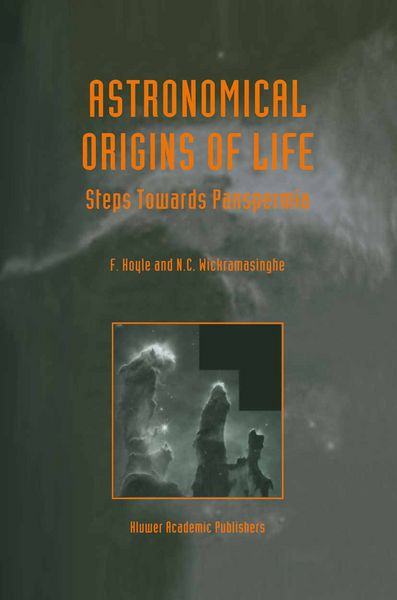
Astronomical Origins of Life Steps Towards Panspermia

Fr. 191.00

inkl. gesetzl. MwSt., Versandkostenfrei


Beschreibung

Produktdetails

Einband

Taschenbuch

Erscheinungsdatum

13.10.2012

Abbildungen

VIII, 381 p.

Verlag

Springer Netherland

Seitenzahl

381

Maße (L/B/H)

24/16/2.2 cm

Gewicht

625 g

Auflage

Softcover reprint of the original 1st ed. 2000

Sprache

Englisch

ISBN

978-94-010-5862-9

Beschreibung

Produktdetails

Einband

Taschenbuch

Erscheinungsdatum

13.10.2012

Abbildungen

VIII, 381 p.

Verlag

Springer Netherland

Seitenzahl

381

Maße (L/B/H)

24/16/2.2 cm

Gewicht

625 g

Auflage

Softcover reprint of the original 1st ed. 2000

Sprache

Englisch

ISBN

978-94-010-5862-9

Herstelleradresse

Springer-Verlag KG
Sachsenplatz 4-6
1201 Wien
AT

Email: ProductSafety@springernature.com

Noch keine Bewertungen vorhanden

Verfassen Sie die erste Bewertung zu diesem Artikel

Helfen Sie anderen Kundinnen und Kunden durch Ihre Meinung.

Kundinnen und Kunden meinen

Bewertungen (0)

  • Produktbild: Astronomical Origins of Life
  • Produktbild: Astronomical Origins of Life
  • Panspermia 2000.- 1. General Considerations.- On a Possibly Fundamental Principle in Chemistry as Viewed in a Cosmogonic Context.- Biological Activity in the Early Solar System in its Outer Regions.- An Object within a Particle of Extraterrestrial Origin Compared with an Object of Presumed Terrestrial Origin.- The Viability with Respect to Temperature of Micro-Organisms Incident on the Earth’s Atmosphere.- A Laboratory Experiment with Relevance to the Survival of Micro-Organisms Entering a Planetary Atmosphere.- Biological Evolution.- Metallic Particles in Astronomy.- The Universe and Life: Deductions from the Weak Anthropic Principle.- Miller-Urey Synthesis in the Nuclei of Galaxies.- 2. Cosmic Organic Polymers.- Formaldehyde Polymers in Interstellar Space.- Formaldehyde Polymers in Comets.- Composition of Cometary Dust: the Case against Silicates.- Primitive Grain Clumps and Organic Compounds in Carbonaceous Chondrites.- Spectroscopic Evidence for Interstellar Grain Clumps in Meteoritic Inclusions.- Calculations of Infrared Fluxes from Galactic Sources for a Polysaccharide Grain Model.- 3. Cosmic Micro-Organisms: Infrared Characterisation.- Infrared Spectroscopy of Micro-Organisms Near 3.4 ?m in Relation to Geology and Astronomy.- Infrared Spectroscopy over the 2.9-3.9 ?m Waveband in Biochemistry and Astronomy.- 2.8-3.6 ?m Spectra of Micro-Organisms with Varying H2O Ice-Content.- Organo-Siliceous Biomolecules and the Infrared Spectrum of the Trapezium Nebula.- The Spectroscopic Identification of Interstellar Grains.- The Availability of Phosphorus in the Bacterial Model of the Interstellar Grains.- Diatoms on Earth, Comets, Europa an. i. Interstellar Space.- A Diatom Model of Dust in the Trapezium Nebula.- Infrared Evidence for Panspermia: An Update.- 4. Evidencefrom Interstellar Extinction.- On the Nature of Interstellar Grains.- A Model for Interstellar Extinction.- The Ultraviolet Absorbance of Presumably Interstellar Bacteria and Related Matters.- The Case against Graphite Particles in Interstellar Space.- 5. Biogenic Aromatic Molecules in Space.- Organic Molecules in Interstellar Dust: A Possible Spectral Signature at ?.2200Å?.- Identification of the ? 2 200 Å Interstellar Absorption Feature.- A Unified Model for the 3.28 ? Emission and the 2200 Å Interstellar Extinction Feature.- Aromatic Hydrocarbons in Very Small Interstellar Grains.- An Integrated 2.5-12.5 ?m Emission Spectrum of Naturally-Occurring Aromatic Molecules.- Biofluorescence and the Extended Red Emission in Astrophysical Sources.- 6. Comets and Life.- Comets, Ice Ages, and Ecological Catastrophes.- Comets - A Vehicle for Panspermia.- Some Predictions on the Nature of Comet Halley.- A Model of the 2-1 ?m Spectrum of Comet Halley.- Modelling the 5-30 ?ectrum of Comet Halley.- Very Small Dust Particles (VSDP’met C/19962 B2 (Hyakutake).- The Astonishing Redness of Kuiper-Belt Objects.- Eruptions of Comet Hale-Bopp at 6.5 AU.- Infrared Radiation from Comet Hale-Bopp.