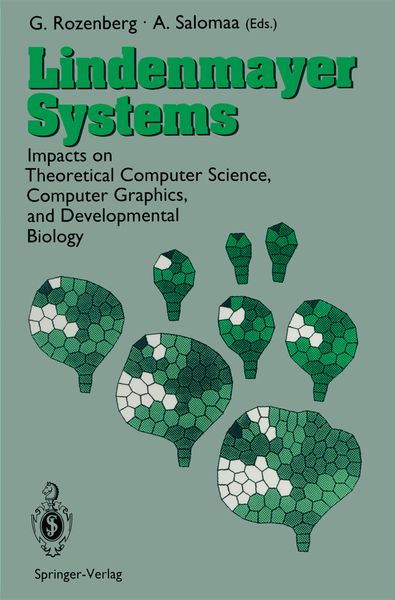
Lindenmayer Systems Impacts on Theoretical Computer Science, Computer Graphics, and Developmental Biology
-
- Hardcover
- Taschenbuch ausgewählt
-
Sprache:Englisch
Fr. 209.00
inkl. gesetzl. MwSt.,
Beschreibung
Produktdetails
Einband
Taschenbuch
Erscheinungsdatum
24.10.2012
Abbildungen
IX, 514 p.
Herausgeber
Grzegorz Rozenberg + weitereVerlag
Springer BerlinSeitenzahl
514
Maße (L/B/H)
23.5/15.5/2.9 cm
Gewicht
791 g
Auflage
Softcover reprint of the original 1st ed. 1992
Sprache
Englisch
ISBN
978-3-642-63474-1
L systems are language-theoretic models for developmental
biology. They wereintroduced in 1968 by Aristid Lindenmayer
(1925-1989) and have proved to be among the most beautiful
examples of interdisciplinary science, where work in one
area induces fruitful ideas and results in other areas. L
systemsare based on relational and set-theoretic concepts,
which are more suitable for the discrete and combinatorial
structures of biology than mathematical models based on
calculus or statistics. L systems have stimulated new work
not only in the realistic simulation of developing organisms
but also in the theory of automata and formal languages,
formal power series, computer graphics, and combinatorics of
words.
This book contains research papers by almost all leading
authorities and by many of the most promising young
researchers in the field. The 28 contributions are organized
in sections on basic L systems, computer graphics, graph
grammars and map L systems, biological aspects and models,
and variations and generalizations of L systems. The
introductory paper by Lindenmayer and J}rgensen was written
for a wide audience and is accessible to the non-specialist
reader.
The volume documents the state of the art in the theory of L
systems and their applications. It will interest researchers
and advanced students in theoretical computer science and
developmental biology as well as professionals in computer
graphics.
biology. They wereintroduced in 1968 by Aristid Lindenmayer
(1925-1989) and have proved to be among the most beautiful
examples of interdisciplinary science, where work in one
area induces fruitful ideas and results in other areas. L
systemsare based on relational and set-theoretic concepts,
which are more suitable for the discrete and combinatorial
structures of biology than mathematical models based on
calculus or statistics. L systems have stimulated new work
not only in the realistic simulation of developing organisms
but also in the theory of automata and formal languages,
formal power series, computer graphics, and combinatorics of
words.
This book contains research papers by almost all leading
authorities and by many of the most promising young
researchers in the field. The 28 contributions are organized
in sections on basic L systems, computer graphics, graph
grammars and map L systems, biological aspects and models,
and variations and generalizations of L systems. The
introductory paper by Lindenmayer and J}rgensen was written
for a wide audience and is accessible to the non-specialist
reader.
The volume documents the state of the art in the theory of L
systems and their applications. It will interest researchers
and advanced students in theoretical computer science and
developmental biology as well as professionals in computer
graphics.
Noch keine Bewertungen vorhanden
Verfassen Sie die erste Bewertung zu diesem Artikel
Helfen Sie anderen Kundinnen und Kunden durch Ihre Meinung.