
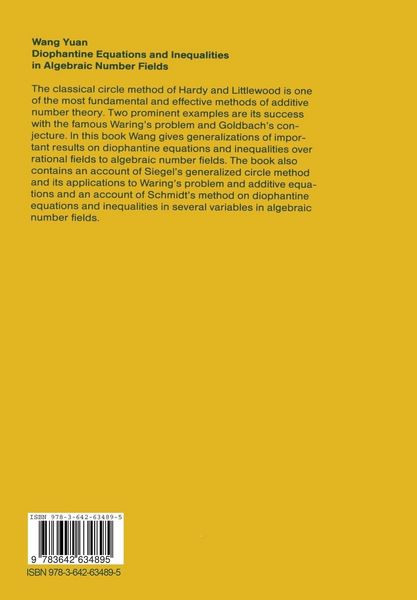
• Produktbild: Diophantine Equations and Inequalities in Algebraic Number Fields
  • Produktbild: Diophantine Equations and Inequalities in Algebraic Number Fields

Diophantine Equations and Inequalities in Algebraic Number Fields

Fr. 73.90

inkl. gesetzl. MwSt., Versandkostenfrei


Beschreibung

Produktdetails

Einband

Taschenbuch

Erscheinungsdatum

18.10.2012

Abbildungen

XVI, 170 p.

Verlag

Springer Berlin

Seitenzahl

170

Maße (L/B/H)

24.2/17/1.1 cm

Gewicht

339 g

Sprache

Englisch

ISBN

978-3-642-63489-5

Beschreibung

Produktdetails

Einband

Taschenbuch

Erscheinungsdatum

18.10.2012

Abbildungen

XVI, 170 p.

Verlag

Springer Berlin

Seitenzahl

170

Maße (L/B/H)

24.2/17/1.1 cm

Gewicht

339 g

Sprache

Englisch

ISBN

978-3-642-63489-5

Herstelleradresse

Springer-Verlag KG
Sachsenplatz 4-6
1201 Wien
AT

Email: ProductSafety@springernature.com

Noch keine Bewertungen vorhanden

Verfassen Sie die erste Bewertung zu diesem Artikel

Helfen Sie anderen Kundinnen und Kunden durch Ihre Meinung.

Kundinnen und Kunden meinen

Bewertungen (0)

  • Produktbild: Diophantine Equations and Inequalities in Algebraic Number Fields
  • Produktbild: Diophantine Equations and Inequalities in Algebraic Number Fields
  • 1. The Circle Method and Waring’s Problem.- 1.1 Introduction.- 1.2 Farey Division.- 1.3 Auxiliary Lemmas.- 1.4 Major Arcs.- 1.5 Singular Integral.- 1.6 Singular Series.- 1.7 Proof of Lemma 1.12.- 1.8 Proof of Theorem 1.1.- Notes.- 2. Complete Exponential Sums.- 2.1 Introduction.- 2.2 Several Lemmas.- 2.3 Mordell’s Lemma.- 2.4 Fundamental Lemma.- 2.5 Proof of Theorem 2.1.- 2.6 Proof of Theorem 2.2.- Notes.- 3. Weyl’s Sums.- 3.1 Introduction.- 3.2 Proof of Theorem 3.1.- 3.3 A Lemma on Units.- 3.4 The Asymptotic Formula for N(a,T).- 3.5 A Sum.- 3.6 Mitsui’s Lemma.- 3.7 Proof of Theorem 3.3.- 3.8 Proof of Lemma 3.6.- 3.9 Continuation.- Notes.- 4. Mean Value Theorems.- 4.1 Introduction.- 4.2 Proof of Theorem 4.1.- 4.3 Proof of Theorem 4.2.- 4.4 A Lemma on the Set D.- 4.5 A Lemma on the Set D(x).- 4.6 Fundamental Lemma.- 4.7 Proof of Lemma 4.1.- Notes.- 5. The Circle Method in Algebraic Number Fields.- 5.1 Introduction.- 5.2 Lemmas.- 5.3 Asympotic Expansion forSi (?, T).- 5.4 Further Estimates on Basic Domains.- 5.5 Proof of Theorem 5.1.- 5.6 Proof of Theorem 5.2.- Notes.- 6. Singular Series and Singular Integrals.- 6.1 Introduction.- 6.2 Product Form for Singular Series.- 6.3 Singular Series and Congruences.- 6.4 p-adic Valuations.- 6.5 k-th Power Residues.- 6.6 Proof of Theorem 6.1.- 6.7 Monotonic Functions.- 6.8 Proof of Theorem 6.2.- Notes.- 7. Waring’s Problem.- 7.1 Introduction.- 7.2 The Ring Jk.- 7.3 Proofs of Theorems 7.1 and 7.2.- 7.4 Proof of Theorem 7.3.- 7.5 Proof of Theorem 7.4.- Notes.- 8. Additive Equations.- 8.1 Introduction.- 8.2 Reductions.- 8.3 Contraction.- 8.4 Derived Variables.- 8.5 Proof of Theorem 8.1.- 8.6 Proof of Theorem 8.2.- 8.7 Bounds for Solutions.- Notes.- 9. Small Nonnegative Solutions of Additive Equations.- 9.1 Introduction.- 9.2Hurwitz’s Lemma.- 9.3 Reductions.- 9.4 Continuation.- 9.5 Farey Division.- 9.6 Supplementary Domain.- 9.7 Basic Domains.- 9.8 Proof of Theorem 9.1.- Notes.- 10. Small Solutions of Additive Equations.- 10.1 Introduction.- 10.2 Reductions.- 10.3 Continuation.- 10.4 Farey Division.- 10.5 Supplementary Domain.- 10.6 Basic Domains.- 10.7 Proof of Theorem 10.1.- Notes.- 11. Diophantine Inequalities for Forms.- 11.1 Introduction.- 11.2 A Single Additive Form.- 11.3 A Variant Circle Method.- 11.4 Continuation.- 11.5 Proof of Lemma 11.1.- 11.6 Linear Forms.- 11.7 A Single Form.- 11.8 Proof of Theorem 11.1.- Notes.- References I.- References II.