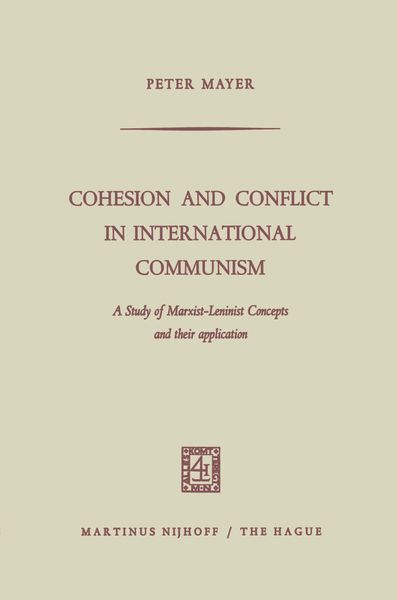

Cohesion and Conflict in International Communism A Study of Marxist-Leninist Concepts and Their Application
-
- Taschenbuch ausgewählt
- eBook
-
Sprache:Englisch
Fr. 137.00
inkl. gesetzl. MwSt.,
Beschreibung
Produktdetails
Einband
Taschenbuch
Erscheinungsdatum
01.01.1968
Verlag
Springer NetherlandSeitenzahl
257
Maße (L/B/H)
23.5/15.5/1.6 cm
Auflage
1. Auflage
Sprache
Englisch
ISBN
978-94-015-0030-2
The current conflict which threatens the very existence of the inter national communist movement as a single coherent entity must be looked for in the roots of Marxian philosophy. The central concept of pre-Leninist communism is contained in the notion of "proletarian internationalism. " Yet the emergence of the communist party-states has been squarely predicated on the requirements of single national states, as viewed through the training and experience of the various communist leaders. Thus the Soviet version has been shaped by the nationalism of Lenin, Stalin, and Khrushchev. The only aberrant case, the internationalism of Trotsky, was doomed to failure. The Chinese version of "communism" has as its root concepts the spirit of "prolonged" struggle against a superior enemy, whose ultimate defeat is ensured through the dialectics of political growth. The non communist societies are by definition "decadent. " The movement came to power by exploiting the nationalism engendered within China by the Japanese invasion. Its mass support was based on the peasantry, although the transparent fiction of "proletarian leadership" was strictly maintained. Further, "communism" is a term which has lost its original encompassing definition. Peking now narrowly defines it as policies consonant with "the thought of Mao Tse-tung. " Thus both the Soviet and the Chinese interpretation of "commun ism" are based on a concept which was anathema to the intellectual founders of the movement.
Kundinnen und Kunden meinen
Verfassen Sie die erste Bewertung zu diesem Artikel
Helfen Sie anderen Kund*innen durch Ihre Meinung