KI-Beratung Beta

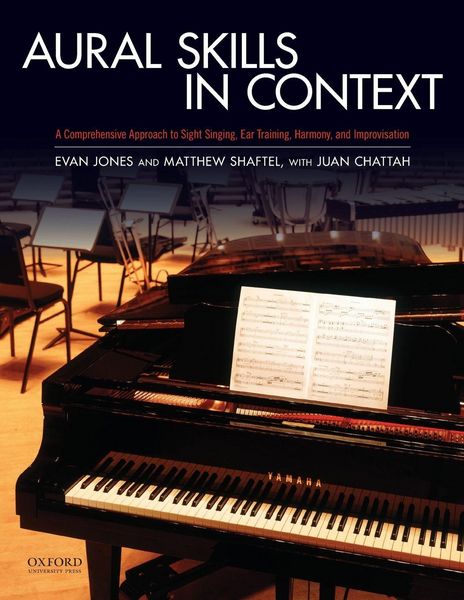
Produktbild: Aural Skills in Context

Aural Skills in Context A Comprehensive Approach to Sight Singing, Ear Training, Keyboard Harmony, and Improvisation

Fr. 262.00

inkl. gesetzl. MwSt., Versandkostenfrei


Beschreibung

Aural Skills in Context takes a comprehensive approach to sight singing, ear training, and rhythm practice. By featuring real examples from classical music to folk and jazz, and offering melodies with their related harmonies, the text parallels the full Music Theory curriculum and reinforces the relevance...

Beschreibung

Aural Skills in Context takes a comprehensive approach to sight singing, ear training, and rhythm practice. By featuring real examples from classical music to folk and jazz, and offering melodies with their related harmonies, the text parallels the full Music Theory curriculum and reinforces the relevance of aural skills to students' other classes, as well as their performance and listening interests.

Produktdetails

Einband

Taschenbuch

Erscheinungsdatum

01.10.2013

Verlag Oxford University Press
Seitenzahl

866

Produktdetails

Einband

Taschenbuch

Erscheinungsdatum

01.10.2013

Verlag Oxford University Press
Seitenzahl

866

Maße (L/B/H)

28/21.6/4.6 cm

Gewicht

2132 g

Sprache

Englisch

ISBN

978-0-19-994382-1

Herstelleradresse

Libri GmbH
Europaallee 1
36244 Bad Hersfeld
DE

Email: gpsr@libri.de

Noch keine Bewertungen vorhanden

Verfassen Sie die erste Bewertung zu diesem Artikel

Helfen Sie anderen Kundinnen und Kunden durch Ihre Meinung.

Kundinnen und Kunden meinen

Bewertungen (0)

  • Produktbild: Aural Skills in Context

    • Preface: Pedagogical Approach, Curricular Planning, Practicalities


    • The Foundations of Aural Skills


    • . Introduction to the Student


    • . Major and Minor Scales and Simple Intervals


    • . Basic Rhythmic Patterns


    • . Conducting of Simple Meters


    • . Neighbor and Passing Tones in a Stepwise Context


    • . Keyboard Orientation


    • . First Steps in Improvisation


    • . Tonic Triad


    • . Practice in Multiple Clefs


    • . Six-Step Method for Dictation


    • . Introduction to Smartmusic


    • Unit 1: The Diatonic Scale Degrees


    • Chapter 1: Tonic Triad and its Melodies


    • . Tonic Triad as Melodic Basis


    • . Major and Minor Scales in Context


    • . First Five Notes of the Scale


    • Chapter 2: Submediant Scale Degree and Major Pentatonic


    • . Submediant Scale Degree


    • . The I-V-I Harmonic Paradigm


    • . Major Pentatonic Scale


    • . Introduction to Compound Meter


    • Chapter 3: Seventh Scale Degree and Minor Pentatonic


    • . Minor Pentatonic Scale


    • . Compound Meter


    • . Leading Tone and Subtonic Scale Degree


    • . Subdominant Harmony


    • Chapter 4: Plagal Melodies I


    • . Upper and Lower Dominant Scale Degrees


    • . First Inversion Triads


    • . Expanding the Melodic Range Beyond the Octave


    • Chapter 5: Plagal Melodies II


    • . Syncopation


    • . Changing Meters


    • . Harmonic Study of Tonic Prolongation


    • Chapter 6: The Octave and Beyond


    • . Excerpts that Span the Entire Octave and Beyond


    • . Periodic Structures (Parallel Period)


    • . Inconclusive and Conclusive Cadences


    • Chapter 7: Complete Examples from the Repertoire


    • . Reviewing Unit I through Complete Works


    • . Focus on Rhythm in a Non-Pitched Work


    • Unit II: Diatonic Contexts and Introduction to Chromatic Pitches


    • Chapter 8: Diatonic Sequences


    • . Ascending and Descending Fifths Sequence


    • . Descending Thirds Sequence


    • . Ground Bass


    • . Harmonic Study of Tonic Prolongation: viio6, Passing 6/4, and Inversions of V7


    • Chapter 9: Diatonic Sequences II and


    • . New Rhythmic Configurations


    • . Ascending Seconds Sequence


    • . Quasi-Sequential Progressions


    • . Four-Part Schemata of Sequences


    • Chapter 10: Motivic Development and the Sentence


    • . Sentence Structure


    • . Expansions and Extensions of Sentences


    • . Harmonic Study of Tonic Prolongation: Combination of Predominants with Inversions of vii° and V7


    • Chapter 11: Chromatic Neighbor Tones


    • . Chromatic Neighbor Tones as Surface-Level Embellishments


    • . Resolution of Chromatic-Altered Pitches


    • . Chromatic Solmization Syllables (Ascending: di, ri, fi, si, li; Descending: te, le, se, me)


    • . Cadential Progressions with vi and ii


    • . Cadential 6/4


    • Chapter 12: Chromatic Passing Tones


    • . Chromatic Passing Tones as Surface-Level Embellishments


    • . Harmonic Study of Mediant and Subtonic Triads


    • Chapter 13: Beyond the Stepwise Context


    • . Delayed Resolutions of Chromatic Pitches


    • . Harmonic Study of Tonicization via


    • Chapter 14: Complete Examples from the Repertoire


    • . Reviewing Unit II through Complete Works


    • . Focus on Rhythm in a Non-Pitched Work


    • Unit III: Advanced Melodies, Modulation, and Introduction to Musical Form


    • Chapter 15: Melodic Chromaticism


    • . Chromatic Melodies and Bass Lines


    • . Singing Complete Musical Forms


    • . Extended Melodic Range


    • . Lowered Supertonic Scale Degree


    • . Harmonic Study of Tonicization via


    • Chapter 16: Modulation


    • . Tonicization vs. Modulation


    • . Modulation to the Dominant


    • . Harmonic Study of Tonicization via


    • Chapter 17: Simple Binary Form


    • . Categories and Classification of Binary Forms based on Harmonic Design


    • . Harmonic Study of Tonicization via


    • Chapter 18: Rounded and Balanced Binary Form


    • . Categories and Classification of Binary Forms based on Motivic Design


    • . Harmonic Study of Tonicization via and


    • Chapter 19: Modal Mixture


    • . Coloristic Use of Modal Mixture Chords


    • . Tendency of Tones in Modal Mixture Chords


    • . Tonicization of Modal Mixture Chords


    • . Modulation to Modally Mixed Tonal Areas


    • Chapter 20: Ternary Form


    • . Categories and Classification of Ternary Forms


    • . Harmonic Study of Chromatic Third Relations


    • Chapter 21: Neapolitan Triad and Common-Tone Diminished Seventh


    • . Neapolitan as Predominant Harmony


    • . Uses of Common-Tone Diminished Seventh


    • . Focus on Rhythm in a Non-Pitched Work


    • Unit IV: Advanced Chromaticism and Larger Forms


    • Chapter 22: Introduction to Augmented-Sixth Chords


    • . Augmented-Sixth Chords as Pre-Dominant Harmonies


    • . The Tritone Substitution in Jazz and Popular Music


    • . Harmonic Study of the Common-Tone Diminished Seventh


    • Chapter 23: Rondo Form


    • . Five-Part and Seven-Part Rondos


    • . Harmonic Study of Augmented Sixth Chords


    • Chapter 24: Further Uses of Augmented-Sixth Chords


    • . Use of Augmented-Sixth Chords in Larger Forms


    • . Advanced Uses of Augmented-Sixth Chords


    • Chapter 25: Sonata Form


    • . Basic Harmonic and Motivic Traits of Sonata Forms


    • . Introduction and Coda in Sonata Forms


    • . Harmonic Study of Complex Chromatic Progressions


    • Chapter 26: Advanced Melodic and Harmonic Chromaticism


    • . Equal Division of the Octave


    • . Complex Melodic Chromaticism


    • Chapter 27: Later Tonal Styles


    • . Post-Romantic, Impressionist, and Contemporary Tonal Styles