
KI-Beratung Beta

  • Produktbild: Genetic Programming and Data Structures
  • Produktbild: Genetic Programming and Data Structures
Band 1

Genetic Programming and Data Structures Genetic Programming + Data Structures = Automatic Programming!

Aus der Reihe Genetic Programming

Fr. 191.00

inkl. gesetzl. MwSt., Versandkostenfrei


Beschreibung

Computers that `program themselves' has long been an aim of computer scientists. Recently genetic programming (GP) has started to show its promise by automatically evolving programs. Indeed in a small number of problems GP has evolved programs whose performance is similar to or even slightly better than...

Beschreibung

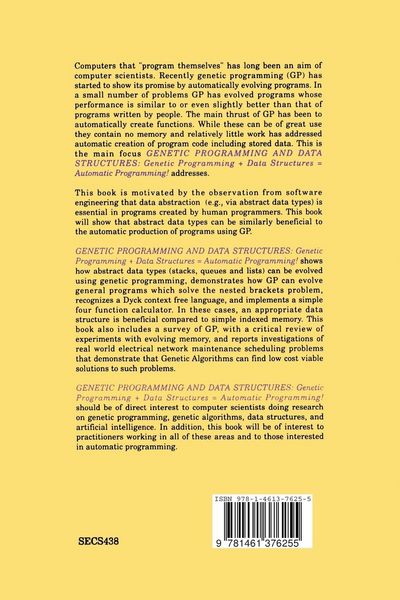
Computers that `program themselves' has long been an aim of computer scientists. Recently genetic programming (GP) has started to show its promise by automatically evolving programs. Indeed in a small number of problems GP has evolved programs whose performance is similar to or even slightly better than that of programs written by people. The main thrust of GP has been to automatically create functions. While these can be of great use they contain no memory and relatively little work has addressed automatic creation of program code including stored data. This issue is the main focus of Genetic Programming, and Data Structures: Genetic Programming + Data Structures = Automatic Programming! .
This book is motivated by the observation from software engineering that data abstraction (e.g., via abstract data types) is essential in programs created by human programmers. This book shows that abstract data types can be similarly beneficial to the automatic production of programs using GP.
Genetic Programming and Data Structures: Genetic Programming + Data Structures = Automatic Programming! shows how abstract data types (stacks, queues and lists) can be evolved using genetic programming, demonstrates how GP can evolve general programs which solve the nested brackets problem, recognises a Dyck context free language, and implements a simple four function calculator. In these cases, an appropriate data structure is beneficial compared to simple indexed memory. This book also includes a survey of GP, with a critical review of experiments with evolving memory, and reports investigations of real world electrical network maintenance scheduling problems that demonstrate that Genetic Algorithms can find low cost viable solutions to such problems.
Genetic Programming and Data Structures: Genetic Programming + Data Structures = Automatic Programming! should be of direct interest to computer scientists doing research on genetic programming, genetic algorithms, data structures, and artificial intelligence. In addition, this book will be of interest to practitioners working in all of these areas and to those interested in automatic programming.

Rezension

`
The book is nicely produced ... and well illustrated. The text is well written and is easy to read and understand. The concepts in genetic programming are well presented, as are those in genetic algorithms. The references are selected to be useful. People of a non-mathematical disposition will find few problems in reading this book.
'
Robotica, 17 (1999)

Produktdetails

Einband

Taschenbuch

Erscheinungsdatum

29.10.2012

Abbildungen

XIII, 279 p.

Verlag Springer Us

Produktdetails

Einband

Taschenbuch

Erscheinungsdatum

29.10.2012

Abbildungen

XIII, 279 p.

Verlag Springer Us
Seitenzahl

279

Maße (L/B/H)

23.5/15.5/1.7 cm

Gewicht

452 g

Auflage

Softcover reprint of the original 1st ed. 1998

Sprache

Englisch

ISBN

978-1-4613-7625-5

Herstelleradresse

Springer-Verlag KG
Sachsenplatz 4-6
1201 Wien
AT

Email: ProductSafety@springernature.com

Noch keine Bewertungen vorhanden

Verfassen Sie die erste Bewertung zu diesem Artikel

Helfen Sie anderen Kundinnen und Kunden durch Ihre Meinung.

Kundinnen und Kunden meinen

Bewertungen (0)

  • Produktbild: Genetic Programming and Data Structures
  • Produktbild: Genetic Programming and Data Structures
  • 1. Introduction.- 1.1 What is Genetic Programming?.- 1.2 Motivation.- 1.3 Outline.- 2. Survey.- 2.1 Introduction.- 2.2 Genetic Algorithms.- 2.3 Genetic Programming.- 2.4 GP Research.- 2.5 GP Applications.- 2.6 Conclusions.- 3. Advanced Genetic Programming Techniques.- 3.1 Background.- 3.2 Tournament Selection.- 3.3 Steady State Populations.- 3.4 Indexed memory.- 3.5 Scalar Memory.- 3.6 Multi-tree programs.- 3.7 Directed Crossover.- 3.8 Demes.- 3.9 Pareto Optimality.- 3.10 Conclusions.- 4. Evolving a Stack.- 4.1 Problem Statement.- 4.2 Architecture.- 4.3 Choice of Primitives.- 4.4 Fitness Function.- 4.5 Parameters.- 4.6 Results.- 4.7 Summary.- 5. Evolving a Queue.- 5.1 Problem Statement.- 5.2 Architecture.- 5.3 Choice of Primitives.- 5.4 Fitness Functions.- 5.5 Parameters.- 5.6 Automatically Defined Functions.- 5.7 Evolved Solutions — Caterpillar.- 5.8 Evolved Programs — Shuffler.- 5.9 Circular Buffer — Given Modulus Increment.- 5.10 Circular Buffer — Evolving Modulus Increment.- 5.11 Discussion: Building Blocks and Introns.- 5.12 Summary.- 6. Evolving a List.- 6.1 Problem Statement.- 6.2 Architecture.- 6.3 Automatically Defined Functions.- 6.4 Choice of Primitives.- 6.5 Fitness Function.- 6.6 Directed Crossover.- 6.7 Parameters.- 6.8 Results.- 6.9 Software Maintenance.- 6.10 Discussion.- 6.11 Conclusions.- 7. Problems Solved Using Data Structures.- 7.1 Balanced Bracket Problem.- 7.2 Dyck Language.- 7.3 Evaluating Reverse Polish Expressions.- 7.4 Work by Others on Solving Problems with Memory.- 7.5 Summary.- 8. Evolution of GP Populations.- 8.1 Price’s Selection and Covariance Theorem.- 8.2 Fisher’s Fundamental Theorem of Natural Selection.- 8.3 Evolution of Stack Problem Populations.- 8.4 Loss of Variety.- 8.5 Measurements of GP Crossover’s Effects.- 8.6Discussion.- 8.7 Summary.- 9. Conclusions.- 9.1 Recommendations.- 9.2 Future work.- References.- Appendices.- A–Number of Fitness Evaluations Required.- B–Glossary.- C–Scheduling Planned Maintenance of the National Grid.- C.1 Introduction.- C.2 The Electricity Transmission Network in Great Britain.- C.3 The South Wales Region of the UK Electricity Network.- C.4 Approximating Replacement Generation Costs.- C.5 The Fitness Function.- C.6 The Chromosome.- C.7 Greedy Optimisers.- C.8 South Wales Problem without Contingencies.- C.9 South Wales and Genetic Programming.- C.10 South Wales Problem with Contingencies.- C.11 Conclusions.- C.12 Future Work.- C.13 Using QGAME.- D–Implementation.- D.1 GP-QUICK.- D.2 Coding Changes to GP-QUICK-2.1.- D.3 Default Parameters.- D.4 Network Running.- D.5 Reusing Ancestors Fitness Information.- D.6 Caches.- D.7 Compressing the Check Point File.- D.8 Benchmarks.- D.9 Code.