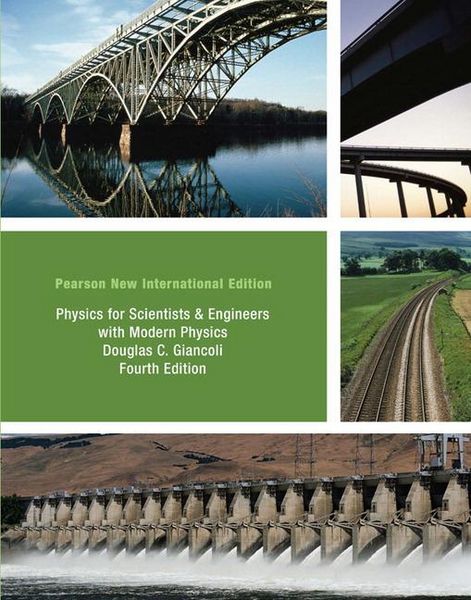
Produktbild: Giancoli, D: Physics for Scientists & Engineers with Modern

Giancoli, D: Physics for Scientists & Engineers with Modern With modern physics

Fr. 84.90

inkl. gesetzl. MwSt., Versandkostenfrei


Beschreibung

Produktdetails

Einband

Taschenbuch

Erscheinungsdatum

31.07.2013

Verlag

Pearson Academic

Maße (L/B/H)

22.4/27.9/5.4 cm

Gewicht

14380 g

Sprache

Englisch

ISBN

978-1-4479-6528-2

Beschreibung

Produktdetails

Einband

Taschenbuch

Erscheinungsdatum

31.07.2013

Verlag

Pearson Academic

Maße (L/B/H)

22.4/27.9/5.4 cm

Gewicht

14380 g

Sprache

Englisch

ISBN

978-1-4479-6528-2

Noch keine Bewertungen vorhanden

Verfassen Sie die erste Bewertung zu diesem Artikel

Helfen Sie anderen Kundinnen und Kunden durch Ihre Meinung.

Kundinnen und Kunden meinen

Bewertungen (0)

  • Produktbild: Giancoli, D: Physics for Scientists & Engineers with Modern
  • CONTENTS OF VOLUME 1


    APPLICATIONS LIST xii

    PREFACE xiv

    AVAILABLE SUPPLEMENTS AND MEDIA xxii

    NOTES TO STUDENTS (AND INSTRUCTORS) ON THE FORMAT xxiv

    COLOR USE: VECTORS, FIELDS, AND SYMBOLS xxv


    CHAPTER1: INTRODUCTION, MEASUREMENT, ESTIMATING

    1—1 The Nature of Science

    1—2 Models, Theories, and Laws

    1—3 Measurement and Uncertainty; Significant Figures

    1—4 Units, Standards, and the SI System

    1—5 Converting Units

    1—6 Order of Magnitude: Rapid Estimating

    *1—7 Dimensions and Dimensional Analysis

    SUMMARY

    QUESTIONS

    PROBLEMS

    GENERAL PROBLEMS


    CHAPTER 2: DESCRIBING MOTION: KINEMATICS IN ONE DIMENSION

    2—1 Reference Frames and Displacement

    2—2 Average Velocity

    2—3 Instantaneous Velocity

    2—4 Acceleration

    2—5 Motion at Constant Acceleration

    2—6 Solving Problems

    2—7 Freely Falling Objects

    *2—8 Variable Acceleration; Integral Calculus

    *2—9 Graphical Analysis and Numerical Integration

    SUMMARY

    QUESTIONS

    PROBLEMS

    GENERAL PROBLEMS


    CHAPTER 3: KINEMATICS IN TWO OR THREE DIMENSIONS; VECTORS

    3—1 Vectors and Scalars

    3—2 Addition of Vectors–Graphical Methods

    3—3 Subtraction of Vectors, and Multiplication of a Vector by a Scalar

    3—4 Adding Vectors by Components

    3—5 Unit Vectors

    3—6 Vector Kinematics

    3—7 Projectile Motion

    3—8 Solving Problems Involving Projectile Motion

    3—9 Relative Velocity

    SUMMARY

    QUESTIONS

    PROBLEMS

    GENERAL PROBLEMS


    CHAPTER 4: DYNAMICS: NEWTON’S LAWS OF MOTION

    4—1 Force

    4—2 Newton’s First Law of Motion

    4—3 Mass

    4—4 Newton’s Second Law of Motion

    4—5 Newton’s Third Law of Motion

    4—6 Weight–the Force of Gravity; and the Normal Force

    4—7 Solving Problems with Newton’s Laws: Free-Body Diagrams

    4—8 Problem Solving–A General Approach

    SUMMARY

    QUESTIONS

    PROBLEMS

    GENERAL PROBLEMS


    CHAPTER 5: USING NEWTON’S LAWS: FRICTION, CIRCULAR MOTION, DRAG FORCES

    5—1 Applications of Newton’s Laws Involving Friction

    5—2 Uniform Circular Motion–Kinematics

    5—3 Dynamics of Uniform Circular Motion

    5—4 Highway Curves: Banked and Unbanked

    *5—5 Nonuniform Circular Motion

    *5—6 Velocity-Dependent Forces: Drag and Terminal Velocity

    SUMMARY

    QUESTIONS

    PROBLEMS

    GENERAL PROBLEMS


    CHAPTER 6: GRAVITATION AND NEWTON’S6 SYNTHESIS

    6—1 Newton’s Law of Universal Gravitation

    6—2 Vector Form of Newton’s Law of Universal Gravitation

    6—3 Gravity Near the Earth’s Surface; Geophysical Applications

    6—4 Satellites and “Weightlessness”

    6—5 Kepler’s Laws and Newton’s Synthesis

    *6—6 Gravitational Field

    6—7 Types of Forces in Nature

    *6—8 Principle of Equivalence; Curvature of Space; Black Holes

    SUMMARY

    QUESTIONS

    PROBLEMS

    GENERAL PROBLEMS


    CHAPTER 7: WORK AND ENERGY

    7—1 Work Done by a Constant Force

    7—2 Scalar Product of Two Vectors

    7—3 Work Done by a Varying Force

    7—4 Kinetic Energy and the Work-Energy Principle

    SUMMARY

    QUESTIONS

    PROBLEMS

    GENERAL PROBLEMS


    CHAPTER 8: CONSERVATION OF ENERGY

    8—1 Conservative and Nonconservative Forces

    8—2 Potential E