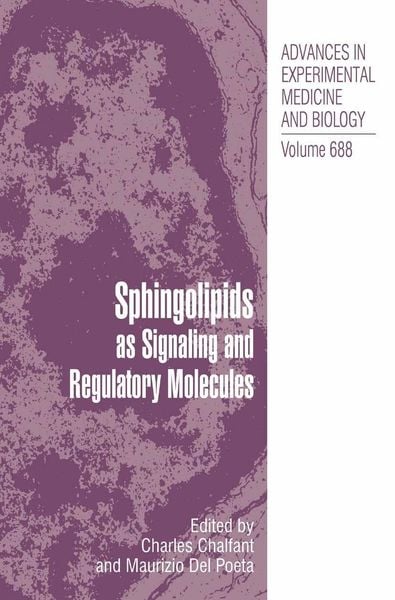
Produktbild: Sphingolipids as Signaling and Regulatory Molecules
Band 688

Sphingolipids as Signaling and Regulatory Molecules

Fr. 250.90

inkl. gesetzl. MwSt.

Beschreibung

Produktdetails

Format

PDF

Kopierschutz

Nein

Family Sharing

Nein

Text-to-Speech

Nein

Erscheinungsdatum

12.01.2011

Herausgeber

Charles Chalfant + weitere

Verlag

Springer Us

Seitenzahl

291 (Printausgabe)

Dateigröße

8753 KB

Sprache

Englisch

EAN

9781441967411

Beschreibung

Portrait

CHARLES CHALFANT is a tenured Associate Professor of Biochemistry and Molecular Biology at Virginia Commonwealth University-School of Medicine. He is also a Research Career Scientist in the Veterans Administration based at the Hunter Holmes McGuire Veterans Administration Medical Center in Richmond, Virginia. His main research interests lie in lipid signaling, specifically the role of intracellular lipid second messengers (e.g., ceramide-1-phosphate) in regulating eicosanoid synthesis. He also studies the role of oncogenic signaling pathways in regulating the alternative splicing of tumor suppressor genes such as caspase 9. Dr. Chalfant serves on the Editorial Board of The Journal of Lipid Research as well as on several National Panels of Scientific Review including formal membership on the Cancer Molecular Pathobiology Study Section for the National Institutes of Health and the Oncology A Study Section for the Veterans Administration. He received his PhD degree from the University of South Florida-College of Medicine and did his postdoctoral studies at Duke University and the Medical University of South Carolina. MAURIZIO DEL POETA , MD is a tenured Associate Professor of Biochemistry and Molecular Biology, Microbiology and Immunology, Craniofacial Biology, and for the Division of Infectious Diseases at the Medical University of South Carolina, Charleston, South Carolina, USA. He is also the Director of the Graduate Program in Biochemistry and Molecular Biology at MUSC. Main research interests include the study of the role of sphingolipids in fungal pathogenesis and the development of new diagnostic and therapeutic strategies against fungal infections. He received many awards for his research discoveries and teaching. He is also a member of
many national and international societies such as the American Society for Clinical Investigation (ASCI), the American Society for Biochemistry and Molecular Biology, and the American Society for Microbiology. Dr. Del Poeta is a Burroughs Wellcome New Investigator in the Pathogenesis of Infectious Diseases.

Produktdetails

Format

PDF

eBooks im PDF-Format haben eine festgelegte Seitengröße und eignen sich daher nur bedingt zum Lesen auf einem tolino eReader oder Smartphone. Für den vollen Lesegenuss empfehlen wir Ihnen bei PDF-eBooks die Verwendung eines Tablets oder Computers.

Kopierschutz

Nein

Dieses eBook können Sie uneingeschränkt auf allen Geräten der tolino Familie, allen sonstigen eReadern und am PC lesen. Das eBook ist nicht kopiergeschützt und kann ein personalisiertes Wasserzeichen enthalten. Weitere Hinweise zum Lesen von eBooks mit einem personalisierten Wasserzeichen finden Sie unter Hilfe/Downloads.

Family Sharing

Nein

Mit Family Sharing können Sie eBooks innerhalb Ihrer Familie (max. sechs Mitglieder im gleichen Haushalt) teilen. Sie entscheiden selbst, welches Buch Sie mit welchem Familienmitglied teilen möchten. Auch das parallele Lesen durch verschiedene Familienmitglieder ist durch Family Sharing möglich. Um eBooks zu teilen oder geteilt zu bekommen, muss jedes Familienmitglied ein Konto bei Thalia oder einem anderen tolino-Buchhändler haben. Weitere Informationen finden Sie unter Hilfe/Family-Sharing.

Text-to-Speech

Nein

Bedeutet Ihnen Stimme mehr als Text? Mit der Funktion Text-to-Speech können Sie sich im tolino webReader und in der aktuellen Thalia – Lesen & Hören App das eBook vorlesen lassen. Weitere Informationen finden Sie unter Hilfe/Text-to-Speech.

Barrierefreiheit

  • keine Information zur Barrierefreiheit bekannt

Erscheinungsdatum

12.01.2011

Herausgeber

Verlag

Springer Us

Seitenzahl

291 (Printausgabe)

Dateigröße

8753 KB

Sprache

Englisch

EAN

9781441967411

Kundinnen und Kunden meinen

0 Bewertungen

Informationen zu Bewertungen

Zur Abgabe einer Bewertung ist eine Anmeldung im Konto notwendig. Die Authentizität der Bewertungen wird von uns nicht überprüft. Wir behalten uns vor, Bewertungstexte, die unseren Richtlinien widersprechen, entsprechend zu kürzen oder zu löschen.

Die Bewertungen sind nach Format, Anzahl Sterne und Datum sortiert.

Verfassen Sie die erste Bewertung zu diesem Artikel

Helfen Sie anderen Kund*innen durch Ihre Meinung

Kundinnen und Kunden meinen

0 Bewertungen filtern

Weitere Artikel finden Sie in

  • Produktbild: Sphingolipids as Signaling and Regulatory Molecules
  • 1. An Overview of Sphingolipid Metabolism: From Synthesis to Breakdown
    Christopher R. Gault, Lina M. Obeid and Yusuf A. Hannun
    Abstract
    Sphingolipid Properties in Membranes
    De Novo Synthesis in the ER
    Ceramide Transport from the ER to the Golgi
    Synthesis of Complex Sphingolipids
    Ceramide Kinase and Ceramide?1?Phosphate
    Catabolizing Complex Sphingolipids and Sphingomyelins into Ceramide
    The Catabolism of Ceramides and the Final Common Breakdown Pathway
    Conclusion
    2. Sphingolipid Transport
    Laura Riboni, Paola Giussani and Paola Viani
    Abstract
    Introduction
    Intramembrane Sphingolipid Movements
    Intermembrane Sphingolipid Transport
    Conclusion
    3. Sphingolipid Analysis by High Performance Liquid Chromatography?Ta ndem Mas Spectrometry (HPLC?MS/MS)
    Jacek Bielawski, Jason S. Pierce, Justin Snider, Barbara Rembiesa, Zdzislaw M. Szulc and Alicja Bielawska
    Abstract
    Introduction
    Sphingolipids: Structure and Composition
    LC?MS Methods for Detection and Analysis of Bioactive Sphingolipids
    Lipidomic Approach
    Sample Preparation
    Analysis of Intact Sphingolipids by Mass Spectrometry
    Mechanism of Electrospray Ionization Mass Spectrometry (ESI/MS)
    MS Scan Modes
    Specific Scan Modes for MS/MS Instrumentation
    Sphingolipid Identification
    HPLC?MS/MS Methodology
    Quantitation
    Selection of Internal Standards (ISs)
    Quantitative Calibration
    Data Handling
    Alternative Methodology
    Conclusion
    4. Ceramide Synthases: Roles in Cell Physiology and Signaling
    Johnny Stiban, Rotem Tidhar and Anthony H. Futerman
    Abstract
    Introduction
    Fatty Acid Specificity, Kinetics and Tissue Distribution
    Inhibitors
    Posttranslational Modifications
    Membrane Topology
    Why Are There So Many Mammalian CerS?
    Roles of CerS in Signal Transduction and Disease
    Conclusion
    5. Tales and Mysteries of the Enigmatic Sphingomyelin Synthase Family
    Joost C.M. Holthuis and Chiara Luberto
    Abstract
    Sphingomyelin Biosynthesis: An Historical Perspective
    The Multigenic Sphingomyelin Synthase (SMS) Family
    Cellular Functions of SMS FamilyMembers
    Conclusion
    6. Ceramide in Stress Response
    Mariana N. Nikolova?Karakashian and Krassimira A. Rozenova
    Abstract
    Introduction
    Chemical Structure and Biophysical Properties of Ceramide
    Changes in Ceramide Mass During Stress
    Mechanisms for Ceramide Generation During Stress
    Mechanisms of Ceramide Effects on Cellular Functions
    Conclusion
    7. Animal Models for Studying the Pathophysiology of Ceramide
    Toshihiko Kawamori
    Abstract
    Introduction
    Sphingosine Kinase 1/2
    Ceramidases
    Sphingomyelinases (SMase) and Sphingomyelin Synthases (SMS)
    S1P Lyase
    The Other GEM for Sphingolipid?Related Enzymes
    Conclusion
    8. Ceramide 1?Phosphate in Cell Survival and Inflamatory Signaling
    Antonio Gómez?Muñoz, Patricia Gangoiti, María H. Granado, Lide Arana and Alberto Ouro
    Abstract
    Introduction
    Ceramide 1?Phosphate Synthesis and Degradation
    Ceramide 1?Phosphate: A Key Regulator of Cell Growth and Survival
    Ceramide 1?Phosphate and the Control of Inflammatory Responses
    Ceramide 1?Phosphate Mediates Macrophage Migration
    Conclusion
    9. Ceramide?1?Phosphate in Phagocytosis and Calcium Homeostasis
    Vania Hinkovska?Galcheva and James A. Shayman
    Abstract
    Ceramide?1?Phosphate in Phagocytosis
    Ceramide?1?Phosphate as a Regulator of Calcium Homeostasis
    Conclusion
    10. Extracellular and Intracellular Actions of Sphingosine?1?Phosphate
    Graham M. Strub, Michael Maceyka, Nitai C. Hait, Sheldon Milstien and Sarah Spiegel
    Abstract
    Introduction
    Sphingolipid Metabolism
    Sphingosine Kinases
    Evidence for Intracellular Targets of S1P
    Implications, Future Directions, and Conclusion
    11. Glucosylceramide in Humans
    Maria C. Messner and Myles C. Cabot
    Abstract
    Introduction
    Glucosylceramide Synthesis and Degradation
    Multiple Functions of Glucosylceramide
    Conclusion
    12. Gangliosides as Regulators of Cell Membrane Organization and Functions
    Sandro Sonnino and Alessandro Prinetti
    Abstract
    Introduction
    Segregation of Membrane Lipids and Detergent?Resistant Membrane Domains
    Lipid