Band 1
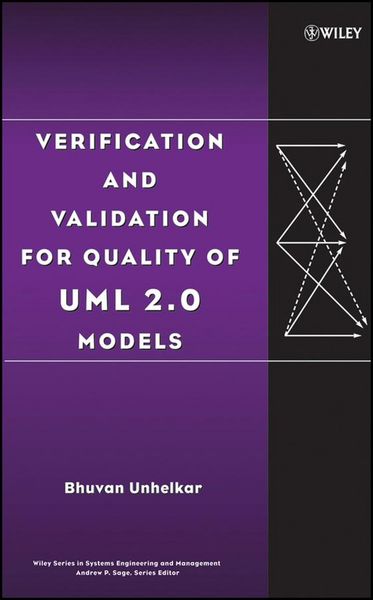
Verification and Validation for Quality of UML 2.0 Models
Aus der Reihe
Wiley Series in Systems Engineering and Management
Fr. 91.00
inkl. gesetzl. MwSt.Beschreibung
Produktdetails
Format
Kopierschutz
Ja
Family Sharing
Nein
Text-to-Speech
Nein
Erscheinungsdatum
01.09.2005
Verlag
John Wiley & SonsSeitenzahl
296 (Printausgabe)
Dateigröße
2671 KB
Auflage
1. Auflage
Sprache
Englisch
EAN
9780471734314
A practical approach to enhancing quality in software models using
UML Version 2.0
"Despite its increasing usage, many companies are not taking the
best advantage of UML and, occasionally, individuals have
experienced frustration in applying its standards. Perhaps this is
because they have not yet read this book!"
-From the Foreword by Prof. Brian Henderson-Sellers
This book presents a practical checklist approach to enhancing the
quality of software models created with the Unified Modeling
Language (UML) Version 2.0. The foundation for quality is set by
the discussion on the nature and creation of UML models. This is
followed by a demonstration of how to apply verification and
validation checks to these models with three foci: syntactical
correctness, semantic meaningfulness, and aesthetic symmetry. The
quality work is carried out within three distinct yet related
modeling spaces:
* Model of problem space (MOPS)
* Model of solution space (MOSS)
* Model of background space (MOBS)
Readers can then choose a specific quality approach according to
their roles in their projects.
Verification and validation checks are also organized according to
these three modeling spaces, making it easier for the reader to
focus on the appropriate diagrams and quality checks corresponding
to their modeling space. In addition, a major element of this
publication is the Strengths, Weaknesses, Objectives, and Traps
(SWOT) analysis. This analysis is performed on each UML diagram,
enabling readers to fully comprehend these diagrams, their
advantages and limitations, and the way in which they can be used
in practical projects for modeling.
A consistent case study of the Lucky Insurance System is provided
throughout the chapters to illustrate the creation of good quality
UML diagrams, followed by application of quality checks to them.
With its emphasis on quality in UML-based projects, this book is an
essential resource for all quality professionals, including quality
analysts, process consultants, quality managers, test designers,
and testers.
UML Version 2.0
"Despite its increasing usage, many companies are not taking the
best advantage of UML and, occasionally, individuals have
experienced frustration in applying its standards. Perhaps this is
because they have not yet read this book!"
-From the Foreword by Prof. Brian Henderson-Sellers
This book presents a practical checklist approach to enhancing the
quality of software models created with the Unified Modeling
Language (UML) Version 2.0. The foundation for quality is set by
the discussion on the nature and creation of UML models. This is
followed by a demonstration of how to apply verification and
validation checks to these models with three foci: syntactical
correctness, semantic meaningfulness, and aesthetic symmetry. The
quality work is carried out within three distinct yet related
modeling spaces:
* Model of problem space (MOPS)
* Model of solution space (MOSS)
* Model of background space (MOBS)
Readers can then choose a specific quality approach according to
their roles in their projects.
Verification and validation checks are also organized according to
these three modeling spaces, making it easier for the reader to
focus on the appropriate diagrams and quality checks corresponding
to their modeling space. In addition, a major element of this
publication is the Strengths, Weaknesses, Objectives, and Traps
(SWOT) analysis. This analysis is performed on each UML diagram,
enabling readers to fully comprehend these diagrams, their
advantages and limitations, and the way in which they can be used
in practical projects for modeling.
A consistent case study of the Lucky Insurance System is provided
throughout the chapters to illustrate the creation of good quality
UML diagrams, followed by application of quality checks to them.
With its emphasis on quality in UML-based projects, this book is an
essential resource for all quality professionals, including quality
analysts, process consultants, quality managers, test designers,
and testers.
Noch keine Bewertungen vorhanden
Verfassen Sie die erste Bewertung zu diesem Artikel
Helfen Sie anderen Kundinnen und Kunden durch Ihre Meinung.