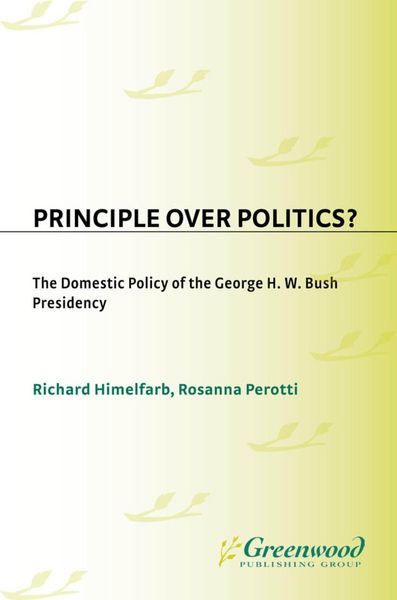
Principle Over Politics? The Domestic Policy of the George H. W. Bush Presidency
-
- Einzelkauf Download ausgewählt
-
Sprache:Englisch
Fr. 86.90
inkl. gesetzl. MwSt.Beschreibung
Produktdetails
Format
Kopierschutz
Ja
Family Sharing
Nein
Text-to-Speech
Nein
Altersempfehlung
ab 7 Jahr(e)
Erscheinungsdatum
30.03.2004
Verlag
Bloomsbury eBooks USSeitenzahl
472 (Printausgabe)
Auflage
1. Auflage
Sprache
Englisch
EAN
9780313072871
Cabinet members, journalists who covered Washington in the 1980s, and scholars who have been reassessing the George H. W. Bush presidency detail his domestic policy. The key areas covered include the economy, the budget, the disabled, civil rights, health, science and technology. In addition, the volume examines his emphasis on volunteerism.
As the essays make clear, Bush's domestic policy stands in vivid contrast to his foreign policy. While his stewardship in the latter area won him praise and popularity, many of his decisions in the domestic sphere brought criticism from both the left and right and proved politically disastrous, playing a key role in his 1992 election defeat.Although some accuse Bush of disengagement and disinterest in domestic affairs, the prevailing opinion voiced at the Bush Presidency Conference, which provided the basis for this and other companion volumes, was that the president's domestic policies were characterized by a deep commitment to principle and pursuit of the public interest, even at the expense of political considerations. Indeed, many argue that the Bush administration pursued policies that were both well intentioned and ultimately successful, but failed to communicate them successfully to the public. While some of the blame for this lies with a hostile news media and simple bad luck-especially the economic downturn beginning in 1991-much of the responsibility appears to rest with President Bush himself, a man reluctant to tout his successes and sully himself in partisan political combat. Thus, the picture that emerges of George H. W. Bush in this volume is that of a decent, principled man whose accomplishments in the domestic arena were unfairly devalued and widely misunderstood.
As the essays make clear, Bush's domestic policy stands in vivid contrast to his foreign policy. While his stewardship in the latter area won him praise and popularity, many of his decisions in the domestic sphere brought criticism from both the left and right and proved politically disastrous, playing a key role in his 1992 election defeat.Although some accuse Bush of disengagement and disinterest in domestic affairs, the prevailing opinion voiced at the Bush Presidency Conference, which provided the basis for this and other companion volumes, was that the president's domestic policies were characterized by a deep commitment to principle and pursuit of the public interest, even at the expense of political considerations. Indeed, many argue that the Bush administration pursued policies that were both well intentioned and ultimately successful, but failed to communicate them successfully to the public. While some of the blame for this lies with a hostile news media and simple bad luck-especially the economic downturn beginning in 1991-much of the responsibility appears to rest with President Bush himself, a man reluctant to tout his successes and sully himself in partisan political combat. Thus, the picture that emerges of George H. W. Bush in this volume is that of a decent, principled man whose accomplishments in the domestic arena were unfairly devalued and widely misunderstood.
Kundinnen und Kunden meinen
Verfassen Sie die erste Bewertung zu diesem Artikel
Helfen Sie anderen Kund*innen durch Ihre Meinung