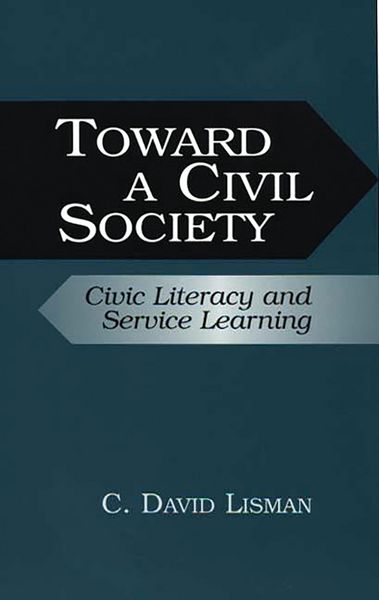
Toward a Civil Society Civic Literacy and Service Learning
-
- Hardcover
- Taschenbuch
- eBook ausgewählt
-
Form:Einzelkauf Download
-
Sprache:Englisch
Fr. 42.90
inkl. gesetzl. MwSt.Beschreibung
Produktdetails
Format
Kopierschutz
Ja
Family Sharing
Nein
Text-to-Speech
Nein
Altersempfehlung
ab 7 Jahr(e)
Erscheinungsdatum
30.08.1998
Verlag
Bloomsbury eBooks USSeitenzahl
192 (Printausgabe)
Auflage
1. Auflage
Sprache
Englisch
EAN
9780313391019
Addressing the need for marshaling the resources of education to help promote a more civil society, this book argues that education has a critical role to play in challenging the dominant views of politics and education. Service learning, or academically based community service,is seen as a promising educational pedagogy that can help students acquire civic virtue and serve as a mechanism to enable institutions of higher education become stronger community partners. However, there is currently is a lack of theoretical grounding for the service-learning movement; consequently,service learning is in danger of being co-opted by academic traditionalism, which could vitiate service learning's social transformative potential and in fact undermine efforts at democratic revitalization.
The author provides a basic explanation of service learning and how it is connected to promoting civic virtue. It examines the underlying public philosophy debate between weak and strong democracy theorists, or procedural and civic republicanism. This book argues that certain approaches to service learning, such as the voluntarist or charity model, the experiential education model, and the justice model are ineffective because of their association with weak democracy theory or procedural republicanism. The central argument of this book is that a progressive communitarian public philosophy maintaining that individuals attain meaning and significance in the context of community is the most appropriate grounding for service learning.
The author provides a basic explanation of service learning and how it is connected to promoting civic virtue. It examines the underlying public philosophy debate between weak and strong democracy theorists, or procedural and civic republicanism. This book argues that certain approaches to service learning, such as the voluntarist or charity model, the experiential education model, and the justice model are ineffective because of their association with weak democracy theory or procedural republicanism. The central argument of this book is that a progressive communitarian public philosophy maintaining that individuals attain meaning and significance in the context of community is the most appropriate grounding for service learning.
Kundinnen und Kunden meinen
Verfassen Sie die erste Bewertung zu diesem Artikel
Helfen Sie anderen Kund*innen durch Ihre Meinung