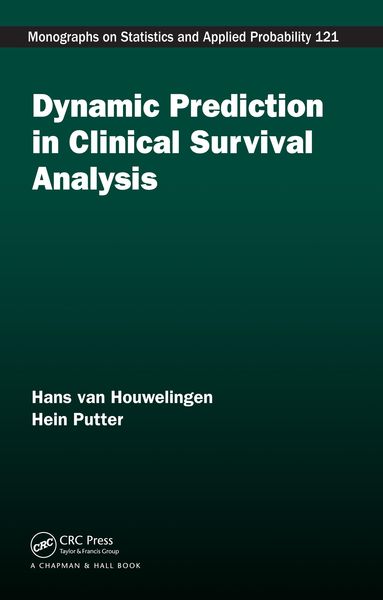
Dynamic Prediction in Clinical Survival Analysis
-
- Hardcover
- Taschenbuch
- eBook ausgewählt
-
Form:Einzelkauf Download
-
Sprache:Englisch
-
eBook Format:PDF
- PDF Fr. 69.90 ausgewählt
- ePUB Fr. 69.90
Fr. 69.90
inkl. gesetzl. MwSt.Beschreibung
Produktdetails
Format
Kopierschutz
Ja
Family Sharing
Nein
Text-to-Speech
Nein
Erscheinungsdatum
09.11.2011
Verlag
Taylor & Francis eBooksSeitenzahl
250 (Printausgabe)
Dateigröße
7834 KB
Sprache
Englisch
EAN
9781439835432
There is a huge amount of literature on statistical models for the prediction of survival after diagnosis of a wide range of diseases like cancer, cardiovascular disease, and chronic kidney disease. Current practice is to use prediction models based on the Cox proportional hazards model and to present those as static models for remaining lifetime after diagnosis or treatment. In contrast, Dynamic Prediction in Clinical Survival Analysis focuses on dynamic models for the remaining lifetime at later points in time, for instance using landmark models.
Designed to be useful to applied statisticians and clinical epidemiologists, each chapter in the book has a practical focus on the issues of working with real life data. Chapters conclude with additional material either on the interpretation of the models, alternative models, or theoretical background. The book consists of four parts:
- Part I deals with prognostic models for survival data using (clinical) information available at baseline, based on the Cox model
- Part II is about prognostic models for survival data using (clinical) information available at baseline, when the proportional hazards assumption of the Cox model is violated
- Part III is dedicated to the use of time-dependent information in dynamic prediction
- Part IV explores dynamic prediction models for survival data using genomic data
Dynamic Prediction in Clinical Survival Analysis summarizes cutting-edge research on the dynamic use of predictive models with traditional and new approaches. Aimed at applied statisticians who actively analyze clinical data in collaboration with clinicians, the analyses of the different data sets throughout the book demonstrate how predictive models can be obtained from proper data sets.
Kundinnen und Kunden meinen
Verfassen Sie die erste Bewertung zu diesem Artikel
Helfen Sie anderen Kund*innen durch Ihre Meinung