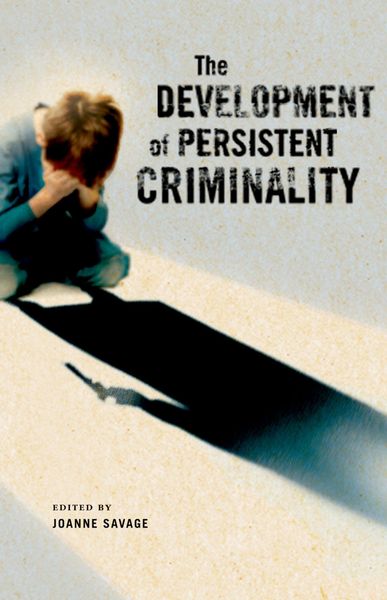
The Development of Persistent Criminality
-
Form:Einzelkauf Download
-
Sprache:Englisch
-
eBook Format:PDF
- PDF Fr. 72.90 ausgewählt
- ePUB Fr. 72.90
Fr. 72.90
inkl. gesetzl. MwSt.Beschreibung
Produktdetails
Format
Kopierschutz
Ja
Family Sharing
Nein
Text-to-Speech
Nein
Erscheinungsdatum
03.02.2009
Verlag
OUP eBookSeitenzahl
(Printausgabe)
Dateigröße
4443 KB
Sprache
Englisch
EAN
9780199718689
The Development of Persistent Criminality addresses one of the most pressing problems of modern criminology: Why do some individuals become chronic, persistent offenders? Because chronic offenders are responsible for the majority of serious crimes committed, understanding which individuals will become chronic offenders is an important step in helping us develop interventions. This volume bridges the gap between the criminological literature, which has recently focused on the existence of various criminal trajectories, and the developmental psychology literature, which has focused on risk factors for conduct problems and delinquency. In it, chapters by some of the most widely published authors in this area unite to contribute to a knowledge base which will be the next major milestone in the field of criminology. The authors of this volume represent a unique gathering of international, interdisciplinary social problem so that we can prevent the enormous human and economic costs associated with serious crimes, these authors share their insights and findings on topics such as families and parenting, poverty, stressful life events, social support, biology and genetics, early onset, foster care, educational programs for juvenile offenders, deterrence, and chronic offending among females. Significant attention is paid throughout to longitudinal studies of offending. Several authors also share new theoretical approaches to understanding persistence and chronicity in offending, including an expansion of the conceptualization of the etiology of self-control, a discussion of offender resistance to social control, a dynamic developmental systems approach to understanding offending in young adulthood, and the application of Wikström's situational action theory to persistent offending.
Kundinnen und Kunden meinen
Verfassen Sie die erste Bewertung zu diesem Artikel
Helfen Sie anderen Kund*innen durch Ihre Meinung