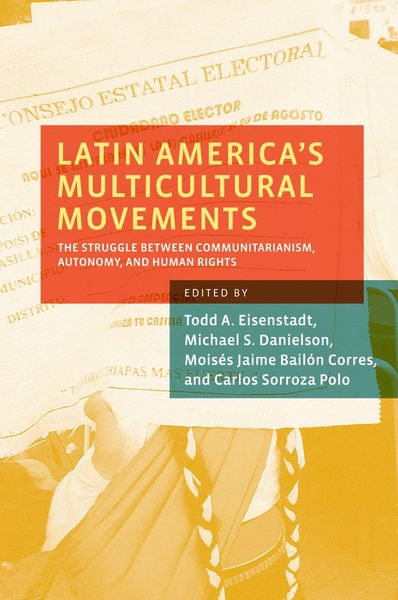
Latin America's Multicultural Movements The Struggle Between Communitarianism, Autonomy, and Human Rights
-
- Hardcover
- Taschenbuch
- eBook ausgewählt
-
Form:Einzelkauf Download
-
Sprache:Englisch
-
eBook Format:ePUB
- PDF Fr. 19.90
- ePUB Fr. 19.90 ausgewählt
Fr. 19.90
inkl. gesetzl. MwSt.Beschreibung
Produktdetails
Format
ePUB
Kopierschutz
Ja
Family Sharing
Nein
Text-to-Speech
Ja
Erscheinungsdatum
28.02.2013
Herausgeber
Todd A. Eisenstadt + weitereVerlag
OUP eBookSeitenzahl
(Printausgabe)
Dateigröße
3441 KB
Sprache
Englisch
EAN
9780199324132
Throughout the Americas, indigenous people have been arguing that they should be entitled, as "first peoples, " to representation in local, national, and international fora in a capacity different from that of other civil society groups. Latin America's Multicultural Movements is a collection of empirically-based chapters that advance debates concerning multiculturalism and indigenous and minority group rights in Latin America by looking at the struggle between
communitarianism, autonomy, and human rights. Rather than advancing a particular argument for or against multiculturalism, the book includes contributions from top Latin American scholars with a range of ideological positions to provide a comparative set of perspectives on the issue. While the book
addresses highly polemical debates, it does so in a way that moves beyond the ideological clashes that characterize most of the literature and invites readers to explore how multicultural reforms affect people in their everyday lives, as well as in political parties, elected offices, and interest groups. The chapters, which include case studies from Mexico, Bolivia and Ecuador, look at the controversial role of the state regarding multicultural rights and discuss whether the state enables or
hinders the advancement of multicultural rights.
communitarianism, autonomy, and human rights. Rather than advancing a particular argument for or against multiculturalism, the book includes contributions from top Latin American scholars with a range of ideological positions to provide a comparative set of perspectives on the issue. While the book
addresses highly polemical debates, it does so in a way that moves beyond the ideological clashes that characterize most of the literature and invites readers to explore how multicultural reforms affect people in their everyday lives, as well as in political parties, elected offices, and interest groups. The chapters, which include case studies from Mexico, Bolivia and Ecuador, look at the controversial role of the state regarding multicultural rights and discuss whether the state enables or
hinders the advancement of multicultural rights.
Kundinnen und Kunden meinen
Verfassen Sie die erste Bewertung zu diesem Artikel
Helfen Sie anderen Kund*innen durch Ihre Meinung