Gutscheinbedingungen

*Gültig bis 05.07.2026 auf (fast) alles. Ausgeschlossen sind Smartboxen, Zeitschriften, Tickets, Lebensmittel, Gaming-Elektroartikel, Tinte/Toner, Gutscheine, Geschenkkarten, Blumen und Abos | Einlösbar in allen Buchhandlungen von Orell Füssli, Barth Bücher, Buchladen Rapunzel, Papeterie Köhler, Schuler Orell Füssli, Stauffacher und ZAP unter Vorweisung des Gutscheins, auf www.orellfüssli.ch durch Eingabe des Gutscheincodes. Beim Service „eBooks verschenken“ und bei eBook-Käufen via eReader nicht einlösbar | Mindesteinkaufswert: Fr. 30.- | Nicht mit anderen Rabatten kumulierbar.

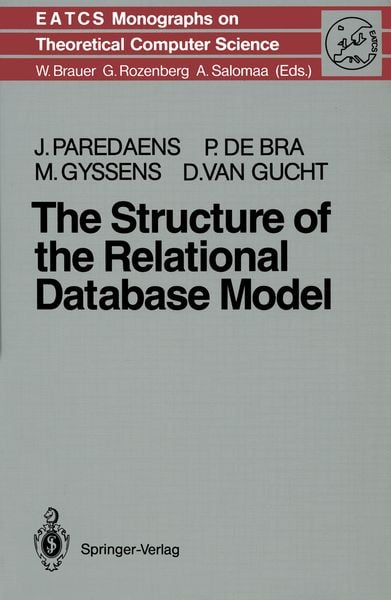
  • Produktbild: The Structure of the Relational Database Model
  • Produktbild: The Structure of the Relational Database Model
Band 17

The Structure of the Relational Database Model

Fr. 72.90

inkl. gesetzl. MwSt., Versandkostenfrei


Beschreibung

Produktdetails

Einband

Taschenbuch

Erscheinungsdatum

03.10.2013

Verlag

Springer Berlin

Seitenzahl

233

Maße (L/B/H)

24.4/17/1.4 cm

Gewicht

435 g

Auflage

Softcover reprint of the original 1st ed. 1989

Sprache

Englisch

ISBN

978-3-642-69958-0

Beschreibung

Produktdetails

Einband

Taschenbuch

Erscheinungsdatum

03.10.2013

Verlag

Springer Berlin

Seitenzahl

233

Maße (L/B/H)

24.4/17/1.4 cm

Gewicht

435 g

Auflage

Softcover reprint of the original 1st ed. 1989

Sprache

Englisch

ISBN

978-3-642-69958-0

Herstelleradresse

Springer-Verlag KG
Sachsenplatz 4-6
1201 Wien
AT

Email: GPSR Kontakt

Noch keine Bewertungen vorhanden

Verfassen Sie die erste Bewertung zu diesem Artikel

Helfen Sie anderen Kundinnen und Kunden durch Ihre Meinung.

Kundinnen und Kunden meinen

Bewertungen (0)

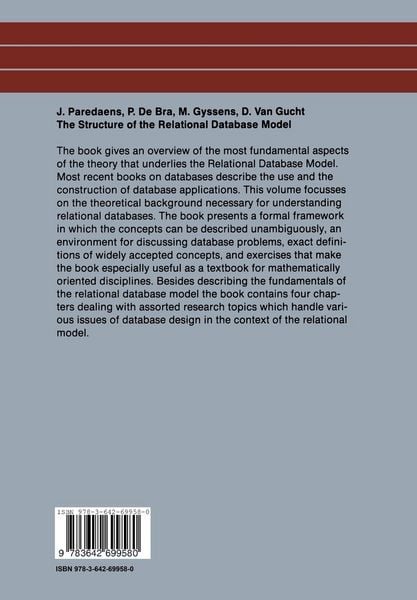
  • Produktbild: The Structure of the Relational Database Model
  • Produktbild: The Structure of the Relational Database Model
  • 1 Relational Database Model.- 1.1 Relation Schemes.- 1.2 Relation Instances.- 1.3 Database Schemes and Database Instances.- 1.4 Dynamic Schemes and Evolutions.- 1.5 Classification of Constraints.- 1.6 Example.- 1.7 Exercises.- 2 Query Systems.- 2.1 The Relational Algebra.- 2.1.1 Informal Description.- 2.1.2 Syntax of the Relational Algebra.- 2.1.3 Generating Part of the Relational Algebra.- 2.1.4 Views Represented by the Relational Algebra.- 2.1.5 Expressive Power of the Generating Part.- 2.2 The Tuple Calculus.- 2.2.1 Informal Description.- 2.2.2 Syntax of the Tuple Calculus.- 2.2.3 Generating Part of the Tuple Calculus.- 2.2.4 Views Represented by the Tuple Calculus.- 2.2.5 Expressive Power of the Generating Part.- 2.3 SQL: Structured Query Language.- 2.3.1 Informal Description.- 2.3.2 Syntax of SQL.- 2.3.3 Generating Part of SQL.- 2.3.4 Views Represented by SQL.- 2.3.5 Expressive Power of the Generating Part.- 2.4 Reduction of the Tuple Calculus to the Algebra.- 2.4.1 Method.- 2.4.2 Example.- 2.5 Reduction of the Algebra to SQL.- 2.5.1 Method.- 2.5.2 Example.- 2.6 Reduction of SQL to the Tuple Calculus.- 2.6.1 Method.- 2.6.2 Example.- 2.7 Exercises.- 3 Constraints.- 3.1 Some Terminology.- 3.2 Functional Dependencies.- 3.3 Multivalued Dependencies.- 3.4 Join Dependencies.- 3.5 Inclusion Dependencies.- 3.6 Tuple and Equality Generating Dependencies.- 3.7 Exercises.- 4 Vertical Decompositions.- 4.1 First Normal Form.- 4.2 Second and Third Normal Form.- 4.3 Boyce-Codd Normal Form.- 4.4 Constraint Preserving Normalization.- 4.5 Fourth and Fifth Normal Form.- 4.6 Vertical Decomposition and Consistency Checking.- 4.7 Exercises.- 5 Horizontal Decompositions.- 5.1 Horizontal Decompositions.- 5.2 The Membership and Inference Problem for Fds and Ads.- 5.3 The Inheritance of Dependencies.- 5.4 Normal Forms for Horizontal Decompositions.- 5.5 Exercises.- 6 Incomplete Information.- 6.1 Representation Systems for Existing-but-Unknown Nulls.- 6.2 Updating Relations with Existing-but-Unknown Nulls.- 6.3 Constraints in Incomplete Databases.- 6.4 Relations with No-Information Nulls.- 6.5 The Weak Instance Model.- 6.6 Exercises.- 7 The Nested Relational Database Model.- 7.1 Nested Relation Schemes and Instances.- 7.2 The Nested Relational Algebra.- 7.3 Constraints.- 7.4 The Expressiveness of the Nested Relational Algebra.- 7.5 Hierarchical Instances.- 7.6 Exercises.- 8 Updates.- 8.1 Transactions.- 8.2 Equivalent Transactions.- 8.3 Dynamic Relation Constraints.- 8.4 Axiomatization of Equivalence of Transactions.- 8.5 Exercises.