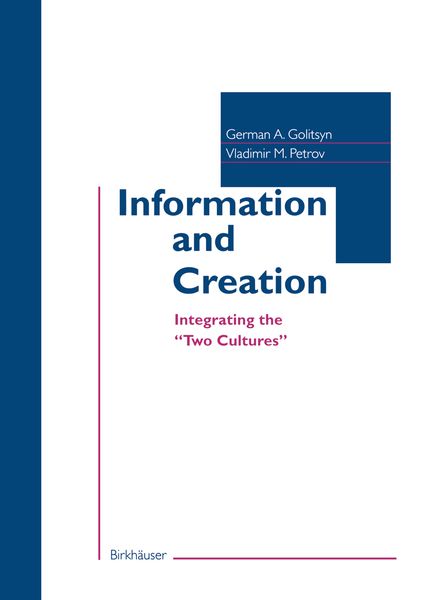
Information and Creation Integrating the “Two Cultures”
-
- Englisch ausgewählt
Fr. 72.90
inkl. gesetzl. MwSt.,
Beschreibung
Produktdetails
Einband
Taschenbuch
Erscheinungsdatum
26.04.2012
Abbildungen
XII, 188 p.
Verlag
Springer BaselSeitenzahl
188
Maße (L/B/H)
24.4/17/1.2 cm
Gewicht
355 g
Auflage
Softcover reprint of the original 1st ed. 1995
Sprache
Englisch
ISBN
978-3-0348-7474-8
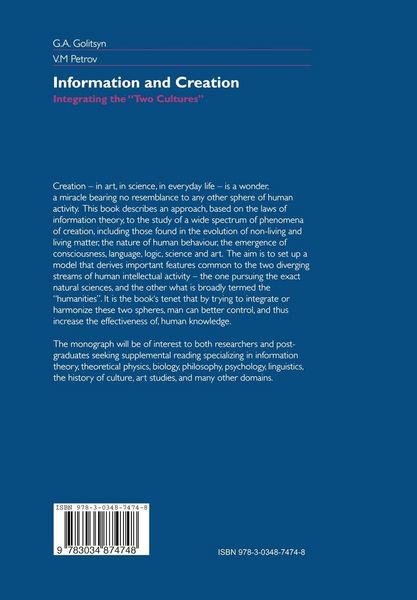
This book is devoted to one of the central problems of contemporary thinking, for which c.P. Snow in 1959 coined the phrase of the «Two Cultures». In this concept, human endeavour is directed on one side to the (forward-looking) sci ences (mathematics, physics, chemistry, biology, etc.) and on the other side to the (backward-looking) humanities (including psychology, linguistics, sociology, etc.). In this dichotomy Snow saw no possibility of unification. On the other hand the urge towards self-consistency and harmony in the mental and spiritual lives of both man and society as a whole is clearly one of the major forces of creativity, both scientific and artistic. This force aims at the unification of the «Two Cultures» in order to build an integrated self-consistent system for our intellectual life. Some attempts in this direction have been made before, and will be described in this book. It is our aim to contribute to the achievement of an integrated mental life on the basis of information theory. In order to construct our model, we examine the laws of information theory, leading us to the deduction of the main laws inherent in both «cultures». Thus, we consider the evolution of both non-living and living matter, human behaviour, the phenomenon of language, the sphere of aesthetics, etc. We hope that our work will be useful both for researchers (who are trying to derive different integral theories) and for various other «consumers» of scientific knowledge (meaning broad circles of intellectuals).
Noch keine Bewertungen vorhanden
Verfassen Sie die erste Bewertung zu diesem Artikel
Helfen Sie anderen Kundinnen und Kunden durch Ihre Meinung.